
Learn about our digital wallpapers: Farbound.Net Digital Wallpapers are created with the dual purpose of not just allowing you to decorate your computer and mobile phone with artistically done, visually pleasing bits of the past, but to also showcase history, display heritage and spread knowledge. Standard dimensions have been maintained, and size has been kept to the bare minimum so as to occupy less space on whichever device you choose to decorate.
Can the wallpapers be used for laptops, tablets and other screens?: Farbound.Net wallpapers are designed as per the standard desktop wallpaper size of 1920 x 1200 pixels, and the standard mobile phone wallpaper size of 1200 x 1920 pixels. However, the desktop wallpapers can be adjusted and used for laptops, tablets and other screens.
Can the digital wallpapers be printed?: Both Farbound.Net Desktop and Mobile Phone wallpapers are created in the RGB colour mode and offered for downloads as JPEGs, making them ideal for digital use. Printers, at home or printing services, rely on the CYMK colour mode. However, it is possible to print and use the desktop wallpapers since many modern printers are capable of printing RGB based JPEGs. If doing so please do not scale/enlarge the size of the desktop wallpaper. Suggested size (Horizontal) is 1920 x 1200 pixels or less. For wall decorations you can browse Farbound.Net's range of wall posters. The wallposters are in Cymk colour mode and provided as PDFs for download to facilitate printing.
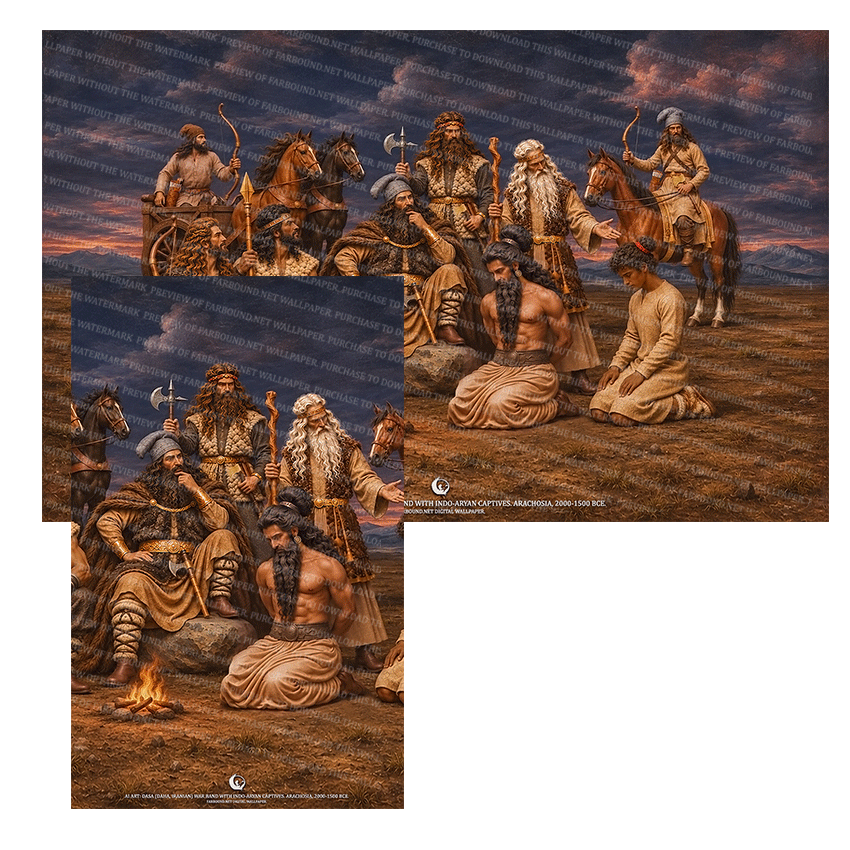
History: This Digital Wallpaper features an AI art presentation of a Dasa (Daha, Iranian) War Band with Indo-Aryan (Vedics from the Rigvedic period) captives. The name/word 'Dasa' appears in the Rigveda as the enemies of the Rigvedic Indo-Aryan tribes - even though, historically, not all Dasa and Indo-Aryan tribes had feuded and warred against each other. Many had maintained cordial and friendly relations.
The Indo-Aryans and the Dasa (Daha, proto Iranian) belonged to the same family of the Indo-Iranian people - a sub group of the larger Indo-European people. The Indo-Iranians were the semi-nomadic tribes of the Yamna who dwelled in the eastern parts of the Pontic-Caspian steppe. They had migrated eastwards and invented the first spoked wheeled chariot in history during the period of the Sintashta culture. As a people, these tribes had evolved in stages and through various evolutionary cultures such as the Sintashta and the larger Andronovo culture. These tribes were also not homogeneous as a people, as one thinks. After having ventured out of the Yamna sphere, they had assimilated and merged with other people and other cultures - adopting technology, beliefs and practices. Genetic mingling has also been identified.
Around 2000 Bce, the Indo-Iranian tribes had split into two groups - the proto Iranians and the Indo-Aryans (better known as the Vedics Rigveda). Their identify and beliefs had diverged for the different migratory routes they had taken at different points in time. The Indo-Aryans (Vedics of the Rigveda) had later originated Hinduism (Vedic religion) and the language of Sanskrit while the Iranians had originated Avestan and the worship of Ahura Mazda. The two cousin groups had shared both friendly and inter-tribal hostilities with the Rigveda and the Avesta recording the hostility.
The Rigvedic word 'Dasa' is a corruption of the word 'Daha'. The Daha were a tribe of Proto Iranians, and the original meaning of the word was 'a Man' and a 'Man' of the 'Daha' tribe at that. The Rigveda Aryans had referred to these Iranians as the 'Dasa'. Likewise, the 'Daha' who were captured as ' prisoner of war' were known as the 'Dasa'. Over the course of time, the meaning of 'Dasa' had changed from war captives to slave and then to servants - since during the time, 'Daha' captives upon being captured were enslaved and made servants.
In the wallpaper Dasa (Daha, Iranian) tribesmen can be seen sitting around a campfire deciding on what to do with their Indo-Aryan captives. The Dasa tribesmen are dressed in steppe garments of their times. They wear woolen pants, long sleeved woolen tunics extending down to their knees, leather boots and sheep wool jackets. I have also added in thick sheep wool wrappings that are tied in with cords around their shins. Such wrappings would have undoubtedly offered a degree of protection from the cold as well as bruises and cuts.
Their chief is sitting on a small rock. He is contemplating on the fate of the captives. He is dressed according to his noble rank and status. He has a thick fur cloak, a sheep wool jacket, pants, leather boots, wrist bands and a golden belt. On his head is a beaked shaped cap and near his lap is a Cakus. Next to him is standing a priest dressed in a one piece tunic with long sleeves that extends down to his ankles. On top he has an open sheep wool jacket and a headband on his forehead. The priest is holding a staff and presenting his opinion on what should be done with the Indo-Aryan captives.
The war band comprises of a chariot archer, a mounted horseman wearing a beaked cap, a foot archer, an axe man and spear man. The chariot, horse, spear, axe, bow and arrow were the weapons used by the Dasa (Daha, Iranian tribes).
Among the captives is an adult Indo-Aryan male and a young boy. The adult male has long beard and braided hair. He also sports a hair knot and earrings. He wears a drape style garment on his lower portion and kneels on the ground with his hands tied behind him. The adult male is a priest and will be very likely be killed. The young boy on the other hand will be enslaved and made a servant. The boy's hands are not tied.
During the period the Dasa (Daha, Iranian) and Indo-Aryans tribes had raided and looted the other. They had also engaged in tribal warfare that after 2000 Bce had also included feuding over religious beliefs. Both had taken captives. It is not known what the fate of adult captives such as warriors and priests was, but it is generally assumed they were killed - while women and young boys were enslaved.
Digital Media Description: Desktop Wallpaper I Desktop Background I Laptop Wallpaper I Mobile Phone Wallpaper I Historical Wallpaper I Daha War Band Wallpaper I Dasa War Band Wallpaper I Indo-Iranian Wallpaper I Dasas of the Rigveda Wallpaper I Proto-Iranian Wallpaper I Daha Wallpaper.


Reviews
There are no reviews yet.