
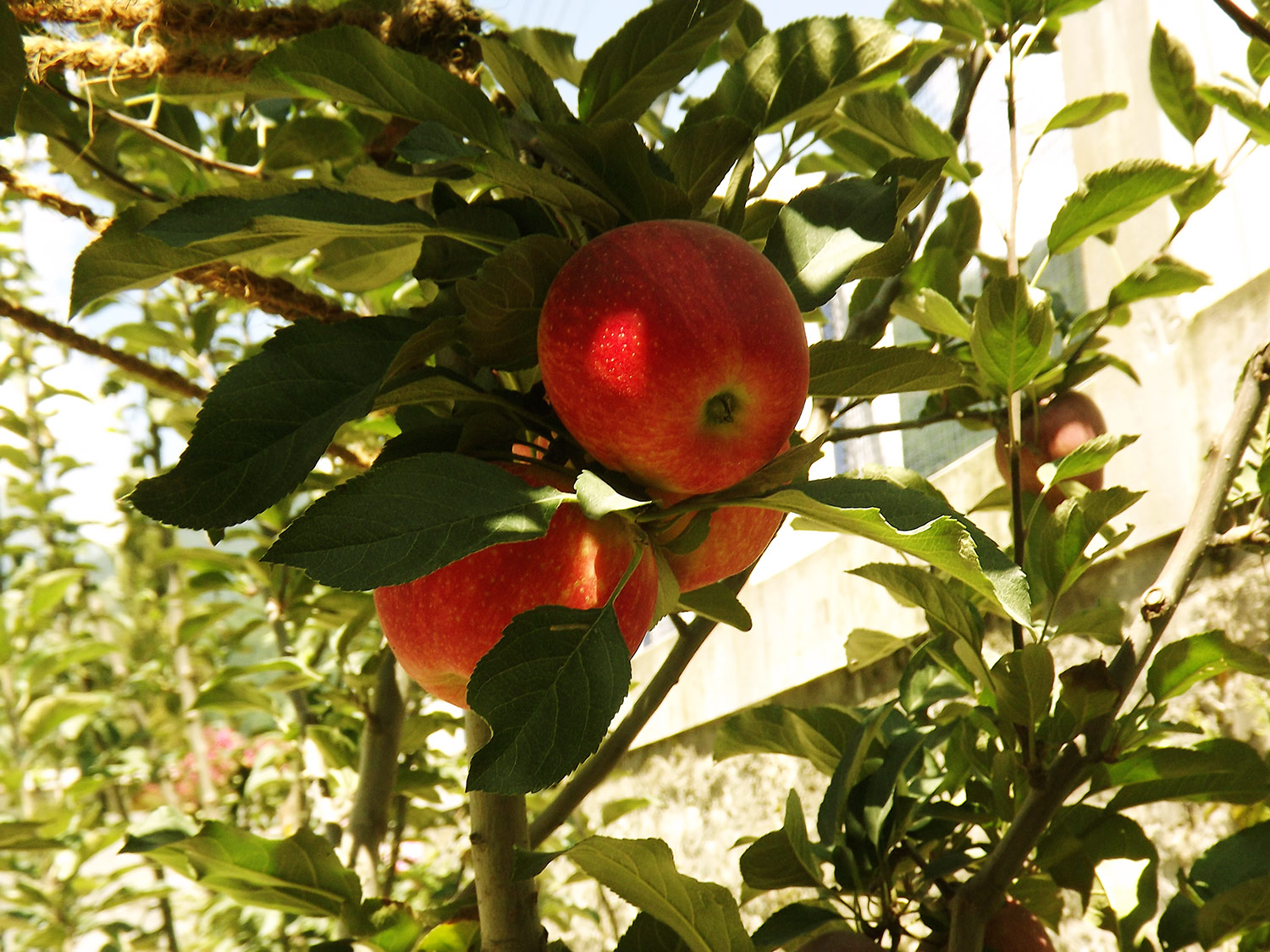
How the Apple came to Himachal.

The legacy of the Red Delicious.

In a region where orchards take up the largest portion of its 2.07 lac hectares of farmland and annual exports sometimes exceed a crop of over 250 million boxes, it is easy to imagine its primary cash crop, ‘the apple’ as a native fruit growing since the beginning of time.

Yet nothing could be farther from the truth.

Ancient Himachal was no Eden and there was not a single apple tree to be found within her present day borders.

The first to bring apples to the region were British settlers. The variety of apples they cultivated were two strains of bitter apples. More suited for European taste, this variety produced limited commercial success.

Then in 1916 arrived the non-indigenous Red Delicious – an American variety of sweet apples from Iowa (USA).

Possibly first cultivated in 1872 AD, the Red Delicious was sweeter in taste.

Farbound.Net Greetings Card: Showing a photo art representation of a Red Delicious Apple.

Greetings Cards by Farbound.Net.

Actual Dimensions: 1200 x 1203 pixels.

First planted by Samuel Evans Stokes (see Hindu article: A foreigner and freedom fighter), an American social worker turned experimental farmer, the fruit was the precursor that kick-started the hill state’s apple industry with its sweet tantalizing taste, and put it on course to be a major power in cultivation.

Presently, this Indian state produces over sixteen varieties of different apples, of which the royal, red and golden variety rate high on the popularity charts.

I F I This is an Independent story highlighting how the Indian state of Himachal Pradesh came to cultivate the apple. It includes bits of information procured from News Outlets. I


Popular in History

Wars of Humayun.

A list of battles of the second Gurkani emperor Humayun.

What's new

Indulge

Browse and Buy

More Stories

Touchdown in Autumn: The Spangle swallowtail Butterfly.

A female of the Spangle Papilio Protenor species poises like a future age plane

Home of the mighty Pandavas.

The old fort is thought by some to be the site on which once stood the fabled city of Indraprasta

Behind the myth of the serpent people known as the Nagas.

According to some scholars, the half serpent-half human Nagas of mythology were actually real people

The Greco-Roman Buddha from Gandhara, the Kushan Period.

Sculpted in Gandhara, a statue that is among the first to show the Buddha in human form

Why native Indian Sepoys had preferred to enlist in the armies of the East India Company, between the 17th and 18th century.

In the 17th century, monthly payments made service in the Bengal army a great attraction.
Siddhartha Mukherjee
Siddhartha Mukherjeehttps://farbound.net
I believe in the wisdom of self-reliance, the moral philosophy of liberalism, and in individualism. When not researching and writing editorial content or creating digital products, I spend my time with my dogs and live a life of solitude.

LEAVE A REPLY

Please enter your comment!
Please enter your name here

Featured Stories

How the Bengal army came to be an army of robust Sepoys.

Delving into the fascination of populating the Bengal army with impressive Prussian type native Sepoys.