
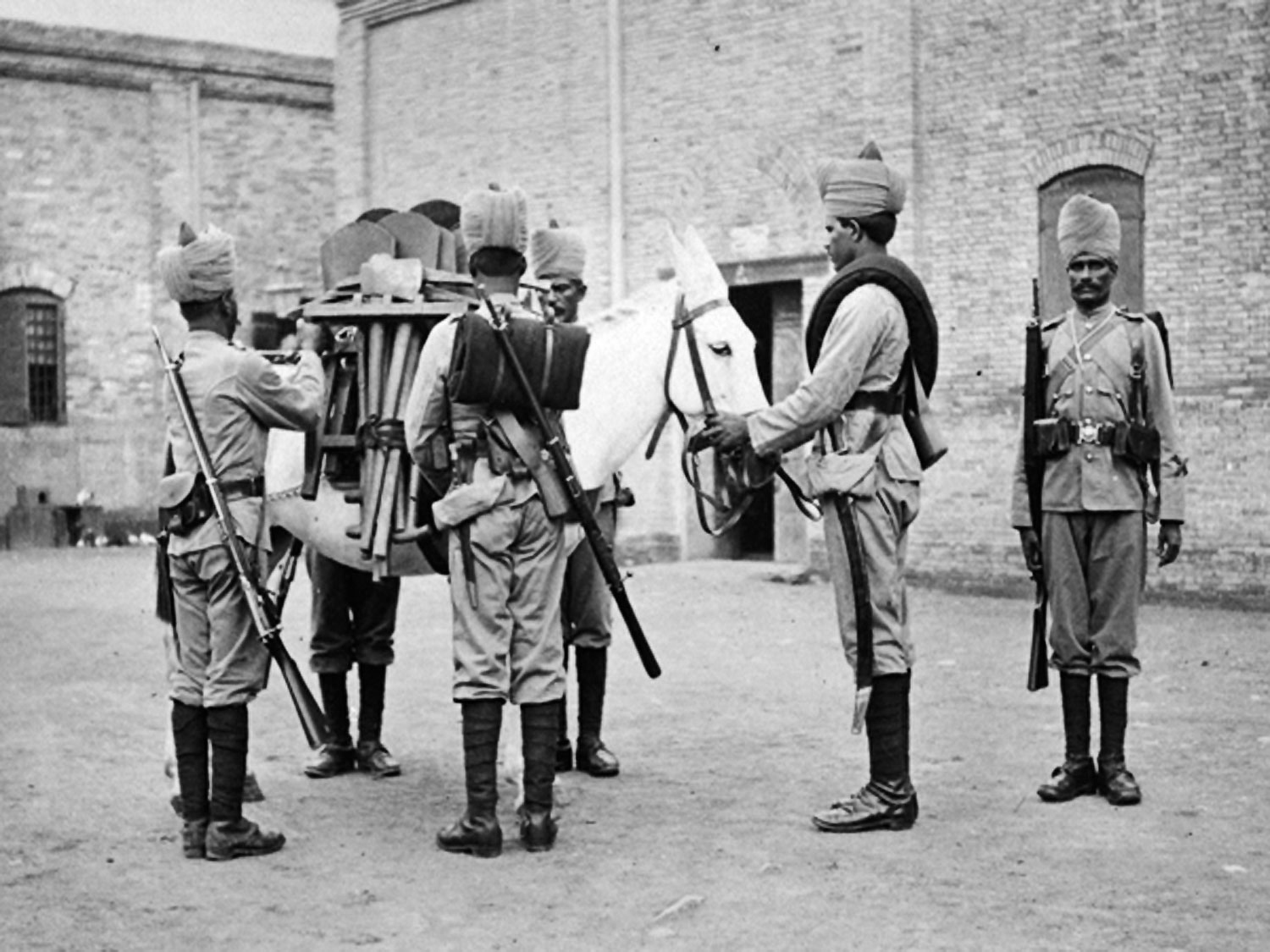

Soldiers of the Bombay Sappers and Miners load a mule with equipment at their post in Tianjin, in this photo produced by an uncredited photographer in 1900. Ferried to the coast of China to liberate a besieged garrison of diplomats and soldiers, the men were now on their way to demolish wrecks in the Pei-Ho river.
Royal Bombay Sappers and Miners.
The Bombay Sappers and Miners was a military unit of engineers. It was raised in 1777 by Major Lawrence Nilson and was a regiment of the Bombay Presidential army. Its primary role was to support infantry and artillery divisions with the building of fortifications, roads and other field works. It was originally made up of 100 men and was known as the Pioneer Lascars, and later as the Pioneer Corps.
In 1840, the regiment was renamed as the Bombay Sappers and Miners and in 1923 as the Royal Bombay Sappers and Miners. After the independence of India in 1947 and the creation of the country of Pakistan in the same year, it was absorbed into the modern day Indian army to be a part of the army’s Corps of Engineers. The regiment is presently known as the Bombay Sappers (formally, the Bombay Engineer Group).
Bombay Sappers, a decorated regiment.
A decorated regiment with a long and illustrious history, the sappers served with distinction both in India and abroad. It was awarded multiple times during World War I and II, and for gallantry on other battlefields. Notably, in Afghanistan, Ethiopia, Arabia, Iran and Somaliland.
Among its ranks, 2nd Lieutenant Premindra Singh Baghat, later a Lieutenant General in the Indian army, was awarded with the British Army’s prestigious Victoria Cross Medal in 1941. Other honours bestowed to the soldiers and officers of the regiment include – the British Empire’s 1914-15 Star, the British Commonwealth’s 1939–45 Star, the British War Medal of 1939-45, the Africa Star, the Burma Star, and the India Service Medal 1939-45.
Several men of this regiment were also the recipients of the Military Cross, the Indian Order of Merit Medal, the Indian Distinguished Service Medal and the Distinguished Service Order Medal.
In China, the regiment saw action during the boxer rebellion of 1899-1901, that culminated in the siege of the International Legation and subsequently resulted in the joint military intervention of seven countries.
For its conduct in this theater of conflict, the regiment was honoured with the China 1900 Battle Honour.
Soldiers of the No.2 Field Company.
The soldiers depicted in the photo belonged to the No. 2 Field Company of the Bombay Sappers and Miners.
Prior to China, the unit served in Afghanistan during the 2nd Anglo-Afghan war. The unit was part of the Girishk column under the command of Brigadier General George Burrows and was led by Lieutenant Thomas Henn, a first rated subaltern engineer.
In 1800, it was a part of the main engineering force of the Reserve Division at Bolan under Captain W.W.B Whitefield and was engaged with work on the Kandahar state railways.
This unit also participated in the Anglo-Abyssinian campaign of 1868. Commanded by Major Sturt, the unit earned praise for its work in the Senafe Pass and the Sooro Defile in northern Ethiopia. There it also saw action in the battle of Arogee and played a key role in the capture of the Ethiopian fortress at Magdala, on the 13th of April in 1868.
In 1878, the unit was reassigned to the Bolan pass and operated in the Nari valley. Here under Lieutenant G.T Jones, it participated in a sortie to Khwaja and in the battle of Kandahar.
Later in China, it was deployed against the Imperial Chinese army and the Boxer militia of the Society of Righteous and Harmonious Fists – a native Chinese organization responsible for initiating an anti-foreign and anti-christian uprising in Northern China.
More commonly known as the Boxer rebellion, the uprising was nicknamed after the young athletic men of the organization who were well versed in martial arts, then known as Chinese boxing.
The No.2 Field Company was involved in the defence of Foreign consulates at Tianjin and in dispersing the Boxer militia. It was also involved in construction and demolition works.
The Photo.
This photo was produced by an uncredited photographer, possibly a soldier or a staff reporter. The photo is titled, “We were there” and the original caption attached to the photo reads:
No. 2 Company was the last of the sapper and miner units to land in China, reaching Teintsin on 11 August 1900. The company was employed for a time on the Teintsin defences and on 19 August took part in an engagement to disperse the Boxer forces threatening the city from the south west. Towards the end of 1900 the unit was occupied in the bridging and preparing winter quarters, as well as, during the following spring, in demolishing wrecks in the Pei-Ho river.
The photo is a part of a collection of photos on the 3rd China War (Boxer Rebellion) 1900-1901. It is archived with the National Army Museum in New Zealand.
Soldiers of this unit, like other Indian units, were informally referred to by the British as the Indian Puttees – for the cloth they wrapped around their legs and for the turbans they wore. All the men in the photo hailed from the state of Maharashtra and the mule was an essential transport option for ferrying equipment for field tasks.
The regiment’s founding father, Major Lawrence Nilson, was the first chief engineer of the Bombay Presidency.
I F I This is an Independent Story produced to unravel the history behind this featured Vintage Photo of Bombay Sappers and Miners from the 1900. The story also sheds a bit of light on the history of the regiment, especially the No.2 Field Company of the Bombay Sappers and Miners. It has been created from facts curated from literary and historical sources. I