
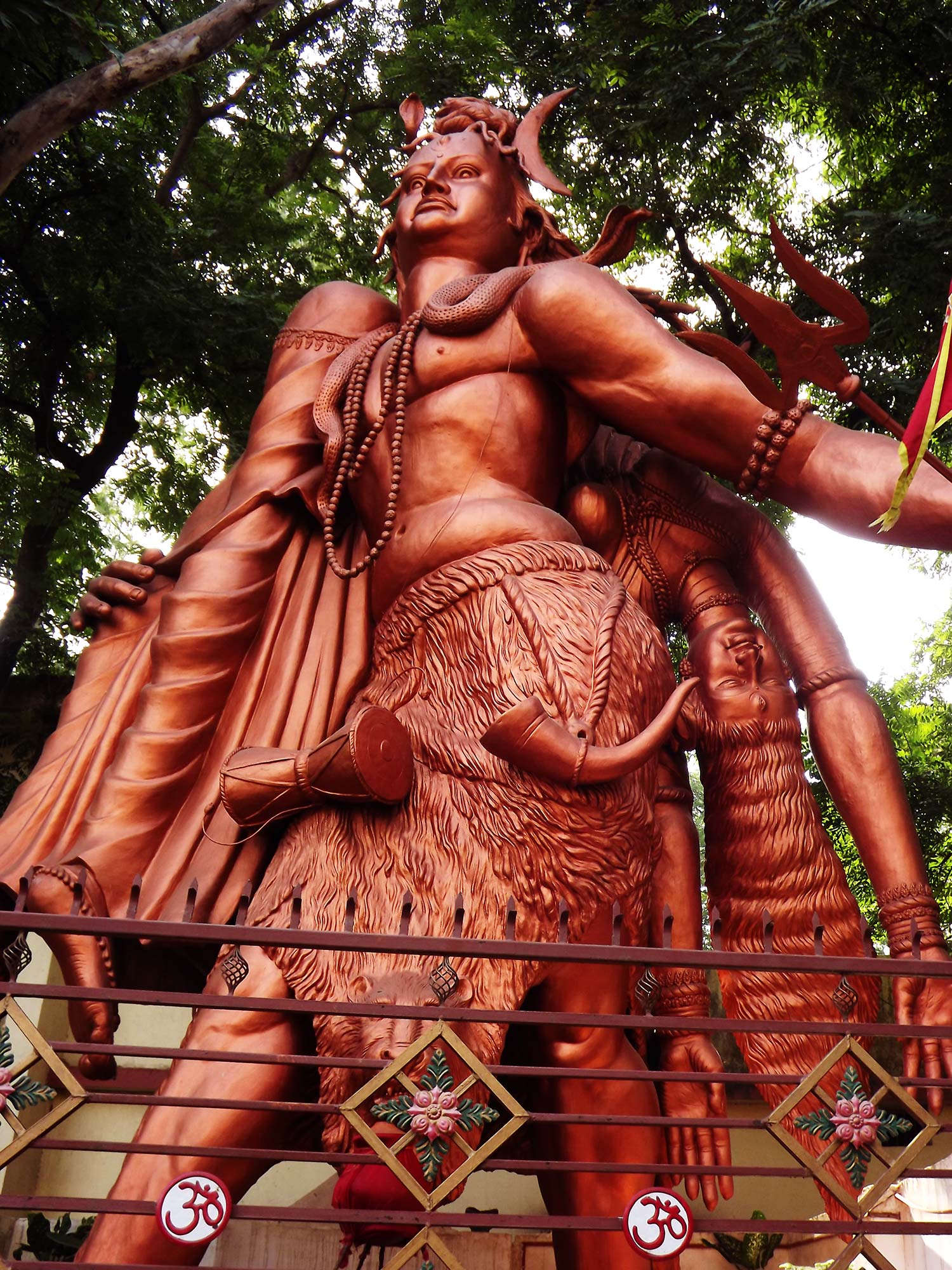

On a quiet little street in Ranchi in Jharkhand, art and religion come together to remind passers by of an immortal love story with no parallel echoes across the world.
At the heart of this story is the Hindu deity ‘Shiva’ and his consort ‘Sati’, later known as ‘Parvati’. In the Hindu pantheon of deities, ‘Shiva’ and ‘Sati’ are a celebrated couple, and their story is one of blessed marital happiness and the inconsolable grief of separation in death – and in which regard they have been identified as the most ‘human’ among all celestial couples.
The concept of ‘Shiva’ and ‘Sati’, however, developed independent of each other in the timeline of Hinduism, and it was only during the period of the ‘Puranas’ that Brahman sages of the era thought it wise to merge them together as a couple – possibly to stress upon the third concept of the eternal attachment of souls and the desire to reunite through reincarnation.

Digital Greetings Cards by Farbound.Net, ft Shiva and Sati.
Actual Dimensions: 1200 x 1203 pixels
Origin of Shiva.
There are two main stream of thoughts regarding the origin of ‘Shiva’ as a Hindu deity. The first one postulates ‘Shiva’ was originally a Harappan deity or divine cosmic figure – based on the excavation of a seal at the site of Mohenjo-daro, that depicted the horned figure of a man, seated in a crossed legged Yogic posture and surrounded by animals.
This seal is famously known as the ‘Pashupati Seal’, and was discovered during a dig by British archeologist, Ernest John Henry Mackay in 1929. Mackay’s boss was Sir John Hubert Marshall, the Director-General of the Indian Archeological survey (1902- 1928), and the discovery of the seal had led him to propose ‘Pashupati’ was a proto-type version of the later ‘Shiva’.
Scholars and historians inclined towards the ‘Harappan origin’ of ‘Shiva’, have since the discovery of the seal, supported Marshal’s proposal with findings of several other artifacts now linked with the deity, such as the ‘Lingam’ – a mysterious pillar shaped object, and several of which were discovered at the sites of Mohenjo-daro, Harappa and Kalibangan.
What this object was originally created to serve has never surfaced but later traditions interpreted it as the phallus of ‘Shiva’ – see the Farbound.Net story: How Shiva lost his manhood. The mythological origin of the Shiva Lingam as a phallic object.
The Rigvedic origin of Shiva.
The other stream of thought regarding the origin of ‘Shiva’ puts the spotlight on the Vedic cosmic figure known as ‘Rudra’.
In the ‘Rigveda’, ‘Rudra’, is a powerful deity related to storms and winds. He is mentioned close to seventy five times, and has five associated hymns.
Out of which, hymn 1.114, 2.33, and 7.46 are solely dedicated to him while hymn 1.43 and 6.74 speak of him and Soma, the divine personification of the intoxicating drink used in Indo-Aryan rituals. Soma was also the name of the plant from which the extract was produce.
‘Rudra’, and despite his fierce reputation, however, was not as exalted as the riverine Saraswati and in the Rigveda period he was a minor deity- see the Farbound.Net story: The indomitable Saraswati. From a river to a strong willed independent woman, the evolution of a Rigveda deity.

Download for Free: Digital Greetings Card by Farbound.Net, ft Shiva with Dog.
Actual Dimensions: 1200 x 1203 pixels
Mention of Shiva in the Shvetashvatara Upanishad of the Yajurveda.
According to scholars like Gavin Flood, the development of ‘Rudra’ into ‘Shiva’, is to be clearly referenced from the ‘Shvetashvatara Upanishad’ of the ‘Yajurveda’ canonical – one of the four principal Vedic canons. The other three are the ‘Rigveda’, the ‘Samaveda’ and the ‘Atharvaveda’.
While the ‘Yajurveda’ is primarily a book on sacrificial rituals and theological philosophies, the ‘Shvetashvatara Upanishad’ is a large section of unbroken text to be found in the book.
The name ‘Shvetashvatara’, is a combination of the words ‘Shveta’ and ‘Ashvatara’, and respectively means ‘White/Pure’ and ‘Mule/Horse’. It is the name of the sage who authored this portion of the text. The Sanskrit word ‘Upanishad’ on the other hand, means ‘ scared text begotten through the recitation of a teacher’.
The ‘Shvetashvatara Upanishad’ comprises of six chapters and one hundred and thirteen verses. This scared text is said to be a synthesis of elements of Vedanta, Samkhya, and Yoga philosophies, and presents both questions related to the metaphysical as well as their answers.
The text is considered important by scholars for introducing the concept of Ishvara (God) and asserting that the universal self (God) exists in all creations. The text is also considered important for projecting ‘Rudra/Shiva’, as the one and only supreme Brahman, the ultimate reality, and as the creator, preserver and destroyer of the universe.
The ‘Yajurveda’ is generally believed to have been composed between 1200 – 800 Bce, and the later ‘Shvetashvatara Upanishad’ between 500 -400 Bce.
In addition to Gavin Flood, the postulation of Shiva’s Rigvedic origin is also stressed upon by R.G Bhandarkar, Indologist Jan Gonda, Mahadev Chakravarti and especially by Stella Kramrisch – who arrives at the same conclusion by exploring Indo-Aryan fire rituals and other associations, and which includes the horned bull.
Presently, the widely accepted view of ‘Shiva’s’ development in Hindu religion is that he had emerged from the Rigvedic ‘Rudra’ and over the course of centuries absorbed non-Vedic lores and aesthetic traditions, including the concept of ‘Pashupati’ to become the ‘Shiva’ of the Puranic legends, created some 1000-1500 years later.
Origin of Sati as the consort of Shiva.
Unlike ‘Shiva’ who emerged from the Rigvedic ‘Rudra’ in the Vedic period, ‘Sati’ made her first appearance in the Puranas, that was developed in the post Vedic period, between 300 -1000 Ce. Prior to her appearance, ‘Shiva’ was associated with the female deities of Rudrani, Ambika and Uma – and it was only later ‘Sati’ came to be his first wife.
‘Sati’s’ legend is described in detail in the Shiva Purana, and appears in anecdotal form in several other Puranas including, the Linga Purana, the Matsya Purana, the Vayu Purana, the Skanda Purana, the Kurma Purana, Padma Purana, and the Kalika Purana. As well as in the Devi Bhagavata and the Mahabhagavata Purana.
She was the favourite daughter of king ‘Daksha’ Prajapati, ruler of the ancient kingdom of Kanakhala, and was the embodiment of truth, virtue and nobility. Most often in the Puranas, she is portrayed as a beautiful and virtuous woman.
Her father ‘Daksha’ was a son of ‘Brahma’ and her mother was ‘Prasuti’ (sometimes Asikni), the daughter of ‘Svaayambhuva Manu’ – the first of the fourteen Manus, and who had lived during the dawn of the Satya Yuga.
After her father, ‘Daksha’, she was also known as ‘Dakshayani’.
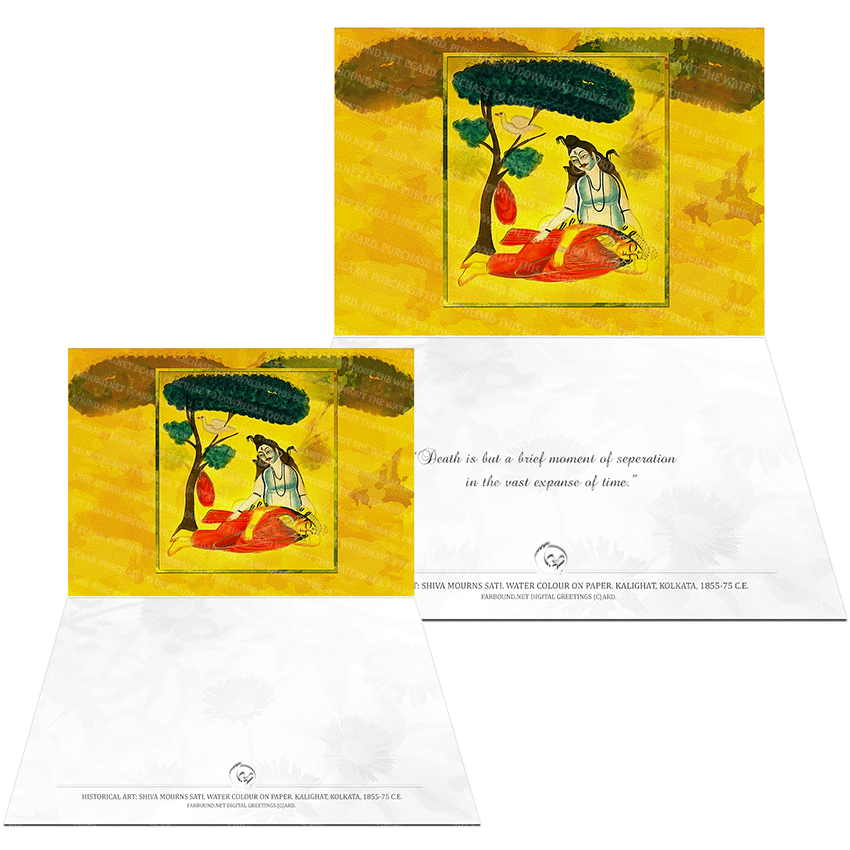
Digital Greetings Cards by Farbound.Net, ft Shiva and Sati.
Actual Dimensions: 1200 x 1203 pixels
Sati and Shiva’s love story.
‘Sati’ and ‘Shiva’s’ love story forms an integral part of the Shiva Purana, composed between 900-1100 Ce. In this particular Purana that is primarily dedicated to ‘Shiva’, she is described as being enamored with the aesthetic deity since she was a child. Her devotion to ‘Shiva’, narrates the Purana, had begun after getting acquainted with the glories of the aesthetic deity in childhood and which had later developed into love.
A love that was so strong that when she had reached a marriageable age, she hadn’t just rejected all potential suitors arranged by her father but had also left the comfort of her home, to perform severe austerities deep in the forest to attain ‘Shiva’ as her husband.
Impressed by her resolve, ‘Shiva’ had materialized not long after and accepted her hand in marriage, and the two had dwelled in blessed marital happiness for several cosmic cycles.
One day, however, continues the narrative, ‘Sati’ upon receiving news of a grand Yajna (Vedic fire ritual) her father ‘Daksha’ had organized to honour all gods and sages, had made her way back to her father’s kingdom – and despite the warning of ‘Shiva’, who was well aware of the reason why the king had invited all deities and sages but left out his daughter and son-in-law.
The innocent ‘Sati’, oblivious to ‘Daksha’s’ hatred for ‘Shiva’, had ventured uninvited into the palace only to be publicly humiliated by her father.
‘Daksha’ had not only rejected her gifts and daughterly affections but also insulted her husband, ‘Shiva’, among the large gathering of gods and sages – the haughty king had secretly despised ‘Shiva’ for his matted dreadlocks, ash covered body and dress of animal hides. He had also harboured a grudge over being slighted in the past by ‘Shiva’.
What had followed was Sati’s self-immolation. Unable to bear the insults and humiliation, she had jumped into the sacred fire of the Yajna in despair and anger.
‘Shiva’, upon, later receiving the news of her death, was consumed by a terrible rage. In anger, he had ripped out a lock of his hair and which upon falling to the ground had transformed into the fierce demon warriors, ‘Bhadrakali’ and ‘Virabhadra’. These two mighty demon warriors, manifestation of ‘Shiva’ himself, had wrecked havoc at ‘Daksha’ palace.
‘Virabhadra’ had later decapitated ‘Daksha’ in the presence of all sages and gods – although later, and once his rage had subsided, ‘Shiva’ had brought ‘Daksha’ back to life but with a goat’s head.
Legend of Shiva and Daksha.
Here is it is interesting to note, that while ‘Sati’ made her first appearance only in the Puranas, the mention of her father ‘Daksha’ and his legendary ‘Yajna’ can be found in the ‘Taittiriya Shakha’ texts composed between 1000 – 600 Bce, followed by anecdotal references in ‘Valmiki’s Ramayana’ ( 750-500 Bce) and the expanded edition of the ‘Mahabharata’ (400 Bce -400 Ce).
While ‘Valmiki’s Ramayana’ gives a slightly different account of the feud between ‘Daksha’ and ‘Shiva’, and explains ‘Shiva’s exclusion from the Yajna had led him to brandish his bow and threaten all deities and sages present. The ‘Mahabharata’ account is closer to the later Puranic versions. It tells that ‘Shiva’ destroyed ‘Daksha’s’ great Yajna because he had failed to appease ‘Shiva’ with an offering.
In the ‘Taittiriya Shakha’ texts, that preceded the composition of both ‘Valmiki’s Ramayana’ and the ‘Mahabharata’, ‘Daksha’ is a Prajapati (creator) but who, and like in the Puranic accounts of the legend, incurs ‘Shiva’s’ wrath for not having invited him to the fire ritual.
Thus, one finds that in the Puranas, ‘Sati’ is the only inclusion to the already existing legend of ‘Shiva’ and ‘Daksha’. It is possible, ‘Sati’ was originally created by the Brahmans at the time of the Puranas – for there is little indication of her evolution from some past deity.
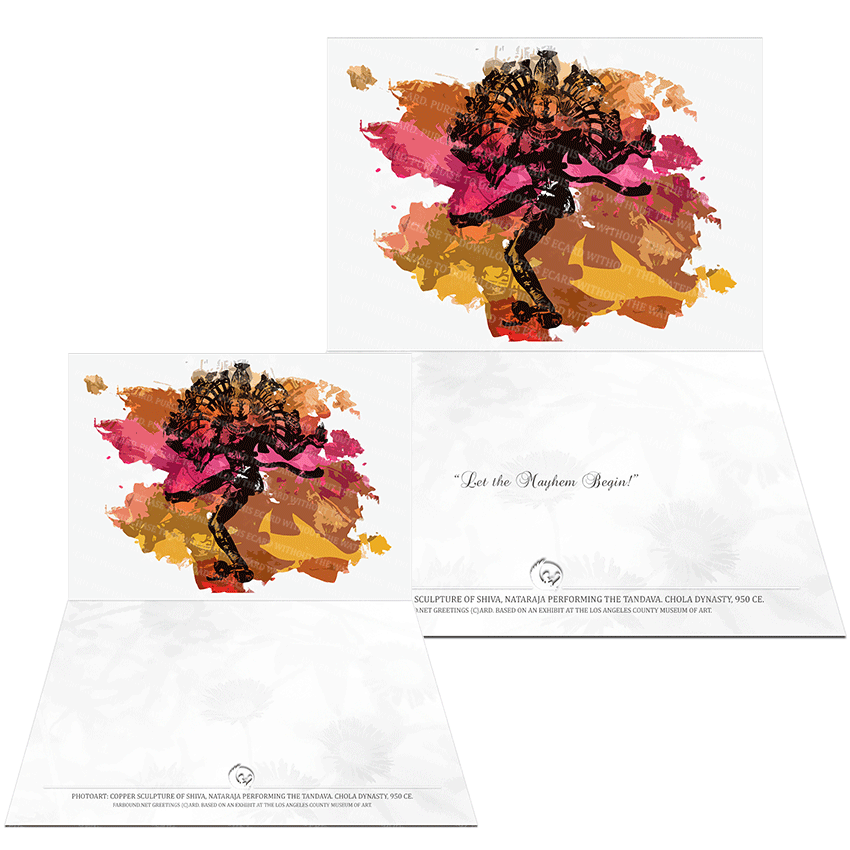
Digital Greetings Cards by Farbound.Net, ft Shiva performing the Tandava.
Actual Dimensions: 1200 x 1203 pixels
Origin of Shiva’s Tandava.
‘Shiva’ performing the Tandava is not mentioned in oral literature composed during the Vedic period. It is not to be found in the ‘Rigveda’, the ‘Samhitas’ and the early ‘Brahmanas’ – although some scholars hold the opinion, the seeds of the cosmic dance is rooted in the motions of ‘Rudra’s violent storms, as described in the ‘Rigveda’.
This cosmic dance of ‘Shiva’ is believed to have gradually taken shape starting with the ‘Taittiriya Shakha’ texts of the ‘Yajurveda’, that was composed between 1000 and 600 Bce.
The ‘Taittiriya Shakha’ texts comprise of a collection of hymns and prose that were recited during Vedic rituals, and it is here, among the hymns associated with ‘Rudra’ that scholars believe lies the concept of a fierce divine cosmic energy swaying the ethereal and the universe in vigorous movements – and which later developed into a dance form.
The first mention of ‘Tandava’ as a dance form, however, appears in the ‘Natya Shastra’, a book on the performing arts that was composed originally by the sage ‘Bharata’, possibly around 200 Bce and was later expanded by descendant sages right up till 500 Ce. The dance is mentioned in the fourth chapter of the ‘Natya Shastra’, titled the ‘Tandava Lakshanam’.
Here the word ‘Tandava’ is described as having sprouted from the name of ‘Tandu’, an attendant of Shiva – while the dance form is described as a vigorous masculine dance representing the five celestial activities of creation, preservation, destruction, illusion and emancipation.
The associated legend describes ‘Shiva’ instructing ‘Tandu’ to teach the dance to the sage ‘Bharata’.
Shiva’s Tandava with the corpse of Sati.
Out of the seven main types of Tandavas, the ‘Rudra Tandava’ is associated with the legend of ‘Shiva’ and ‘Sati’ – and literally means the dance of destruction.
The concept of the ‘Rudra Tandava’ was developed during the time of the Puranas and was first described in detail in the Shiva Purana. Consumed by grief, despair and anger, ‘Shiva’ had danced the ‘Rudra Tandava’ with the corpse of ‘Sati’ on his shoulders – and in the process brought the heavens, earth and the underworld to the brink of complete destruction.
The other six forms of Tandavas are the Ananda Tandava, the Tripura Tandava, the Sandhya Tandava, Kaalika Tandava, the Uma Tandava and Gauri Tandava. In addition to these seven forms, ancient texts mention 101 other variations.
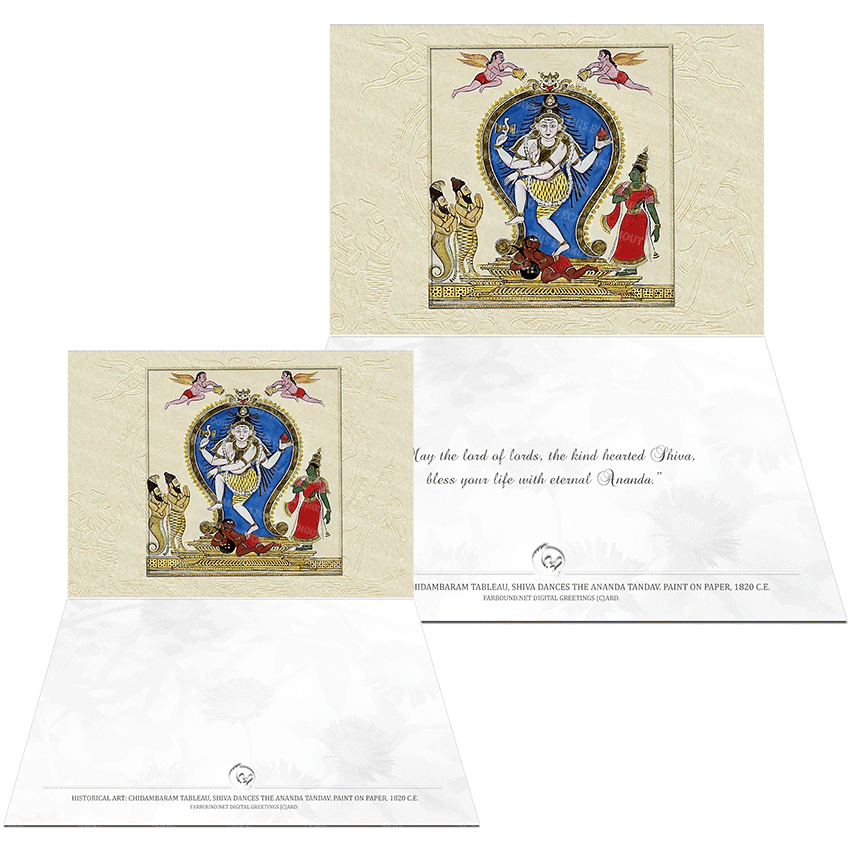
Digital Greetings Cards by Farbound.Net, ft Shiva performing the Ananda Tandava.
Actual Dimensions: 1200 x 1203 pixels
Shiva and Sati’s eternal love.
In the fabric of Puranic legends, ‘Shiva’ and ‘Sati’s’ love story doesn’t end with poignant death of ‘Sati’. For the passages of the Skanda Purana describes ‘Shiva’ waiting 21 Manvantaras (or celestial epochs) to be reunited with ‘Sati’, and which eventually comes to be – indicating their love transcends time and space.
The reincarnation of ‘Sati’ as ‘Parvati’, daughter of ‘Himavan’ (a mountain king residing in the Himalayas) and his queen ‘Menavati’ is described in both the Shiva Purana and the Devi Bhagavata Purana. This later Purana, in addition, provides a detailed account of ‘Sati’ as a manifestation of Shakti. The rebirth of ‘Sati’ and her later reunion with ‘Shiva’, is an allusion to the Vedic’s belief in reincarnation.
In Hindu religion ‘Sati’ is widely recognized as the goddess of marital felicity and longevity. She is worshiped as an avatar of the mother goddess (shakti) and her name literally means the ‘true virtuous one’.
Sati’s later association with the tradition of burning widows.
Till its abolishment as a punishable crime on the 4th of December in 1829, ‘Sati’ was a widely practiced tradition of burning widows among Hindu communities. The tradition is believed to have been in use since 1000 Ce, and was also popularly known as Jauhar in the 13th century.
This widow burning tradition, however, did not the originate with the ‘Shiva’ and ‘Sati’ legend of the Puranas, and neither was the legend of ‘Sati’s immolation the first recorded instance of the tradition – although this legend appears to have been misconstrued by the later Hindu community and developed as a tradition under the same name.
The mention of wives willingly embracing death by immolation is to be found in texts, prior to the creation and inclusion of ‘Sati’ in the Puranas. It is to be found in the expanded edition of the ‘Mahabharata’ that was composed before the Puranic period – specifically, in the legend of ‘Madri’ and ‘Pandu’.
The texts from this early period, however, present the immolation of wives as a choice unfettered by social stigma in stark contrast to the later Hindu tradition of forced immolation. In the expanded ‘Mahabharata’, ‘Madri’ had ascended the funeral pyre of ‘Pandu’ because she had felt responsible for his death.
How widely, wives immolated themselves during the period of the epics, or if it was even carried out at all, is not known. References of such instances are very rare in Vedic oral literature. Furthermore, and in the case of ‘Sati’, unable to bear the humiliation she had, essentially, committed suicide.
Far from the tradition that emerged later, ‘Sati’s’ story in the Puranas, on the contrary, is a love story highlighting the eternal attachment of souls and the desire to reunite through reincarnations. Her, all too human story, has a tragic episode but eventually a happy ending.
The sculpture up in the photo is of an inconsolable ‘Shiva’ running distraught with the corpse of his beloved consort -unable to come to terms with her death. ‘Shiva’ Lingams and giant-size statues of ‘Shiva’ are numerous and scattered across India, but a colossal ‘Shiva’ re-enacting a passage from the Puranas, is a sight one doesn’t come across everyday.
I F I This is an Independent story describing the origin of the legend of Shiva and Sati. It has been created from literary and historical sources. I