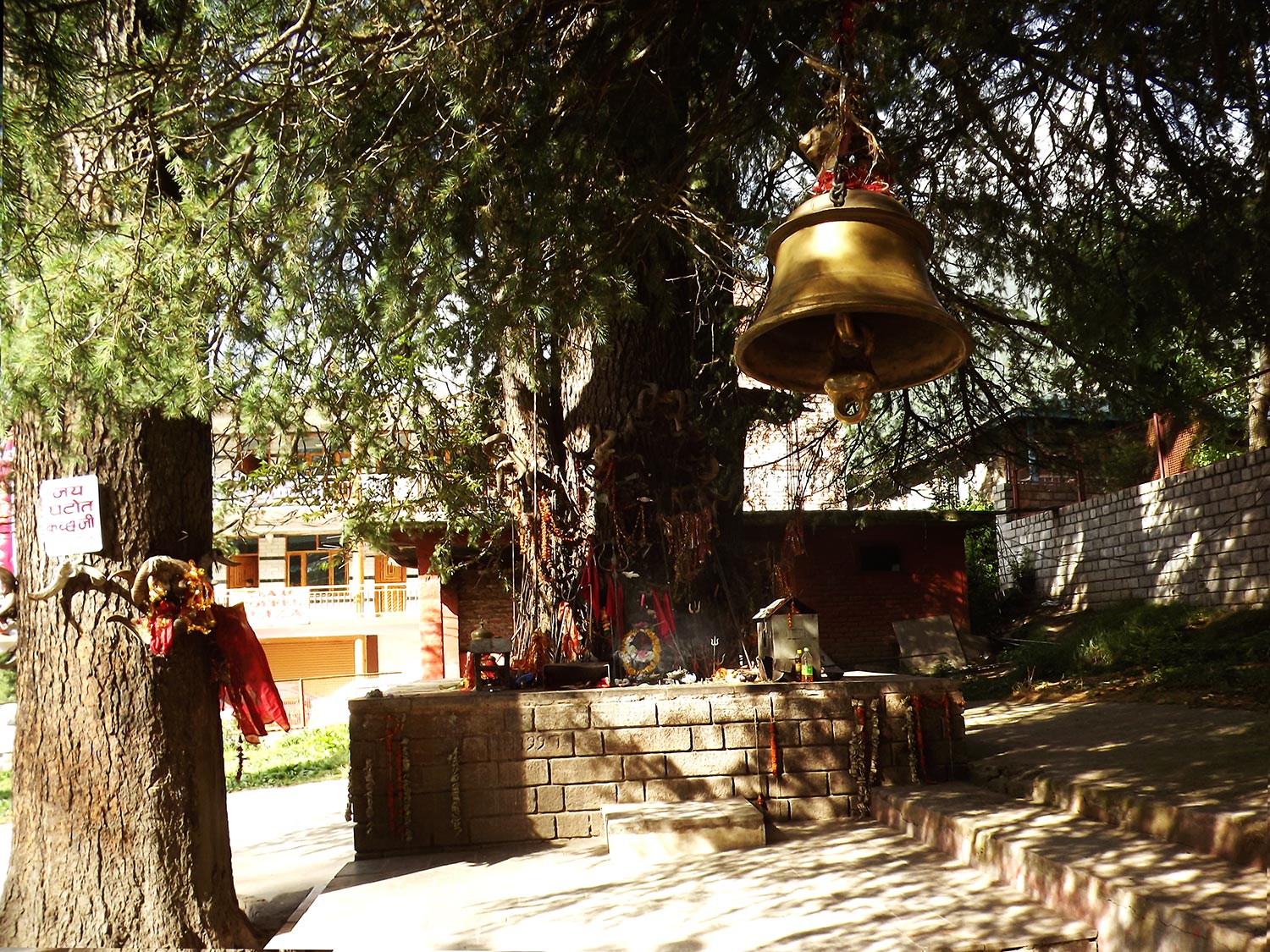

Piled up high underneath the canopy of an old deodar tree, weapons of war pay obeisance to the memory of the mighty warrior ‘Ghatotkacha’, steps away from the Pagoda-style temple of his mother ‘Hidimba’ at Dhungri, in Manali. The weapons largely include the Indian version of the trident, known as the ‘Trishul’, but the mace, chariot, bow and spear (preferred weapons of the Indo-Aryan Vedics) is absent.
The Mahabharata.
The ‘Mahabharata’ is an epic poem that was historically composed to glorify the Kuru race and exalt the historical figures of Janamejaya and Parikshit.
This poem was composed between 400 Bce and 400 Ce, but contains numerous references and anecdotes of names, events and occurrences from 1500 Bce and earlier. It is a poem that was orally composed and recited by successive generations of Vedic wise men and handed down to descendants, and who having memorized the content by rote, had in turn passed it down.
Thus while the ‘Kurus’ were a historical people who rose to power during the Painted Grey Ware period, spanning 1200-600 Bce, and the central plot of the poem revolves around them – names, events and occurrences associated with them in the narrative are from 1500 Bce and earlier – and finely blended with their times and beliefs.
Chronological segments of the Mahabharata.
In modern times, scholars have divided this epic poem into three chronological segments. The earliest, and the foundational composition, is known as the ‘Jaya’, and contains some 8,800 verses. The ‘Bharata’ with 24,000 verses, makes up the second installment. While the final composition is the ‘Mahabharata’, an expanded segment containing 1,00, 000 verses.
The ‘Mahabharat’ is the final evolution of the poem and doesn’t just contain the content of both the ‘Jaya’ and the ‘Bharata’ but a lot more tales and details.
Authors of the Mahabharat.
The ‘Mahabharata’ is traditionally attributed to the Vedic sage poet ‘Veda Vyasa’ – and whose real name was ‘Krishna Dvaipayana’, literally the one with a dark complexion with the Sanskrit word ‘Krishna’ meaning black or dark and ‘Dvaipayana’ meaning island-born.
The same Hindu traditions have also described him as having lived in the 3rd millennium Bce or as a Chiranjeevi, a semi-immortal being blessed with such an unusually long lifespan that we are led to believe he is still alive and living among us.
These descriptions, however, are hyperbolic and poetic exaggerations and does in no way confirm with the actual lifespan of the historical Vedic sage who composed the poem – and thus, moderns scholars have postulated that ‘Veda Vyasa’ was not one but several Vedic sage poets, who dwelled broadly between 1500 Bce and 400 Ce.
From this perspective, and if we are to accept the fact ‘Krishna Dvaipayana’ was indeed the first sage to compose the epic poem, he would have lived in the vicinity of 400 Bce – given the epic poem was composed and developed between 400 Bce and 400 Ce, and a time frame that also corresponds with the Painted Grey Ware culture of 1200 -600 Bce, during which time the historical Kuru clans had also flourished.
The ‘Bharata’ and the expanded ‘Mahabharata’ are the compositions of later sage poets who succeeded ‘Krishna Dvaipayana’ in the timeline. Furthermore, later Vedic texts tell us the ‘Bharata’ was first recited by the sage ‘Vaisampayana’ a disciple of ‘Krishna Dvaipayana’, and the expanded ‘Mahabharata’ by the Vedic bard ‘Ugrasrava Sauti’.
Since, these early Indo-Aryans at the time had the tradition of orally composing and reciting existing material with embellishments, it is possible, ‘Vaisampayana’ and ‘Ugrasrava Sauti’ are two of the uncredited authors of the epic among several others – though there is no conclusive evidence to support this theory
Ghatotkacha in the Mahabharata.
Like the fabled city of ‘Indraprasta’ and his mother ‘Hidimba’, the mention of ‘Ghatotkacha’ is not to be found in the foundational composition ‘Jaya’ by ‘Krishna Dvaipayana’ – also see the Farbound.Net story: Indraprasta, home of the mighty Pandavas. Did the city actually exist?
His mention comes down to us, from the ‘Adi Parva’ the first of the 18 books of the expanded ‘Mahabharata’ and from later chapters such as the ‘Vana Parva’, the ‘Udyoga Parva’, the ‘Bhishma Parva’, the ‘Drona Parva’ and the ‘Harivamsa Parva’ – composed by other Vedic sage/sages, possibly the bard ‘Ugrasrava Sauti’.
This final and expanded edition of the poem, describes Ghatotkacha as a half-human, half-demon warrior. He is the son of the mighty Bhima, the strongest of the Pandava brothers, and Hidimba, a forest dwelling demon princess. He has an unusually large bald head that resembles an earthen water pot, the demonic powers of his mother and the unnatural strength of his human father, Bhima.
Ghatotkacha, the epic tells us, was unlike ordinary human children. Minutes after he was born he had transformed rapidly into a full grown young warrior, versed in the art of war and demonic prowess. We are additionally also acquainted with the knowledge that from his father Bhima, the young Ghatotkacha inherited noble virtues of Vedic chivalry and conduct, that was not to be found in children of pure demon blood.
While the author/authors who composed the final edition of the epic poem, do not develop the character of Ghatotkacha beyond this brief introduction nor grants him the privilege of having his own narrative within the main poem but casts him in a supporting role. They nonetheless, imbibe him with heroic qualities and presents him more generously than his mother, Hidimba, who plays a minor role in the epic.
In the expanded ‘Mahabharata’, ‘Ghatotkacha’ is the loyal and dutiful son who follows the virtuous path of Dharma, devoid of the vices of pride, jealously and hatred, inspite of not being of pure Vedic blood.
He harbours no grudge towards his father nor does he despise the paternal side of his family, inspite of being abandoned within a year of his birth. He is never bestowed the same honour as his purer Vedic cousins but he bears them no ill will.
His character is presented in sharp contrast to his father Bhima, who engages in a war of fratricide to usurp the throne from his cousin Duryodhana, the rightful heir. Whether, this prominent expose was intentionally or inadvertently put in by the Vedic sages is not known.
Furthermore, ‘Ghatotkacha’ demands nothing from his father yet without a moment’s hesitation he comes to assist whenever needed. He and his band of Rakshas materialize out of thin air to carry the Pandavas to Badrikashrama when they are exhausted traversing the mountainous Himalayan terrain.
Later, he makes his father’s cause his own, and as a mighty warrior knight wrecks havoc on his father’s enemies – aware he has nothing to gain but the death of a valiant warrior.
Likewise, the high point of his role in the epic ends with his one-on-one battle with his paternal but estranged uncle Karna, that brings about his demise in the Kurukshetra war.
A war historians believe is an allusion to an actual battle of some magnitude, though not as colossal as the epic exaggerates it to be.

Greetings Cards by Farbound.Net for Goodwishes, ft. the tree temple of Ghatotkacha.
Actual Dimension: 1200 x 1203 pixels.
Ghatotkacha from a historical perspective.
Historically, ‘Ghatotkacha’ or the historical figure behind the inspiration, may likely have belonged to one of the several non-Vedic tribes that existed before the migration of the Indo-Aryans and later coexisted alongside the Vedics.
He was, perhaps, a warrior, a chieftain or a deity of a now forgotten clan that dwelled in the mountains, possibly of the same clan that worshiped ‘Hidimba’, and possibly someone of importance to find a place in Vedic lore.
The men of the tribe he belonged to were, possibly, skilled warriors, night raiders and experts at guerrilla tactics – with their later description as human devouring ‘Rakshas’, simply an allusion to their cannibalistic tendencies or practice of offering human sacrifices.
His mixed parentage, perhaps, a subtle hint that the period may have witnessed an intermingling of Vedic and non-Vedic people, and his secondary role, an indication that the unions, while being tolerated to some degree, were largely unacceptable in Vedic society.
His mother, ‘Hidimba’, after all, was left behind by Bhima, and not inducted into Vedic society during the period the epic was compiled.
Similarly, his participation in the ‘Kurukshetra’ war, is another plausible allusion to actual alliances between Vedic and non Vedic clans. Or perhaps a passing hint that such tribes were vassals who owed tribute to Vedic kings or were simply hired as mercenaries to bolster the main army in times of need.

Digital Greetings Card by Farbound.Net for Goodwishes, ft the metal sculpture of Ghatotkacha.
Actual Dimensions: 1200 x 1203 pixels
Historical non-Vedic tribes.
While, given the obscurity of the period and the absence of substantial evidence, it is impossible to know if ‘Ghatotkacha’ was indeed a historical figure and which historical tribe he may have belonged to, information in Vedic texts do acquaint us with several historical tribes that coexisted with the Vedics.
Such as the Sudras and the Abhiras; the Nisadas and the Ajas; the Sigrus and the Aushmikas; the Romakas and the Yakshas; the Daradas and the Dravas; the Kasmiras, the Nagas and the Pishachas; the Kiratas and the Khasas; the Tanganas and the Parvatas.
Among these, the Daradas, Kiratas, Khasas, Tanganas and the Parvatas were forest tribes that dwelled in the remote Himalayan mountains. While the Kasmiras, the Nagas and Pishachas were a people to be found in the vicinity of the present day region of Kashmir, bordering the present day state of Himachal in India.
The Pishachas and the Nagas, in particular, are described in later Vedic texts in hyperbolic proportions. The Pishachas are spirits and monstrous cannibals, capable of shape shifting and assuming human form, while the Nagas are half-human half-serpent beings – see the Farbound.Net Story: Behind the myth of the serpent people known as the Nagas.
Ghatotkacha’s secondary role in the epic.
Though the author/authors of the expanded ‘Mahabharat’ do imbibe ‘Ghatotkacha’ with heroic qualities and projects him as a loyal and dutiful son, he and his people, are nonetheless portrayed in the epic as ‘a lesser people’ when compared to the Vedics.
In essence ‘Ghatotkacha’, his tribesmen and his mother ‘Hidimba’ are, projected as dark demonic figures to make the Vedic races automatically appear more virtuous. The Vedic author/authors are also careful when presenting ‘Ghatotkacha’ with all his noble attributes.
Unlike pure blooded demon offsprings who are vile and revolting, the mighty warrior is noble and heroic because he has Bhima’s blood flowing through his veins – and who is a pure Vedic prince. Implying that it was only under Vedic influence and guidance could such people be considered worthy.
Undermining the importance of such tribes and portraying them as inferior to the Vedic clans was deliberate and a natural thing to do for the author/authors of the epic, who themselves belonged to the Vedic race and were composing a poem for a Vedic audience that believed in the supernatural, the unimaginable and their own superiority.
Though the ‘Mahabharata’, was originally created to glorify the Kuru race, importantly the personae of Janamejaya and Parikshit. Two historical Vedic kings, the creator of the foundational poem wanted to elevate in status as descendants of the virtuous heroes of the epic, the Pandavas.
In later years, however, the evolution of the foundational poem into the ‘Bharata’ and the ‘Mahabharata’ had also transcended its purpose to promoting the notion of ‘Duty’, ‘Religion’, and ‘Code of Conduct’ – among the Vedic populace, the poem’s primary audience, and not the non-vedic tribes with practices and rituals that outright opposed the Vedic belief system.
Thus, Ghatotkacha’s secondary status in the epic.
Ghatotkacha, a later addition to the fabric of Vedic literature.
Furthermore, ‘Ghatotkacha’ was also a later addition to the fabric of Vedic oral history and literature.
While according to Indologists and scholars like Asok Parpola and Rajesh Kocchar, events that take place in the ‘Mahabharata’ did not actually occur in India but took place long before the Vedics of the Rigveda period had migrated into the country around 1500 Bce – with later generations of Vedic wise men, associating old names of rivers, places and events with counterparts in their new locale, see the Farbound.Net Story: The indomitable Saraswati. From a river to a strong willed independent woman, the evolution of a Rigveda deity.
In the case of ‘Ghatotkacha’, however, his inclusion in Vedic literature occurred after the completion of the foundational poem, the ‘Jaya’ that was composed around 400 Bce.
Indicating that even if the Indo-Aryans had known of such non-vedic tribes during the 1,100 years of their stay in ancient India, and produced oral literature such as ‘Samhitas’, ‘Brahmanas’, and ‘Aranyakas’, his absence in these works clearly suggests, ‘Ghatotkacha’ was not to be found in Indo-Aryan chronicles spanning from 1500 Bce and earlier to a few centuries after 400 Bce.
Ghatotkacha’s Tree Temple.
Tree temples like that of ‘Ghatotkacha’ predates human architecture. They constitute the earliest known places of worship and have been around long before humans started to construct ornate temples and religious buildings.
Besides his tree temple at Dhungri in Manali, ‘Ghatotkacha’ has a more traditional-style temple in the region of Bhuntar, where he is represented by a metal sculpture. In Himachal Pradesh and Indonesia, ‘Ghatotkacha’ is depicted as a human – in stark contrast to his demon like image, popular across the rest of the Hindu world.
The last time I visited the Tree Temple of ‘Ghatotkacha’ was in 2016. I found the giant Deador that shelters the temple with its branches and leaves to be “locked in time”. Just as I had found it to be in the 1980s, when I took up residence in Kullu valley. I was in school then and not as tall as I am now. A time when I also did not study the great epics in the same manner as I do now.
Also see the Farbound.Net story: Hidimba, an enigmatic goddess of non-Vedic origins.
I F I This is an independent story exploring the origin of Ghatotkacha as belonging to a non-Vedic tribe. It is created out of facts curated from literary sources. I