
The village of Bhanara grows on the rocky surface of a sloping hill that rises from the very edge of the old Kullu-Manali highway, not far from the road that leads up to the Nagar castle. A narrow mountain trail links the village to the hamlet of Jagatsuk, which occupies much of the lower portion of the hill and lines both sides of the highway with the type of one-storey shops one usually finds in this side of the Himalayas.
As one ascends the trail, the village becomes impossible to spot, as dense foliage of wild vegetation, rocky outcrops and trees heavy with summer leaves obscure it from view. In August, when the rains pelt down, the trail built of rough-cut stones turns slippery at intervals. But not for the residents of the village, who traverse up and down in haste and leisure, sure-footed as mountain goats.

Mention of Bhanara in western Himalayan folklore.
Bhanara is thought by some to be an ancient Himalayan village, although there is practically zero evidence to suggest when it turned into a sizable cluster of homes to be called a village or who its founding fathers were.
The settlement is mentioned in several versions of Himalayan folklore associated with the rise of serpent worship in the Western Himalayas, particularly that of the serpent deity Shrigan Naga, and whose newly renovated temple, built in the Kath Kuni style of architecture, stands a little distance above the present-day village –see the Farbound.Net story: The Himalayan temple of Shirgan Naga at Bhanara
Inspite of alterations and additions to the original fabric of legends by generations of interpreters, Bharana has unfailingly found mention in each version and is stated to have existed before the arrival of its patron serpent deity.
Bhanara, originally a ‘Naga’ village.
As snake worship in India is known to have found roots even before the primary source of information on India’s obscure past, the Vedic scriptures were compiled, and epics such as the Mahabharata recount battles, wars, wedlocks and alliances with tribes known as the Nagas – see the Farbound.Net story: Behind the myth of the serpent people.
It is possible the area was once inhabited by one such tribe that worshiped the serpent and whose emblem was the hooded cobra – an iconography that still can be seen engraved on temples, and as has been attested by historians, who believe the Himalayas was home to ancient non-Vedic tribes.

Such as the Daradas, Kiratas, Khasas, Tanganas and the Parvatas, who were forest tribes that dwelled in the remote Himalayan mountains – alongside the Kasmiras, the Nagas and Pishachas to be found in the vicinity of the present day region of Kashmir, bordering the present day state of Himachal in India.
The Nagas, in particular, have been traditionally associated with the totem of the serpent – leading to the assumption that this settlement may originally have been a ‘Naga’ village.
Or was a village of some other non-Vedic tribe into which the ‘Nagas’, via inter-tribal interaction, alliances and wedlock, had merged into – and established their deity as the patron deity of the mixed population, prior to the Vedic assimilation.
As was described long ago by Mudaliyar C. Rasanayagam, author of the book Ancient Jaffna – and who was convinced the ‘Nagas’ had gradually become a more mixed-race through intermarriages with other local tribes, including both the Harappans and the Indo-Aryans Vedics.
Conversely, the site could also have been originally visited by early Vedic settlers, sages and hermits, who had brought the legend of the serpent into the hills after the practice of worshiping it had been assimilated into their own religion and actual events had transformed into myths, and which then, over the centuries, acquired local flavour.
Although it is also possible that both the village and the temple are of a much later date.
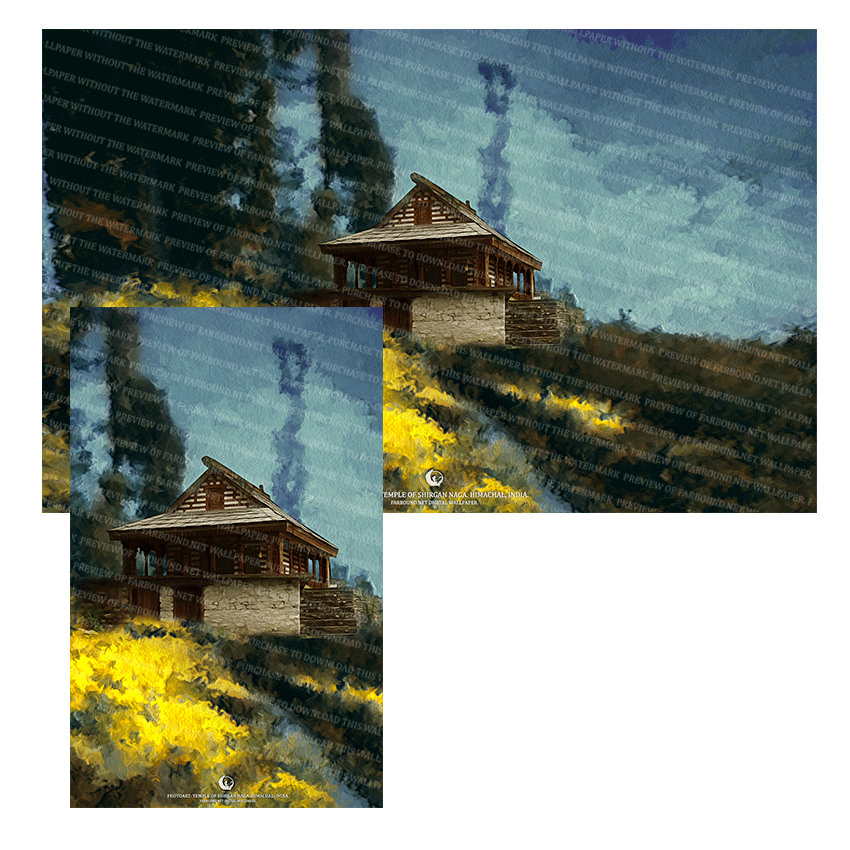
Digital Wallpapers for Desktops and Mobile Phones by Farbound.Net -featuring the temple of Shirgan Naga.
Present Day village of Bhanara.
Whereas the ancient Bharana would have comprised of shoddily made homes of stone and wood, with its inhabitants even living in caves, in present times, the settlement is considered to be a mid-size village with a 2011 census indicating a total of 72 families living in the area, and which may have grown by a negligible margin in 2016 – although no trace of the historical ‘Nagas’ are now to be found barring aside the temple of the serpent deity, Shirgan Naga.
The occupation of the dwellers is mostly farming and cultivation, while houses are a mixture of old Himachali-style village huts made out of slate, stone and wood, as well as more elegant architectural constructions. Nearly all homes are equipped with modern amenities such as electricity and cable televisions, and like most other villages in the Himalayas, local affairs and issues are addressed by a village committee.
Owing to its location up in the mountain, the village as it was in the olden days, still had no motorable road in 2016 when I last visited, traveling alone and on foot. It was midday, raining, and the village was practically deserted.
The residents have to transport everything from construction material to everyday provisions, including the ailing and sick, by foot on the narrow mountain path that links the village to the Kullu-Manali highway, or till the concrete road that wends up the mountain on the other side – much like their forefathers in days now gone by.
Albeit now, the path is reinforced with concrete and crudely made stone steps at intervals, and supplies can be availed close by in the hamlet of Jagatsuk that lies just below the village.
Yet, like several other small settlements located high up in the mountains, Bharana, too, throughout its history has remained a village. Its slow growth in size and population over the years suggesting even in ancient times, it may not have been of much importance.
I F I This is an independent story describing the village Bhanara in relation to its association with the Serpent Deity Shirgan Naga, and as described in legends. I