
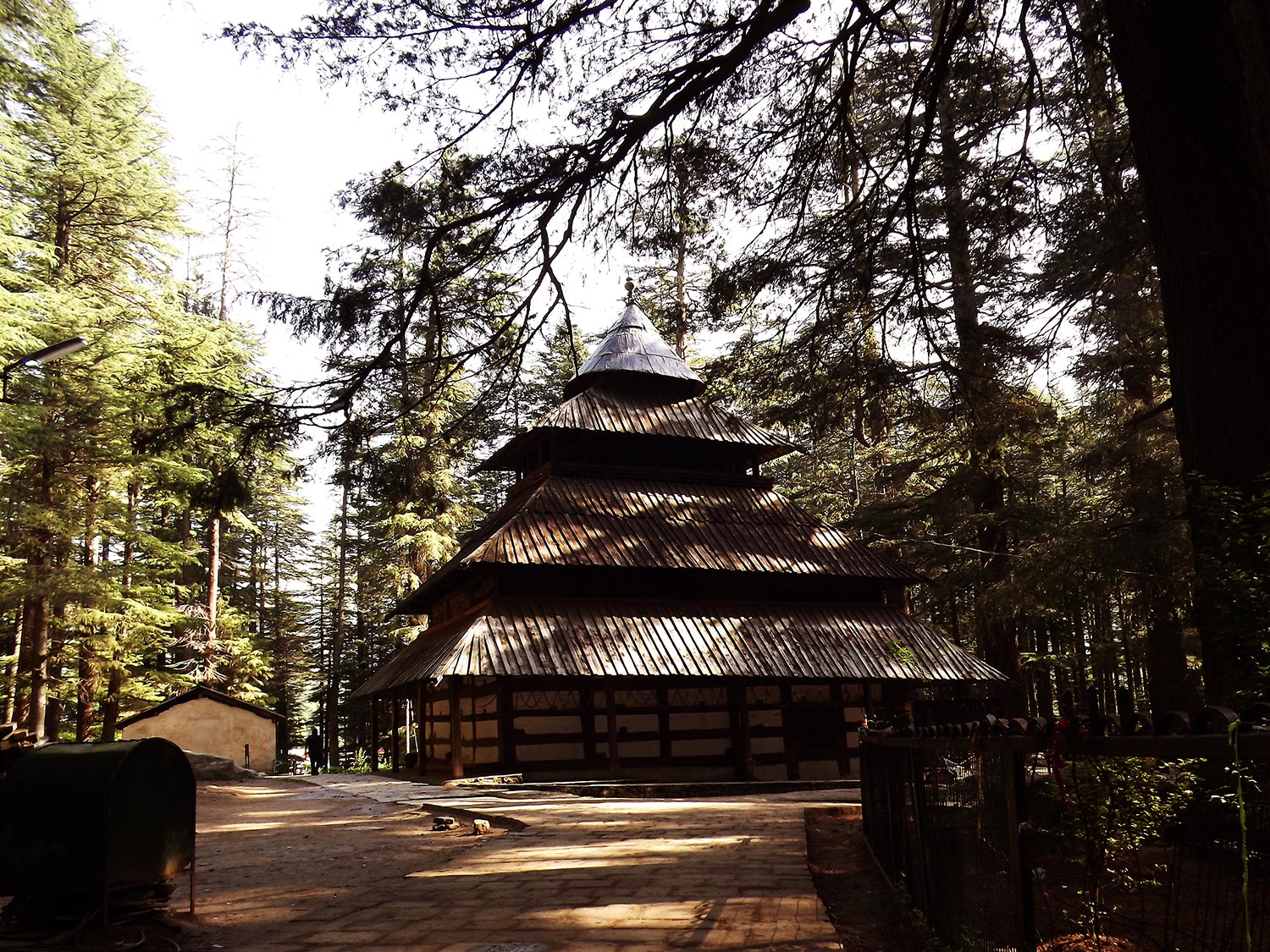

A popular attraction in the town of Manali, the 463-year-old temple of the mother goddess Hidimba, enjoys a momentary spell of quietude in the morning hours of a heavy tourist season, atop the thickly deodar-studded hill of Dhungri, once free of restraining guard fences and littered waste.
Among Himachal’s large consortium of 365 gods and goddesses of mixed origin, Hidimba is perhaps one of the most ancient and prominent in terms of historical significance.
She is one of the few deities of non-Vedic roots, still worshiped in the country, and may have probably existed before the arrival of the Indo Aryans who, over the centuries, flooded the country with divinities of their own creation.
Hidimba made her appearance in Vedic literature, in the epic ‘Mahabharata’, accepted to be the work of Vedic sage poets, and who presented her as a dark-skinned forest-dwelling demon princess.

Digital Wallpapers by Farbound.Net, ft. the temple of Hidimba.
The Mahabharata.
The ‘Mahabharata’ is an epic poem that was historically composed to glorify the Kuru race and exalt the historical figures of Janamejaya and Parikshit.
This poem was composed between 400 Bce and 400 Ce, but contains numerous references and anecdotes of names, events and occurrences from 1500 Bce and earlier. It is a poem that was orally composed and recited by successive generations of Vedic wise men and handed down to descendants, and who having memorized the content by rote, had in turn passed it down.
Thus while the ‘Kurus’ were a historical people who rose to power during the Painted Grey Ware period, spanning 1200-600 Bce, and the central plot of the poem revolves around them – names, events and occurrences associated with them in the narrative are from 1500 Bce and earlier – and finely blended with their times and beliefs.
The core theme of the ‘Mahabharata’ is a dynastic struggle for power. The poem describes a war of fratricide fought between two branches of the same Indo-Vedic family – on one side are the sons of Pandu and on the other the sons of his brother Dhritarashtra, the Kauravas.
In modern times, scholars have divided this epic poem into three chronological segments. The earliest, and the foundational composition, is known as the ‘Jaya’, and contains some 8,800 verses. The ‘Bharata’ with 24,000 verses, makes up the second installment. While the final composition is the ‘Mahabharata’, an expanded segment containing 1,00, 000 verses.
The ‘Mahabharat’ is the final evolution of the poem and doesn’t just contain the content of both the ‘Jaya’ and the ‘Bharata’ but a lot more tales and details.
Authors of the Mahabharat.
The ‘Mahabharata’ is traditionally attributed to be the composition of the Vedic sage poet ‘Veda Vyasa’ – and whose real name was ‘Krishna Dvaipayana’, literally the one with a dark complexion with the Sanskrit word ‘Krishna’ meaning black or dark and ‘Dvaipayana’ meaning island-born.
The timeline ‘Krishna Dvaipayana’ lived in, though, is hard to ascertain. While as per early Hindu traditions he supposedly lived in the 3rd millennium Bce, later Hindu lore describes him as a Chiranjeevi, a semi-immortal being blessed with an unusually long lifespan. On the other hand, scholars have put forward a broad time frame of 1500 Bce – 400 Bce and suggest ‘Veda Vyasa’ was not a name but the honorary title of several poets.
However, if we are to go with the beginning and conclusion dates of the epic poem, it would be safe to consider 400 Bce. The epic poem, after all, was composed and developed between 400 Bce and 400 Ce – while the Kuru kings, Janamejaya and Parikshit, is believed to have lived between 1200 and 900 Bce, possibly closer to 400 Bce.
Thus, if ‘Krishna Dvaipayana’ was indeed the first sage to compose the epic poem, he would have lived in the vicinity of 400 Bce – with the last two chronological portions, the ‘Bharata’ and the ‘Mahabharata’ the compositions of sage poets who succeeded him in the timeline.
From information provided in texts, we know the ‘Bharata’ was first recited by the sage ‘Vaisampayana’ a disciple of ‘Krishna Dvaipayana’ and the expanded ‘Mahabharata’ by the Vedic bard ‘Ugrasrava Sauti’.
Given the Indo-Aryan tradition of orally composing and reciting existing material with embellishments, it is possible, ‘Vaisampayana’ and ‘Ugrasrava Sauti’ are two of the uncredited authors of the epic among several others – albeit there is no conclusive evidence to support this theory.
The tale of Hidimba in the Mahabharata.
The character of Hidmba is not to be found in the ‘Jaya’, the foundational and original composition by ‘Krishna Dvaipayana’ – and who, if we are to consider the advice of scholars who claim ‘Veda Vyasa’ to the title of several sage poets, was the first, ‘Veda Vyasa’.
Like the fabled city of ‘Indraprasta’, the mention of Hidimba is absent from the earliest composition of the epic poem – see the Farbound.Net story: Indraprasta, home of the mighty Pandavas. Did the city actually exist?
Her tales, factually, come from the ‘Hidimbavadha Parva’ of the chapter ‘Adi Parva’ – to be found in the final and expanded portion, the ‘Mahabharata’ – composed by some other Vedic sage/sages, possibly the bard ‘Ugrasrava Sauti’.
According to this later expanded portion of the epic poem, Hidimba was the sister of Hidimb, a Raksha of monstrous strength who preyed on humans – and who upon finding the Pandavas wandering in his part of the forest one fine day had ordered her to lure them to his lair.
To carry out her brother’s wishes, Hidimba had assumed the form of a beautiful human woman. Upon approaching Bhima, however, she had become enamoured with his strength and beauty – and thus love-struck, she had disobeyed her brother’s command and instead revealed her true self and the trap Hidimb had set for them.
Her brother, having seen through her intentions and detesting the union, had rushed to challenge Bhima to a one-on-one contest. But inspite of his monstrous strength, he had turned out to be no match for the strongest of the Pandava brothers and was later slain in combat.
After the death of Hidimb, continues the narrative, a grateful Bhima had agreed to having a relationship with Hidimba with the consent of his mother Kunti. The two had spent a year together, during which time she had given birth to a son, who later came to be known as Ghatotkacha – see the Farbound.Net Story: The Tree temple of the warrior Ghatotkacha of the epic Mahabharata.
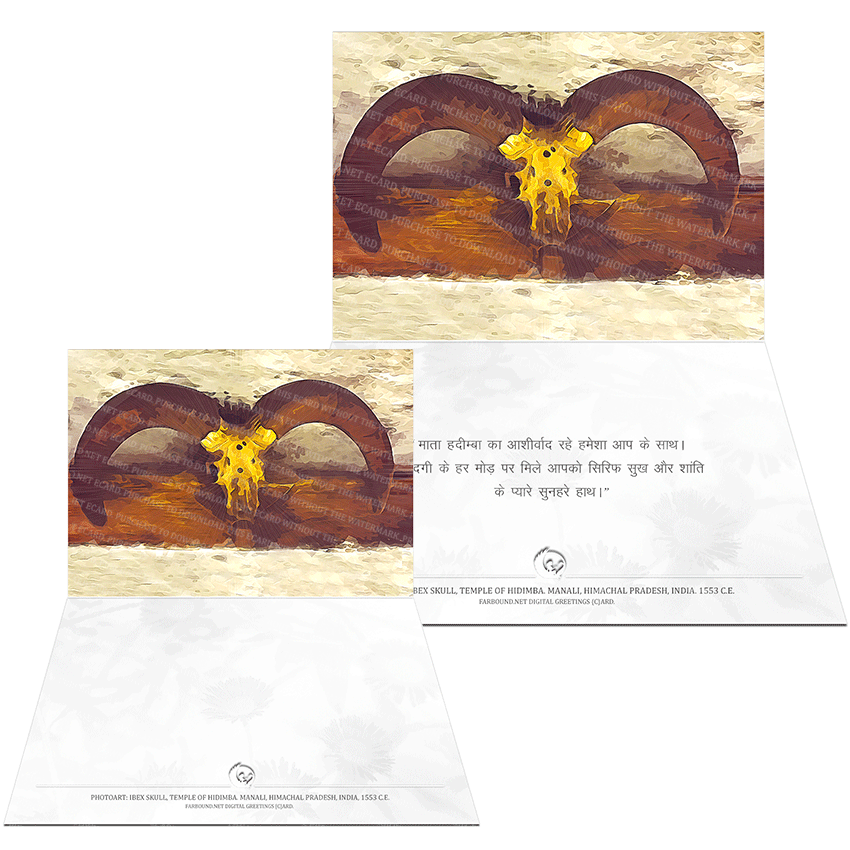
Greetings Card by Farbound.Net for Goodwishes, in Hindi.
Actual Dimension: 1200 x 1203 pixels.
Historical Non-Vedic Tribes in India.
This mythical and hyperbolic tale of Hidimba and Bhima in the epic has led some scholars to see the enigmatic figure of Hidimba as a persona belonging to one of the several non-Vedic tribes that existed in India before the migration of the Indo-Aryans and later coexisted with the Vedics.
While such tribes are collectively described in later Vedic texts as the Asuras (non-luminous ones) they originally were historical tribes, named by the Vedic themselves, as the Sudras and the Abhiras; the Nisadas and the Ajas; the Sigrus and the Aushmikas; the Romakas and the Yakshas; the Daradas and the Dravas; the Kasmiras, the Nagas and the Pishachas; the Kiratas and the Khasas; the Tanganas and the Parvatas.
Such tribes had lived outside the borders of Vedic influence and not adhered to Vedic beliefs. The Daradas, Kiratas, Khasas, Tanganas and the Parvatas, in particular, were forest tribes that dwelled in the remote Himalayan mountains. While the Kasmiras, the Nagas and Pishachas were mountain tribes to be found in the vicinity of the present day region of Kashmir, bordering the present day state of Himachal in India.
Among these, the Pishachas and Nagas were later transformed into supernatural beings. In late Vedic texts, the Pishachas are described as evil spirits and monstrous cannibals, capable of shapeshifting and assuming human form. While the Nagas are described as half-human half-serpent beings – see the Farbound.Net Story: Behind the myth of the serpent people known as the Nagas.
The general assumption that ancient Iranians tribes like the Sakas and Dasas dwelled in India or in the Himalayas is not true.
For and as the soviet archeologist Vicktor Sardini (who excavated the Bactria Margiana Settlements in the Oxus basin) tells us: No signs of the Andronovo tribes (Iranians) are to be found on the Indian Subcontinent, see the Farbound.Net Story: The indomitable Saraswati: From a river to a strong willed independent woman, the evolution of a Rigveda deity.
The name ‘Dasa’ is a corruption of the word ‘Daha’ which originally meant ‘man’ but later came to denote ‘slave’ or ‘servant’. The Daha/Dahe was an Iranian tribe.
Portrayal of non-Vedic tribes in Vedic literature.
These tribes, regardless of their historical origins, had shared with the Vedics, a relationship that had ranged from open hostility to amiable acquaintanceship, but were largely looked down upon in Vedic literature composed to assert Vedic moral character and superiority, and which essentially can be described as a subtle form of ancient world propaganda.
This selective Vedic patronage is clearly evident when we compare the tales of Arjuna and his ‘Naga’ wife Ulupi with that of Bhima and Hidimba, or that of Subhadra.
While Ulupi is described in Vedic texts as a beautiful princess of high standing, as is Arjuna’s later wife, Subhadra. Hidimba is described as a dark-skinned forest-dwelling demon, and who, after their union, is left behind by Bhima. The epic also makes no other memorable mention of Hidimba in the epic other than in this one episode.
Furthermore, and as mentioned in the epic, Hidimba and her brother Hidimb are described not as humans but as ‘Rakshas’, a word that in English translates into supernatural beings (monsters/demons).
However, and if for a moment we take away the exaggerated supernatural shroud covering these two characters, we find that Hidimba and her physically strong brother Hidimb are not monsters but members of a tribe that perhaps dwelled in a forest. Who may have dressed in animal hides and smeared their bodies with mud or ash – and whose beliefs, practices and rituals were vastly different from that of the Vedics.
Their supposed trait of preying on humans, and as portrayed in the epic, is perhaps an allusion to human sacrifices rather than actual cannibalism.
Hidimb and Hidimba may very likely have belonged to one of the historical mountain tribes that inhabited the Himalayas. Namely, the Daradas, the Kiratas, the Khasas, the Tanganas, the Parvatas (group of unidentified mountain tribes), the Kasmiras or the Pishachas.
The reference of people with dark skin in Vedic literature.
The reference of people with ‘dark skin’ in Vedic literature is widely thought by modern day linguists and indologists to be metaphorical rather than actual skin colour.
In the Vedic system of belief ‘white, light and bright’ represented purity, the light of the sun, the radiance of fire, order, truth and divine rituals while ‘black, dark and the night’ represented darkness, evil, chaos, lawlessness and unrighteousness.
The Vedics deliberately used these descriptive colours in their texts and epics to differentiate between themselves and those who did not adhere to their convictions.
They believed their way of life and practices were pure, noble and superior to that of non-Vedic people. In the Rigveda, even the light-skinned Iranian tribes, the Saka and Daha, are denoted as a ‘dark skinned people’ for they did not adhere to Vedic practices, performed fire rituals or worshiped Indra.
Thus, if Hidmib and Hidimba were indeed real historical people, they may not have been dark skinned in the literal sense – especially if we also take into account that the present day people dwelling in the Himalayan mountains including the Kashmiris and Himachalies, usually have fair complexion.
Furthermore, there is enough evidence in Vedic text of proper Vedic sages, with dark or tanned skin tone. The sage ‘Krishna Dvaipayana’ himself, is described as having a dark complexion.

Greetings Card by Farbound.Net for Goodwishes, ft the temple of Hidimba.
Actual Dimension: 1200 x 1203 pixels.
Hidimba, a Tribal Goddess.
What is more likely, though, is that Hidimba was a tribal deity of a now forgotten non-Vedic tribe that dwelled in the Himalayan mountains, and who was important enough to be inducted into Vedic lore in a minor role, but interestingly not as an avatar of a Vedic deity during the period of the epics.
In the expanded portion of the epic poem, the ‘Mahabharat’, the author, after all, was narrating past events, and it is quite possible that by his time, actual events and tribes had turned into myths, folklore and legends, like in the case of the Nagas (see the Farbound.Net story: Behind the myth of the Serpent people).
Hidimba in folklore.
In later folklore, however, Hidimba is an avatar of Parvati /Durga (shakti), the consort of Shiva. In local folklore, she is an incarnation of Sati.
This local legend, which borrows heavily from an earlier legend of Shiva and Sati. Wherein Shiva dances his dance of destruction, the Tandava, with Sati on his shoulder, and Vishnu to save creation, uses his divine disk to dissolve Sati in order to bring Shiva back to his senses. Tells that when Sati’s corpse was thus being cut up into pieces, and parts of her body fell in different parts of the earth. Her breasts fell, where the temple of Hidimba stands today.

Digital Wallpapers by Farbound.Net ft. the temple of Hidimba.
While this local folklore appeared at a much later date, and clearly indicates the process of assimilating non-Vedic deities into Vedic lore. This legend isn’t unique to Hidimba’s temple in Manali, India.
Other locales of India also claim to be the very spots where Sati’s breasts fell during the Tandava. Prominent among these are Gaya in Bihar, the Kumari Hills in Odisha, Jalhandar in Punjab and Kangra in Himachal Pradesh.
Hidimba’s temple.
The temple with its three-tiered slanting roof was built close to the middle of the 15th century in the Pagoda style of architecture – a borrowed construction method reflecting oriental Buddhist influences that was slowly seeping into the valley during the period. The temple houses an ancient cave believed to have been inhabited by Hidimba during her penance for attaining celestial status, as mentioned in the epic Mahabharata.
Pagoda architecture originated in China, and from where it reached Tibet and later arrived in India.

Greetings Card by Farbound.Net for Goodwishes, ft the temple of Hidimba.
Actual Dimension: 1200 x 1203 pixels.
Highly revered by the local populace of present-day Kullu, Hidimba continues to be an influential figure in Himachal’s consortium of divinities and plays an important role in the festival of Dusshera, a congregation of gods and goddesses in the month of October. Manali is one of the few places where a temple dedicated to her exists.
The last time I visited the temple was in 2016. The structure still retained much of its original architecture as when I first saw it as a schoolboy in the 1980s. A time when the temple wasn’t as popular as it is today, and the hill that it stands on was free of guard fences. A time when Manali was a sparsely populated, sleepy town.
I F I This is an independent story exploring the origins of Hidima as a non-Vedic tribal goddess and her temple in Manali. It is primarily built out of facts curated from literary sources, especially the epic Mahabharat, but also encompasses local folklore and beliefs. I