
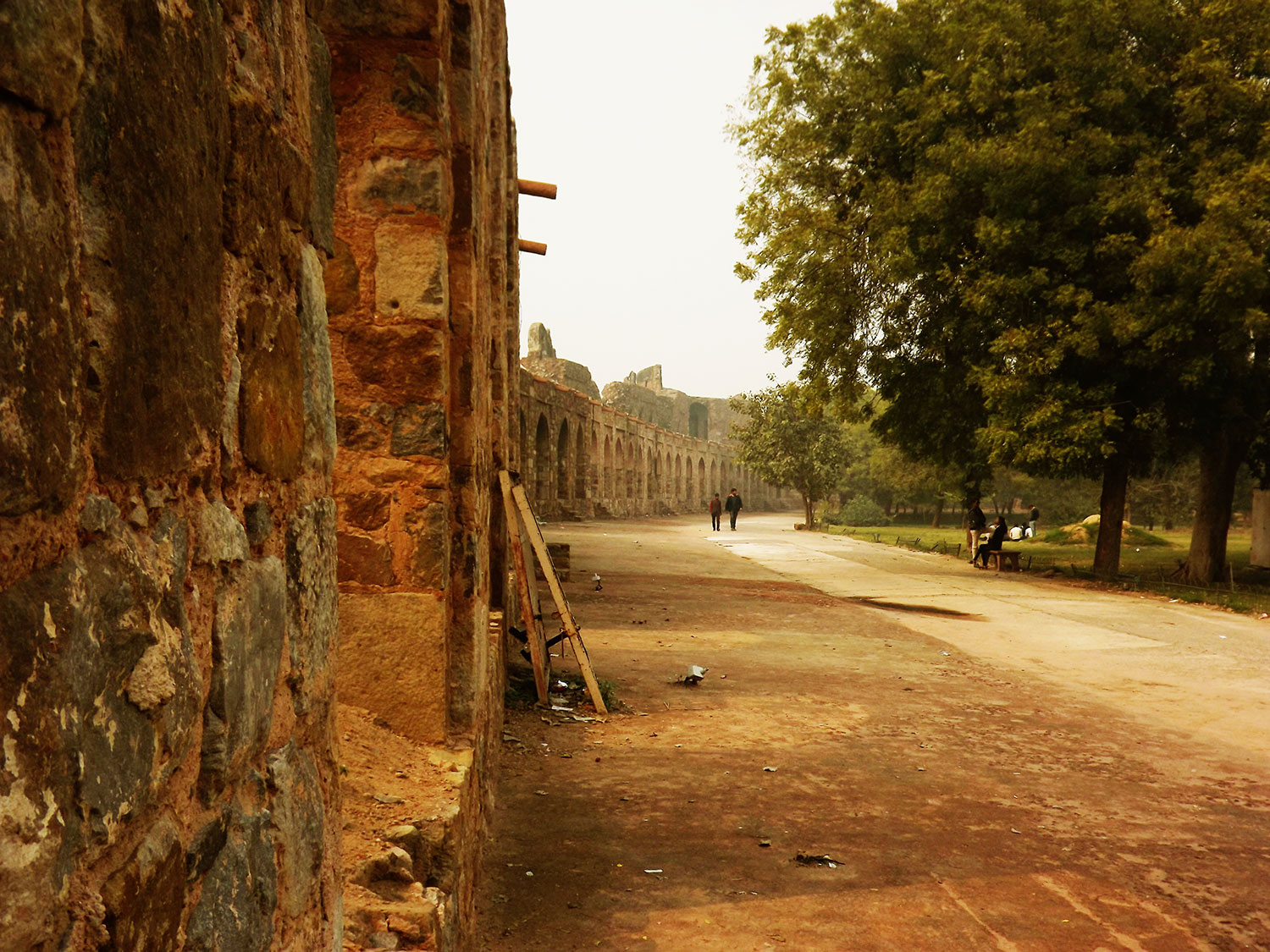

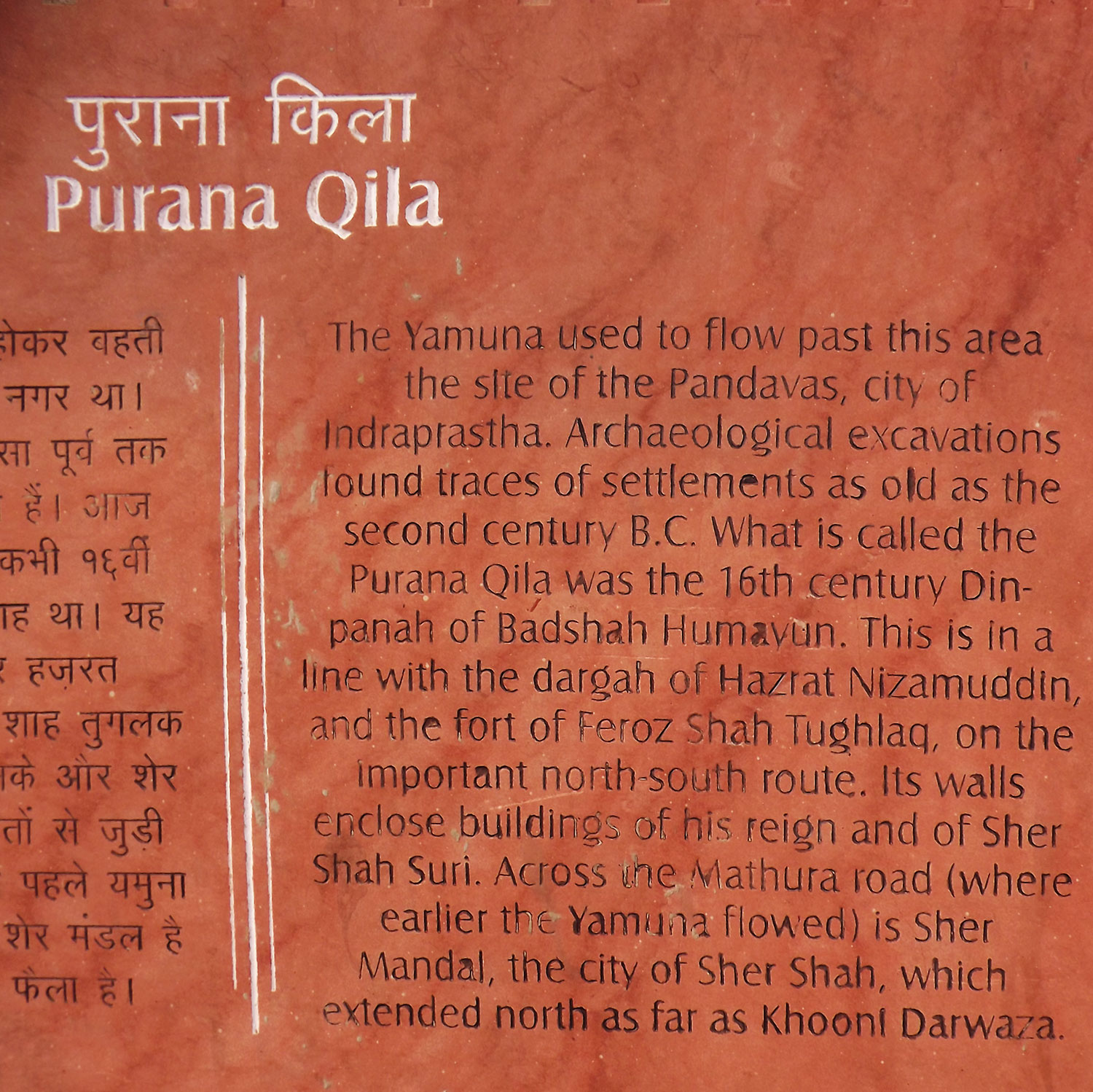
If you walk into what is presently known as the Purana Quila (Old Fort) in New Delhi and meander to the left along the massive walls, chances are you will not fail to spot an old stone tablet inscribed with the words: The Yamuna used to flow past this area, the site of the Pandavas, city of ‘Indraprasta’.
This inference (though not universally agreed upon as conclusive evidence) is derived from the fact that long ago there existed in this location a village known as ‘Indraprat’ among the ruins of several ancient settlements dating back to the second century and possibly farther back into the past.
Since, the primary source of information on the fabled city of ‘Indraprasta’ is to be found in the ‘Mahabharata’. A good starting point to ascertain, is the epic poem itself.
Veda Vyasa, author of the Mahabharata.
The ‘Mahabharata’ was historically composed to glorify the Kuru race and exalt the historical figures of Janamejaya and Parikshit. The creation of the poem is universally attributed to the poet ‘Veda Vyasa’ – a Vedic sage of repute.
His real name was ‘Krishna Dvaipayana’, literally the one with a dark complexion with the Sanskrit word ‘Krishna’ meaning black or dark and ‘Dvaipayana’ meaning island-born.
The timeline he lived in, however, is hard to ascertain. While as per early Hindu traditions he supposedly lived in the 3rd millennium Bce, later Hindu lore describes him as a Chiranjeevi, a semi-immortal being blessed with an unusually long lifespan, and who as per this dictum is still living among us.
On the other hand, academicians have put forward a broad time frame of 1500 Bce – 400 Bce and suggest ‘Veda Vyasa’ was not a name but the honorary title of several poets.
Although, if we are to go with the genesis and conclusion of the epic poem, it would be safe to consider the starting date of 400 Bce.
The ‘Mahabharata’, after all, was composed and developed between 400 Bce and 400 Ce – while the Kuru kings, Janamejaya and Parikshit, is believed to have lived between 1200 and 900 Bce, possibly closer to 400 Bce.
Thus, if ‘Krishna Dvaipayana’ was indeed the first sage to compose the epic poem, he would have lived in the vicinity of 400 Bce.
The central plot of the Mahabharata.
The epic ‘Mahabharata’ revolves around the core theme of a dynastic upheaval. The poem describes a war of fratricide fought between two branches of the same Indo-Vedic family – on one side are the five sons of Pandu and on the other the hundred sons of his brother Dhritarashtra, the Kauravas.
In modern times, scholars have divided this epic poem into three chronological segments. The earliest, and the one that was quite possibly the original composition of ‘Krishna Dvaipayana’, is known as the ‘Jaya’. It roughly contains some 8,800 verses.
This segment is followed by the ‘Bharata’ with 24,000 verses. While the final composition is the ‘Mahabharata’, an expanded segment containing 1,00, 000 verses.
The last two segments, the ‘Bharata’ and the ‘Mahabharata’ are quite possibly the compositions of sages and poets who succeeded ‘Krishna Dvaipayana’.
Sages and poets, whose real names are lost to time but are collectively remembered as ‘Veda Vyasa’ – just like the Latin name ‘Caesar’ later came to represent all Roman emperors.
The content of the Mahabharata.
The poetic content of the ‘Mahabharata’ is an amalgamation of imagination and altered information.
Within this epic poem, ‘Krishna Dvaipayana’ and his successors are not simply unveiling to us their own times but also tales of past events that were passed down from one Vedic generation to another from 1500 Bce, possibly even farther back in time.
As a matter of fact, according to Indologists and scholars like Asok Parpola and Rajesh Kocchar, events that take place in the ‘Mahabharata’ did not actually occur in India but took place long before the Vedics of the Rigveda period had migrated into the country – and which Vedic bards and poets had meshed together with places and events that had come about at later dates.
Doing so, was a long standing Indo-Aryan tradition. These early Indo-Aryans had not only acquired and passed down the tales and experiences of their forefathers to generations of descendants but also added in their own embellishments to the original fabric of information.
Furthermore, they had also followed the tradition of reassociating old names, places and events with counterparts in new locales – see the Farbound.Net Story: The indomitable Saraswati. From a river to a strong willed independent woman, the evolution of a Rigveda deity.
Thus, and from a historical point of view, the poetic content of the epic poem presents enormous difficulty in identifying original events and places.
For instance, while historians are positive a clash of Vedic clans of some magnitude did indeed occur, and as is described in the epic as a great war, none can pinpoint with conviction, when it actually happened and where it took place.
Likewise, is the case of the fabled city of ‘Indraprasta’.
The real audience and the hyperbolic narration of the Mahabharata.
A third Indo-Aryan tradition that increases the difficulty of clearly identifying historical occurrences and sites, such as the city of ‘Indraprasta’, is the poem’s hyperbolic style of narration.
Firstly, ‘Krishna Dvaipayana’ and his successors are not simply overwhelming our modern senses with an undetectable collage of their own times and tales of past events that were passed down to them from 1500 Bce and beyond. But also confounding us with their style of poetic exaggeration as well.
In the epic, one finds certain historical people have been transformed into demon and monsters, and as is in the case of the ‘Nagas’, into half human-half serpent beings – see the Farbound.Net Story: Behind the myth of the serpent people known as the Nagas.
Likewise, ordinary historical weapons are described as divine weapons of mass destruction. Ordinary mortals as off springs of gods and deities. Brahman sages altering destinies with curses. Incredible lifespans that extends well and beyond a thousand years, and what were, very likely, minor settlements and villages, as cities of marvelous architecture.
While such a style of narration does present historical difficulties and makes locating the fabled city of ‘Indraprasta’ an impossible task – especially if we are to solely go by its description in the epic.
What needs to be kept in mind, however, is that ‘Krishna Dvaipayana’ and his successors did not compose the epic for historians and scholars of the 21st century but the Indo-Vedic people of their time.
Men and women who were superstitious, believed in the existence of demons and monsters, and were swayed by tales of the extraordinary and the unimaginable.
An Iron Age people who also believed in their own superiority, in the valor of their forefathers and who took great pride in belonging to a lineage of heroes – and thus, the hyperbolic and self patronizing narration of the epic.
Mention of Indraprasta in the Mahabharata.
The mention of the city of ‘Indraprasta’ comes down to us from the second chronological portion of the epic poem, the ‘Bharata’ and later in the expanded ‘Mahabharata’. Its founding and description are to be found in the Sabha Parva. Here, it is described as the city of the mythical Pandavas.
According to these two chronological portions of the epic, ‘Indraprasta’ was a city resplendent in gold, glimmer and magnificence. Its creator was the celestial architect ‘Mayasura’, the architect of the Asuras, Daityas, and Danavas, and it stood on a cleared spot of the dense ‘Khandava’ forest, that grew on the west bank of the river Yamuna, in the region where modern day Delhi now exists.
Furthermore, this large and fascinating city was guarded by massive defensive walls and towers, and had numerous gates. Inside was many multi-storied mansions and a Royal Palace that left beholders awe struck with its beauty – nestled as it additionally was amidst boulevards, vine ponds, fruit orchards and gardens.
The jewel of the palace, the later portions of the epic additionally tells us, was the Maya Sabha (hall of illusion) where the floors were created to present optional illusions. Solid objects appeared as water bodies while water bodies, appeared solid.
The Mahabharat as historical material.
While this epic poem is indeed an amalgamation of imagination and jumbled information, and contains indiscernible allusions and anecdotes of past events spanning from before 1500 Bce to the day the last chapter was composed, and moreover, overflows with hyperbolic poetic exaggerations, it is still a rich source of historical information.
Especially, on India’s Vedic age that blossomed after the decline of the Harappan civilization – affected as it was by droughts, natural calamities and importantly the drying up of the Gaggar Hakkra.
A river system that according to Indigenous Aryan theorists (sometimes also referred to as the ‘Hindu Nationalist’ revisionists) was the and only Saraswati river of the Rigveda.
The epic poem not only allows us a glimpse of the Vedics way of life, their rituals, practices and beliefs but also abounds with numerous references of historically accurate tribes that existed during the time.
Including the non-vedic tribes of the Sudras and the Abhiras; the Nisadas and the Ajas; the Sigrus and the Aushmikas; the Romakas and the Yakshas; the Daradas and the Dravas; the Kasmiras, the Nagas and the Pishachas; the Kiratas and the Khasas; the Tanganas and the Parvatas.
What archeological excavations have revealed at Purana Quila (Old Fort).
However, while the epic does contain enough credible information for scholars and historians to vouch for the existence of tribes and beliefs, its exaggerated portions contradict the architecture that was historically present.
The semi nomadic pastoralists we know as the Indo-Aryans, even by ‘Krishna Dvaipayana’s’ time, were not master city builders like the preceding Harappan civilization or the Sumerians in Mesopotamia – and thus it is highly unlikely that a city of such a description could have been built by them in antiquity.
Especially, if we consider ‘Krishna Dvaipayana’ and his successors were describing past events in the epic poem – 1500 Bce and earlier to 400 Bce.
While the Indo-Aryan tribes during their centuries long migration from the Pontic steppes to India, did reside for a while in the Bactria Margiana region where fortified settlements existed and as they also did in the neighbouring Yaz I culture regions, it was not till 600 Bce that they had started to build their own fortifications with earthen embankments and wooden palisades.
Furthermore, only after 600 Bce, during the ‘Second Indo-Aryan Urbanization phase’ had major urban centers and palatial complexes begun to appear.
Far from all this, what excavations inside the Old Fort, have actually revealed are the presence of small settlements and among the layers of remnants, several bits and pieces of grey coloured pottery decorated with geometric patterns in black.
The Painted Grey Ware Culture.
Painted Grey Ware Culture, is an archeological phrase, that describes the period from 1200 Bce to 600 Bce. The name comes from the grey coloured pottery with black geometrical symbols produced during the time, and when the village of ‘Indraprat’ may have possibly existed.
This particular culture was preceded by the Cemetery H culture (late Harappan/Indus valley) and the Black and Red Ware culture (a broad range of pottery created by the people of Neolithic, Harappan, Chalcolithic and Iron Age cultures).
The Black and Red Ware culture is often viewed as a bridge between late Harappan period and the Indo-Aryan’s Vedic period. It is also, and quite frequently, linked to the Ahar-Banas people, thought to be the Megalithic builders of South India, and later Iron Age periods.
Discovery of the Painted Grey Ware Culture, 1946.
The Painted Grey Ware Culture was discovered by the prominent Indian archeologist, Braj Basi Lal. This culture was essentially an Indo-Aryan culture and had emerged around 1200 Bce – some 300 years after the Indo-Aryans had migrated into India, starting around 1500 Bce.
The date of emergence of this culture is said to correspond with the appearance of the Vedic period.
Lal had first stumbled upon the signs of this culture in 1946 during an excavation at the historical site of Ahichchhatra, the capital city of the Indo-Vedic Northern Panchala tribe. Some four years later, in 1950, he had unearthed the presence of the culture again at ‘Hastinapur’, a town in Uttar Pradesh, and subsequently at the ‘Old Fort’ in 1954.
Though Lal in later years, was an ardent advocate of the ‘Cultural Continuity’ theory and refuted an Indo-Aryan migration based on a lack of archeological evidence – a theory that is considered flawed by main stream scholars and historians.
His discovery, nonetheless, is considered to be of major significance for it tells us a lot about this particular point in history, that had followed the 300 years period of Indo-Aryan expansion in India.
A total of 30 Indo-Aryan tribes had migrated into India and by the time of the Painted Grey Ware culture, were firmly entrenched in the country.
The real Indraprasta.
According to current archeological evidence, the historical ‘Indraprasta’ or to be more specific the site that is thought to be the historical ‘Indraprasta (Old Fort)’ was a settlement no larger than the size of a small village. Its occupants were likely some branch or clan of an Indo-Aryan Vedic tribe, perhaps a stream of the Kurus, themselves.
The Painted Grey Ware Culture, after all, spanned from 1200 -600 Bce, and saw the emergence of the Kuru kingdom – with both Janamejaya and Parikshit belonging to the Kuru line.
The ‘Mahabharata’ was composed between 400 Bce – 400 Ce, and it is possible, ‘Krishna Dvaipayana’ had begun composing the poem some 200 years after the Painted Grey Ware period. His original oral composition, later transformed by his successors right up till the Gupta period when the epic poem finally attained written form.
If the city of ‘Indraprasta’ did exist prior to 600 Bce, it certainly would not have been as described in the epic poem. In reality, it would have been an unimpressive settlement of raw materials, such as mud and wood – close in appearance to other historical settlements to be found during the period. It is also possible, the site of ‘Indraprasta’ was likely a Harappan settlement that was occupied by the Indo-Aryans.
However, and given the tradition of the early Indo-Aryans of reassociating old names, places and events with counterparts in new locales, there also exists the possibility, this postulated site inside the ‘Old Fort’ was renamed as ‘Indraprasta’ in memory of some other place that existed before the Indo-Aryans had migrated into India.
One that over the centuries evolved into the fabled city of ‘Indraprasta’.
What the name Indraprasta means.
The name ‘Indraprasta’, in essence, means ‘Indra’s Abode or the ‘Abode of Indra’. Together with Saraswati, Indra was one of the original Rigveda deities. In the epic, Indra is also the father of the Vedic prince Arjuna – one of the five Pandava brothers.
The fortress that one sees today at this historic location, was the 15th century citadel of the city of Dinpanah. It was commissioned by the Gurkani emperor Humayun in 1534 Ad. Inside, and besides the crumbling walls of rubble architecture, are to be found a Medieval bath house, a mosque, a squat red tower, and a museum that displays archeological finds.
The village of ‘Indraprat’ that existed inside the citadel was inhabited till 1913 Ce. The dwellers of the village were later relocated. There is little information to gauge how ancient this village really was.
In folklore, ‘Indraprasta’ was one of the five villages demanded by the Pandavas, as a final peace compromise before the Kurukshetra war. The other four were the villages of Swarnprastha, Panprastha, Vyaghraprastha, and Tilprastha – places located in Delhi and Haryana.
In the final chronological portion of the epic poem, however, the names of the villages are described as Kusasthala, Vrikasthala, Makandi, Varanavata and an unnamed village of Durodhanaya’s choice. This event is narrated in the ‘Bhagavadayana Parva’ chapter.
What is highly probable is that the ‘Indraprasta’ of the ‘Mahabharata’ and the image that exists in popular culture today, was and still is, a complete poetic exaggeration – like most other things mentioned in the epic poem.
It is also noteworthy, that ‘Indraprasta’ is not mentioned in the foundational and original composition of the poem the ‘Jaya’, by ‘Krishna Dvaipayana’ – indicating the fabled city was a later addition by other poets and perhaps was just a poetic invention.
I F I This is an independent story exploring the origins of the fabled city of Indraprasta. It is primarily built out of facts curated from literary sources, especially the epic Mahabharat, and historical works of scholars and archeologists I






I think the so-called Mahabharata inscription is of a much later date and someone put it there a few hundred years ago to lay claim over this place. This could be easily tested using carbon dating on the inscription, the language and the dialect of the writing. Is the writing in Brahmi, which was the earliest script used in India, excluding the undeciphered Harappan script? Or is it in modern day Sanskrit, which could prove a much later origin. I think, originally, this fortress was possibly of a local Jat king that got taken over by Rajput kings and then by the Turkic dynasty kings. It urgently needs restoration from the ASI.