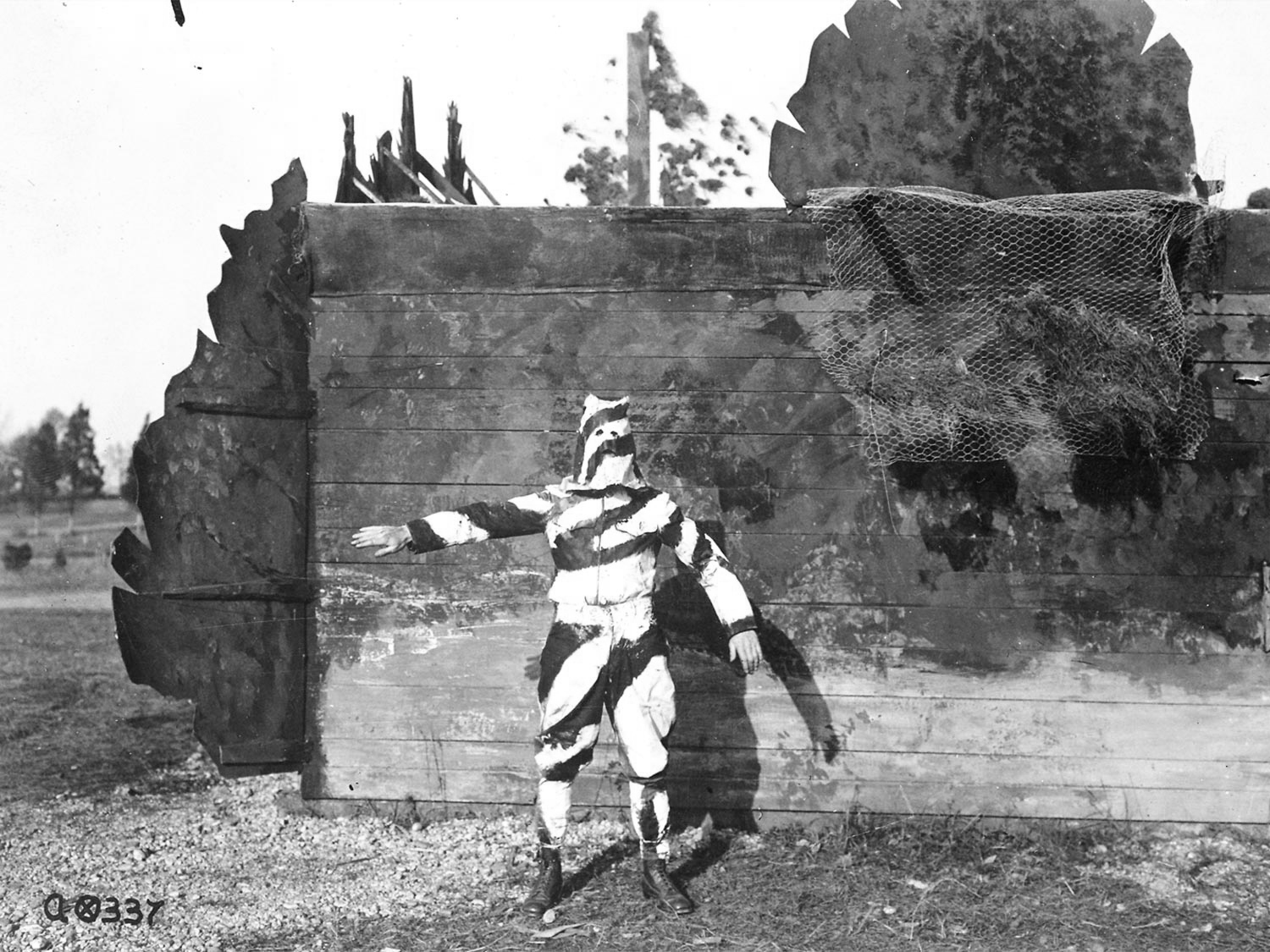

A soldier dressed in a special uniform with black and white stripes prepares to blend into the background in this photo produced on the 14th of November in 1917 – during what was an experiment to develop camouflage.
The experiment was being conducted at the time of the first world war – a conflict that begun on the 28th of July in 1914 and was officially declared to be over on 11th November in 1918.
Razzle Dazzle Camouflage.
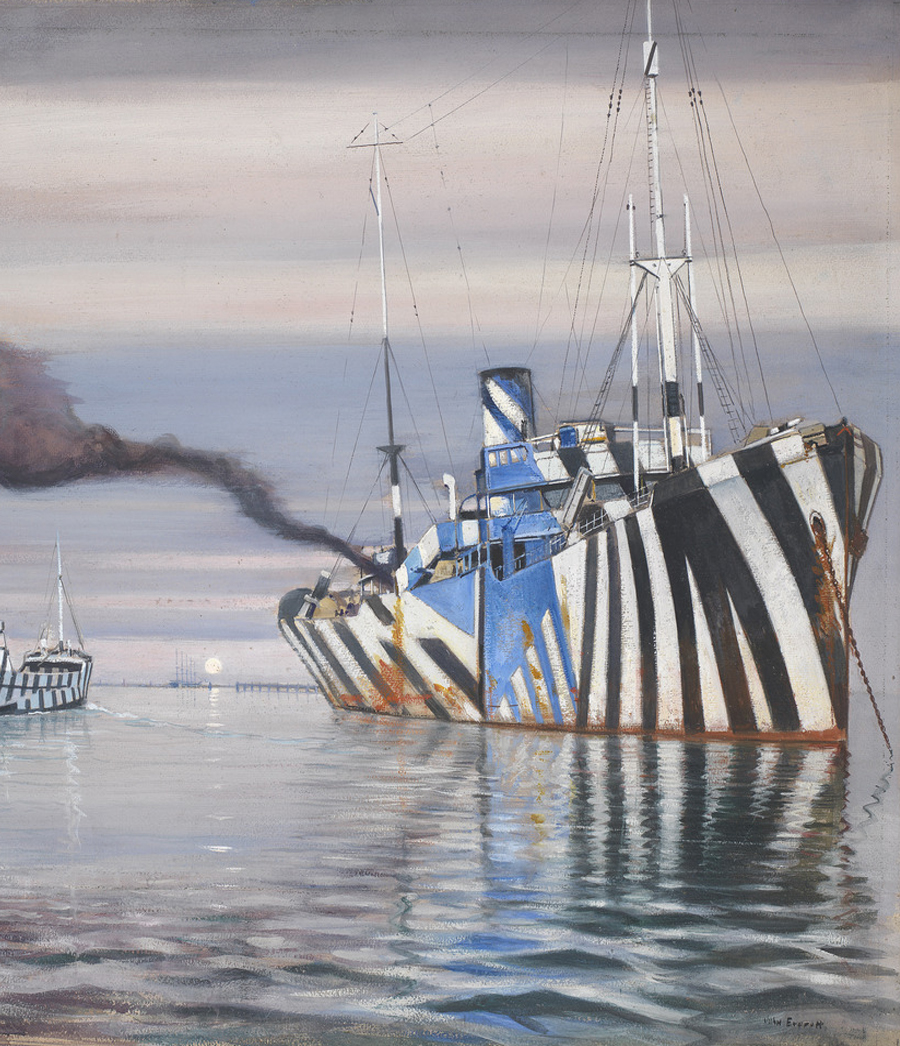
Predominantly to be seen on British and U.S. warships sailing the oceans, this zebra pattern camouflage of black and white stripes was popularly known as the Dazzle camouflage in Britain and as the Razzle Dazzle camouflage in the U.S. It was originally conceived by British Zoologist, John Graham Kerr and improved by British marine artist, Norman Wilkinson.
Though Kerr had presented the idea to Winston Churchill in 1914, Wilkinson was declared its inventor – after having won a legal battle.
In the U.S. this particular type of camouflage was developed by William Mackay – and had come in a variety of colours including Haze Gray, Pale Gray, Ocean Gray, Navy Blue and Black. The camouflage was applied both in stripes and in other geometrical patterns.
Purpose of the Razzle Dazzle Camouflage.
The purpose of developing and using the zebra pattern black and white camouflage on warships, and to a lesser extent on air planes and armoured vehicles was basically to confuse the human optical senses and for motion disruption.
On the seas, it was not to hide a warship but to make it difficult for enemy submarine and enemy airplanes from accurately judging speed and size from a distance, and thus make it difficult to target.
The Dazzle camouflage was applied to over 2,300 British war and merchant ships during the World War I. A similar kind of camouflage was also used by the Germans and the Japanese.
This particular type of camouflage, however, fell out of use by the time of World War II – as upgrades in technology ushered in more advanced rangefinders and optical sights.
The Photo.
This photo was produced by an uncredited photographer, possibly by a photographer of the U.S Army’s Audio Visual Center. This department was a military field agency entrusted to support the U.S Army’s Deputy Chief of Staff for Operations and Plans. The photo is now archived by the National Archives and Records Administration (NARA).
The original caption attached to the photo reads: Soldier in black and white uniform to conceal him while climbing trees. He stands in front of a house camouflaged to represent a fence and trees. Company F,24th Engineers. American University, D.C. Army Engineer Corps.
Both the Dazzle and Razzle Camouflage were defined as Disruptive Camouflage. Its use was meant to delay or prevent identification by sight. The word Camouflage comes from the French word, Camoufler – and which means to disguise.
I F I This is an independent story produced to highlight the history behind this Vintage Photo from 1917. The story also highlights what the Razzle Dazzle camouflage was all about. It has been created from facts curated from literary sources and historical documents. I