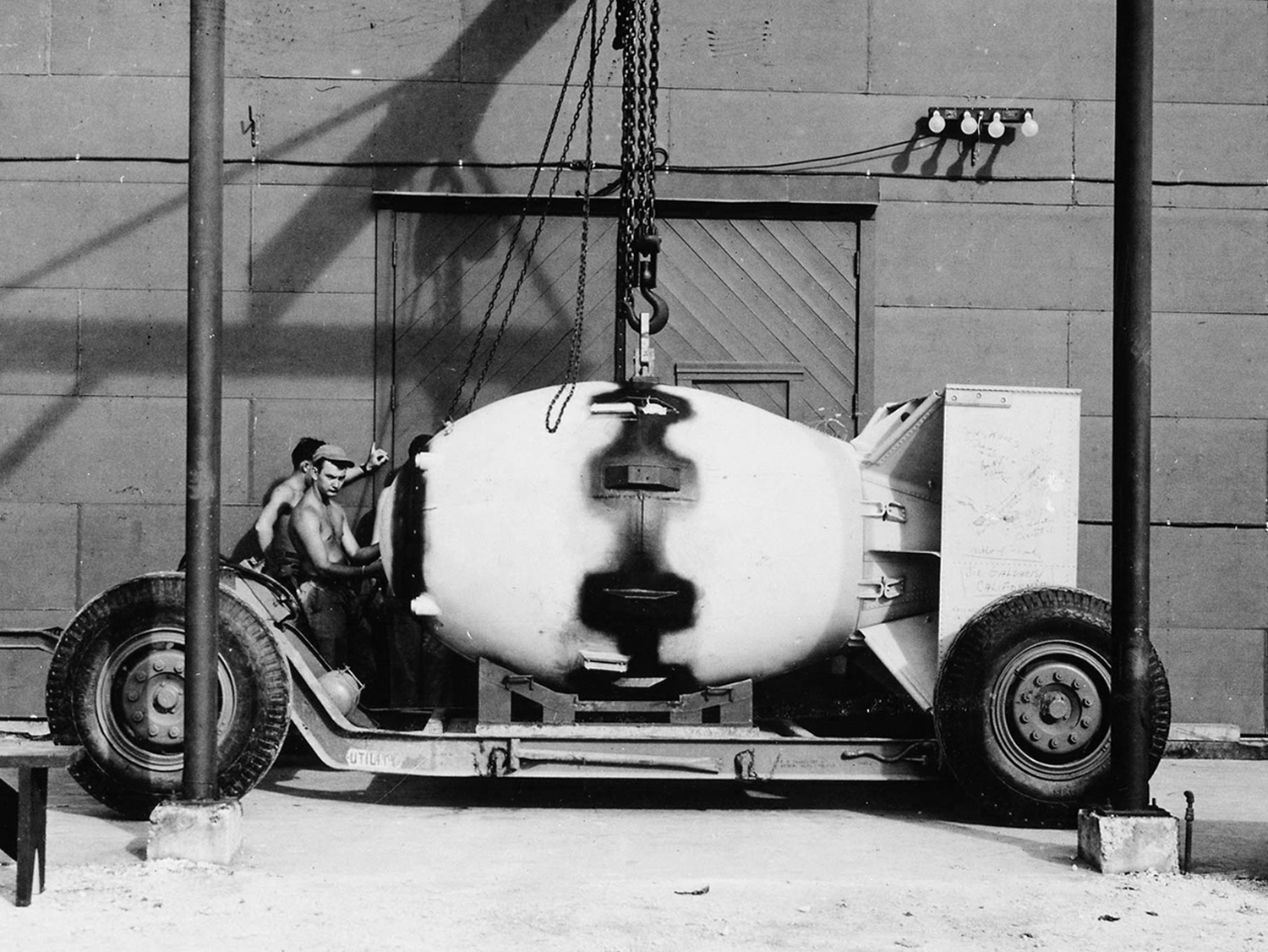

Pulleys, levers, chains and human muscles combine to gently lift the fully assembled Fat Man into a waiting trailer cradle at the North Field airbase on Tinian island, on the 8th of August in 1945.
The atom bomb was being transported to a waiting B-29 Super Fortress Bomber, nicknamed BocksCar – two days after its predecessor Little Boy was dropped over Hiroshima on the 6th of August in 1945.
Size of the Fat Man Atom Bomb.
With Japan refusing to surrender in spite of the death and destruction brought about by the uranium based Little Boy, a second atom bomb had become the need of the hour and the only one near at hand at the time was the Fat Man – a 10,800 pounds egg-shaped bomb designed to implode at a predesignated moment over its target.
A plutonium based atom bomb, the Fat Man was 10 feet 8 inches in length and 60 inches in diameter. The plutonium for the bomb was produced from uranium isotope 239. Processed in huge refineries at Hanford in Washington – a now decommissioned nuclear facility but which then had provided the Manhattan Project with tons of the rare metal for experiments and weapons.
The bomb was packed with an explosive firepower equaling 21,000 tons of TNT.
Unlike the uranium based Little Boy, the plutonium Fat Man had not required a gun fired projectile to start the atomic chain reaction. As an implosion device, it had a dense ring of 5,300 pounds of high-grade explosives stacked around a sub-critical plutonium core. These explosives were preset to explode at a configured time and crush the plutonium at the centre, to trigger the atomic chain reaction.
Also see the Farbound.Net story: Little Boy, the uranium Atom Bomb.
Fat Man’s release over Nagasaki by the B-29 Super Fortress Bomber, BocksCar.
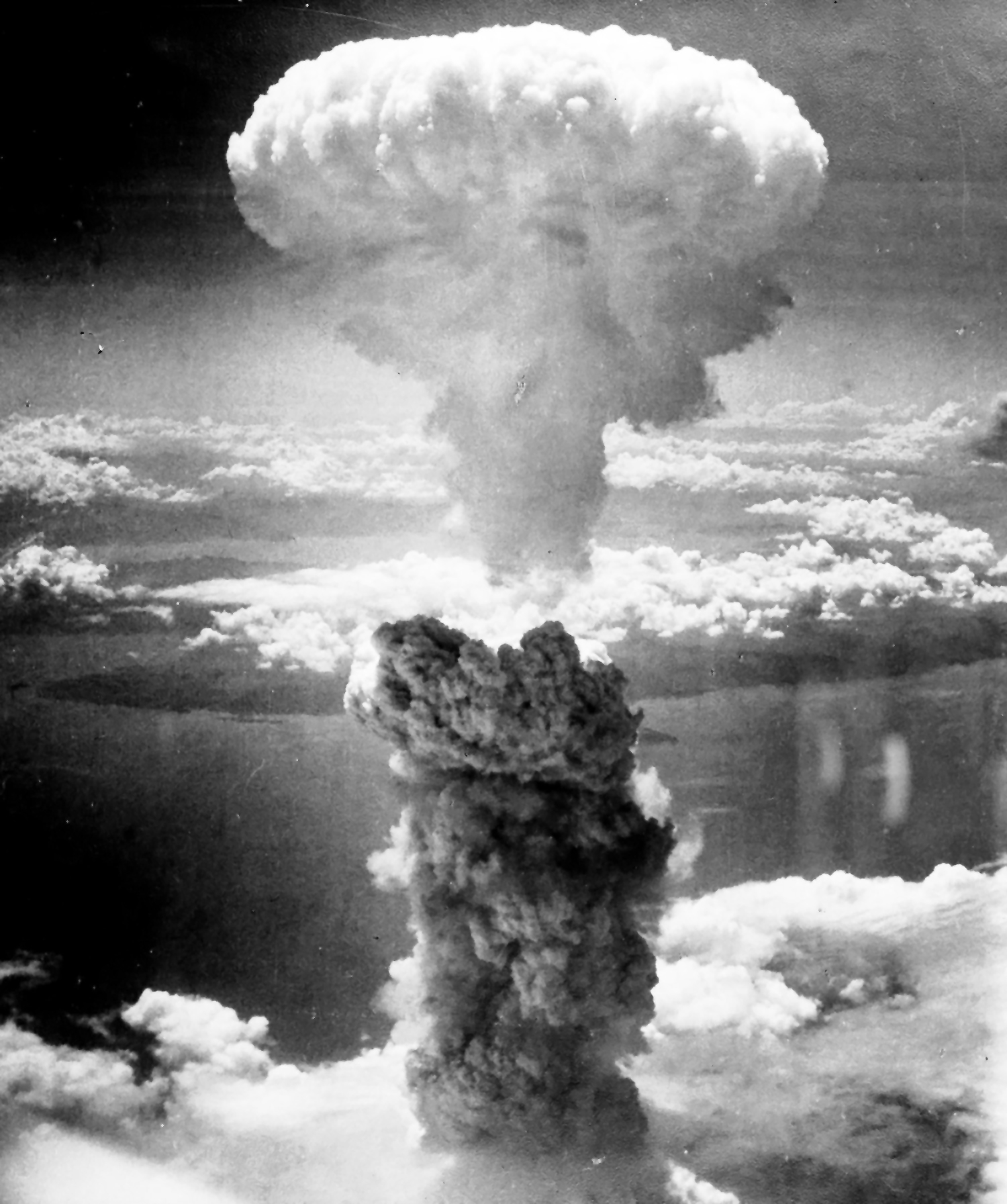
The Fat Man was released over Nagasaki by the U.S. B-29 Super Fortress Bomber BocksCar, on the 9th of August in 1945 at about 10:58 a.m. The bomb had plummeted down to earth from a height of 30,000 feet and imploded after 43 seconds of free falling at 1,650 feet.
Although the bomb had missed its designated landmark, the explosion is estimated to have killed between 40,000 to 70,000 people and level half of the city’s surface area.
While the Fat Man was a more powerful weapon than the uranium Little Boy and had yielded a better fission (approximately 17%), the presence of hills and less inflammable objects on the ground had stemmed its enormous power and limited the destruction.
Inspiration behind the Fat Man’s code name.
The bomb is said to have been named after Winston Churchill, inspired by his lumpish appearance. The Little Boy was named after Harry Trueman and an early prototype known as the Thin Man, after Franklin Roosevelt.
The uranium based Little Boy had replaced the Thin Man as a gun-type fission weapon while the Fat Man with its implosion based trigger had succeeded the Thin Man as a plutonium bomb – developed under enormous pressure to bring the war to an end, and to make up for the millions of dollars that were invested in harvesting plutonium.
Almost identical to the Trinity Gadget – which was detonated in July 1945, the bomb was scheduled to be dropped over the city of Kokura on the 11th of August in 1945.
Forecast of bad weather, however, had led the 509th Bomber Squadron, in charge of the mission, to advance the date to the 9th of August in 1945.
Over Kokura, dense smoke and limited visibility had led the crew to further alter plans and make their way for the alternate target of Nagasaki.
The bomb that brought WW2 to an end.
Though it is said that more atom bombs were in the pipeline and intended for use against Japan, the nation’s surrender on the 14th of August in 1945, makes the Fat Man, the atom bomb to bring Word War II to an end.
The photo.
This photo shows technicians of the Project Alberta placing the Fat Man atom bomb in a trailer cradle in front of Assembly Building 2 at the North Field airbase on Tinian island. The original caption affixed to the photo reads: FM (Fat Man) unit being placed on trailer cradle in front of Assembly Building #2.
The photo is archived by the National Archives Catalog.It is a part of a collection of photos titled, Photographic Prints of Atomic Bomb preparation at Tinian Island 1945-1945.
A division of the Manhattan Project, the technicians of Project Alberta had comprised of military and civilian personnel. The division was tasked with the transportation and onsite assembly of the atom bombs on Tinian island.
The photo may have been produced by a technician or a photographer assigned by the U.S. War Department to document the event.
I F I This is an independent story highlighting this featured Vintage photo of the plutonium Fat Man atom bomb from 1945. The story also sheds light on the specifications of the Fat Man atom Bomb and when it was dropped over Nagasaki. It has been created from facts curated from literary sources and historical documents. I