
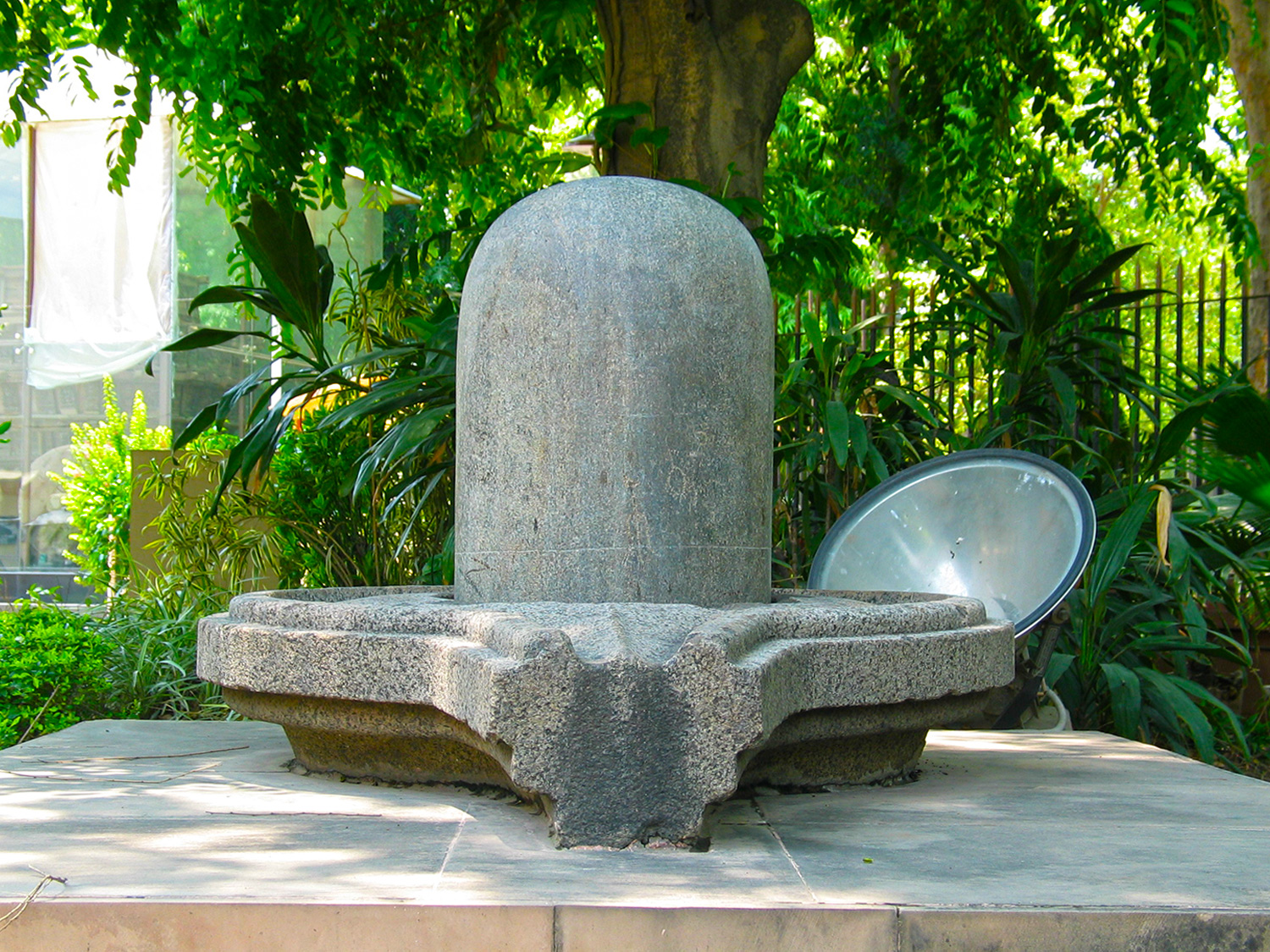

While the Lingam continues to be a topic of debate between scholars and researchers out to decipher its real nature, as to whether it was indeed conceived to represent a phallic object, or was a ceremonial pillar that somewhere down the lane lost its true significance or perhaps, as seen from the air, stood as a symbol of an eye that served some unknown purpose in the obscure past.
For the subjects of the Vijaya Nagara empire that lasted some three centuries in the southern half of India as a powerful island of Hinduism surrounded by a sea of Islamic kingdoms, it was a sacred object of worship related to their patron god Shiva and revered in sculpted stones of hefty dimensions such as the one that was excavated in Hampi, now in the Indian state of Karnataka.
A mythological account of the Shiva Lingam from the Skanda Purana.
In the Skanda Purana, a scriptural composition of 81,000 verses compiled by Vedic writers in what is speculated to be the 8th century CE, there is an amusing account of how the Lingam came to be.
It once so happened, narrates the ancient scriptures, Brahma, the creator of the Vedic universe was participating in a ceremonial rite at an auspicious hour and had desperately needed by his side, his consort Saraswati – the goddess of speech, learning and science.
Saraswati, however, was not a woman to be ordered around, even if her spouse happened to be an important member of the supreme trinity. Engaged in maquillage and dressing, she had send word to Brahma that she wasn’t ready to enter the ceremonial hall, especially when the wives of the other gods had not yet come.
This had enraged the impatient Brahma for the ceremonial rite had required the presence of husband and wife and the auspicious hour was soon to pass.
Turning to Indra, he had commanded the king of the Devtas, to beget him a second wife from where ever he could find a maiden of marriageable age. Indra in haste had seized and brought in Gaytri, a young and beautiful milkmaid, he had found walking with a jarful of butter.
No sooner had the wedding taken place with Vishnu giving away the bride’s hand in marriage, there had appeared the wives of the other gods with Saraswati in their midst, and after having witnessed what had occurred in her absence, she had flown into a terrible rage and cursed all those who partook in the wedding.

Farbound.Net Digital Greetings Digital for Compliments, featuring a Shivalingam.
Buy Online. Send Online.
Looking at Brahma she had fumed, “as you have partaken in such a vile act henceforth no temple of you will exist, no idol of you will ever be seen and you’ll be worshipped only once a year”.
To Indra she had said, “as it was your hands that brought in the milkmaid, so shall your hands be bind in chains and you will be made a prisoner by your enemies in a strange land with all your possessions coveted”.
Turning to Vishnu she had uttered, “as it was you who gave away his woman’s hand in marriage so shall the sage Brighu condemn you to suffer by being born in the world of men, and have your wife ravaged by your enemy”.
Finally, onto Shiva, she had pronounced, “as you pride yourself in your virility, so shall the holy sage also condemn you to be deprived of your manhood”.
Gayatri alters Saraswati’s Curse.
But after Saraswati having poured forth her rage had stormed out of Bhrama’s abode with the other wives of the Gods, the milkmaid Gayatri, newly wedded to Brahma and now his second wife, had stepped in and to the relief of all the gods present altered the curse for a happier ending.
To Brahma, she had said, “even though no temple of you will henceforth be built nor your idol ever seen, you will be continued to be worshipped and receive ablutions”.

To Indra, she had uttered, “even though you will be chained and made prisoner by your enemies in a strange land and have all your possessions coveted, your sons will bring about your release”.
To Vishnu, she had promised, “even though you will be condemned to be born in the world of men, and your wife will be ravaged by your enemies, you will regain her in the end”.
Finally, to Shiva she had assured, “even though you will be deprived of your manhood, it will be universally worshipped in place of you”.
Account from the Padma Purana.
The Padma Purana, compiled by another generation of Vedic writers, after a gap of some centuries, depicts Saraswati as a more submissive woman.
In this account, Saraswati not only forgives her husband Brahama for marrying a second time but also lectures his second wife, Gaytri, that the role of a dutiful wife is to always abide by her husband’s wishes.
Signifying perhaps, and as the author of the ‘Hindu Mythology’, W.J. Wilkins himself theorized, the accepted role for women of that age – see the Farbound.Net story, The fruit of an Englishman’s Curiosity.
Or perhaps this account is simply a writer’s fantasy and his endeavour to create a new role model for the ideal wife.
Account from the Shiva Purana.
In the Shiva Purana, yet another compilation of scriptures to be produced down the line, the curse is more prominently attributed to Brighu, a learned and great sage known for his divine powers and propensity to bring suffering upon the gods.
In this compilation, this sage puts all three gods to the test and finding their responses not satisfactory condemns them to the same suffering as mentioned in the earlier Puranas.
Brahma is never to be worshipped in a temple. Vishnu is to be reborn in the world of men and have his wife stolen by his enemy. Shiva is to be deprived of his manhood – for instead of attendance to the sage, this God had preferred the amorous embrace of his wife, Parvati.
Vedic Puranas.
The Vedic Puranas literally translated stand to mean ‘old scriptures’ and are considered an important aspect of Hinduism. Each is a composition of legends, myths, tales of gods and goddesses.
These scriptures have been build upon and updated by succeeding generations of Vedic writers editing older thoughts, weaving in new themes and morals into the fabric as per their times and preferences, while ensuring synergy with other existing versions.
As is evident from the mythological origin of the Shiva Lingam.
From a historical perspective, the Puranas allow one to chart the development of Hinduism’s gods and goddesses as well as reveal the presence and growth of the Vedic clans, the lives they led and their beliefs.
Shiva and Shiva Lingam.
The concept of Shiva as a deity and the Shiva Lingam is known to existed during the period of the Harappan civilization, based on excavations and archeological finds. Leading to the possibility that the ‘deity’ and the ‘object’ may have been adopted by the Vedic clans upon their arrival in the subcontinent and after a point in time meshed together in the same narrative.
In which case the actual purpose of the ‘object’ we know as the Shiva Lingam, remains unknown. In the current age, however, the Shiva Lingam is accepted as a phallic object. Together with the ‘Yoni’ usually in the shape of a Vulva, and on which it is placed, it represents the union of man and woman, and in the larger sense creation, regeneration and the universe.
I F I This is an Independent Story highlighting the mythological origin of the Shiva Lingam as a phallic object. It has been created out of facts curated from literary and historical sources. In the updated version Matysa has been updated to Skanda Purana. The Shiva Lingam featured in this story comes from the 15 century and was produced during the period of the Vijayanagra Empire. It is on exhibit at the National Museum in Delhi. I






Thank you for your comment. However, during the evolution of the Vedic Puranas, Saraswati has been predominantly linked to Brahma. In some versions, she is his daughter, as he created her out of his own intellect. In others his spouse. In another earlier version of the Puranas compiled by a different set of Vedic writers Lakshmi and Swaraswati are both the wives of Vishnu. In relation to the story of how the early Vedic societies interpreted the Lingam, Saraswati is the first wife of Brahma and his second is Gaytri. Savitri and Saraswati by this stage was considered the same as later. Vishnu’s consort is now more commonly accepted to be Lakshmi.
Make your facts right.
सरस्वती विष्णु पत्नी हैं, ब्रह्माजी की पत्नियाँ सावित्री और गायत्री हैं।