
A 19th century stone sculpture from South India depicts the ‘Vaishnavi’ deity ‘Narishima’ sitting crossed legged like a yogi on a raised stone pillar. A panel next to it reveals it to be the ‘Yog Narshima’ – one of the less ferocious forms of a protector deity that was conceived during the development of ‘Vaishnavism’ in India.
Origin of Vaishnavism.
‘Vaishnavism’ is a stream of Hinduism that proclaims ‘Vishnu’ as the supreme deity of the universe, and propagates for his acceptance and worship. It is defined as a ‘Bhakti’, faith based, movement that lets one commune with the divine (‘Vishnu’) on a one-on-one and personal basis to attain spiritual salvation. There is, however, no clear consensus on when ‘Vaishnavism’ emerged in the Vedic timeline.
A broad range puts the general appearance of this tradition to between 700 to 400 Bce – a tercentenary that was preceded by shifts in beliefs and philosophies, and saw the appearance of the ascetic religions of ‘Jainism’ between 900-800 Bce and ‘Buddhism’ in 600 Bce.
Vaishnaism is the name given to the Bhakti religion which recognizes Vishnu, also called Bhagvat (the blessed one), Purushottma (supreme one), Narayana, Hari as the sole God. He is defined as the Unborn (Aja) and the eternal (Sasvata). He is the creator (Dhata), embodiment of immortality (Amritam), the father and the mother and the Eternal Preceptor of the universe.
Hem Chandra Raychaudhuri, Early History of the Vaishnava Sect.
‘Vaishnavism’ is widely believed to have started as a non-vedic tribal movement in this time frame of 700-400 Bce, before its assimilation and amalgamation into the Vedic system of belief.
Factors that led to its incorporation are obscure but it is generally assumed it was at a pivotal point in Vedic history and when denizens of the early Vedic society had grown disenchanted with old Indo-Aryan rituals, practices and Brahman hegemony, yet had craved spiritual salvation.
It is also believed, this denomination had appeared in Vedic religion, possibly, as a solution to draw into its fold both Vedic and non-Vedic people in an attempt to offset the social, ideological and political challenges that were thrust upon it by the massive popularity of ‘Buddhism’ – a religion that was started by the Shakya sage, Siddhartha Gautama.
This new religion of ‘Buddhism’ was part of the ‘Shramana’ movement, and had rejected the authority of the Vedic texts, rituals and dominance of the Brahman priests. Furthermore, it had also advocated social equality by omitting from its doctrines, the birth based ‘Varna’ system, and thus gained massive popularity among the non-Brahmanical Vedic masses.

Romila Thapar, a noted historian and author on early Indian culture, suggests that it may indeed have been the case. Thapar posits, that ‘Buddhism’ had not only challenged the established social hierarchy and the religious authority of the Brahman caste but the heterodox sect had also presented a very real threat to the Vedic socio-religious order, and which in turn had led to a long period of intense sectarian competition, polemics, and occasional state-backed friction.
The late historian Dwijendra Narayan Jha, was yet another strong advocate of this hypothesis. Jha had strongly claimed that early Hinduism was immensely hostile towards ‘Buddhism’, and in his book, Against the Grain, he had argued that the Brahmanical system had attacked Buddhism for its anti-ritualistic, anti-caste philosophy that had threatened the hold of the Brahmans.
Keeping with the same line of thought, Arthur Llewellyn Basham, a British historian and Indologist, had argued that the Vedic religion had survived and outlasted ‘Buddhism’ through a process of synthesis. By absorbing ‘Buddhist’ elements like ‘Ahimsa’ and incorporating the ‘Buddha’ into the Hindu pantheon as an avatar of ‘Vishnu’, it had regained back its popularity and devotes.
Several archeologists including the Hinduvata historian and author, Koenraad Elst believe both Vedic religion and ‘Buddhism’ had coexisted peacefully and that reports of violent Hindu-Buddhist persecutions are largely sectarian exaggerations from ancient texts – and which leads one to assume Vedic religion may have evolved with changing times and preferences.
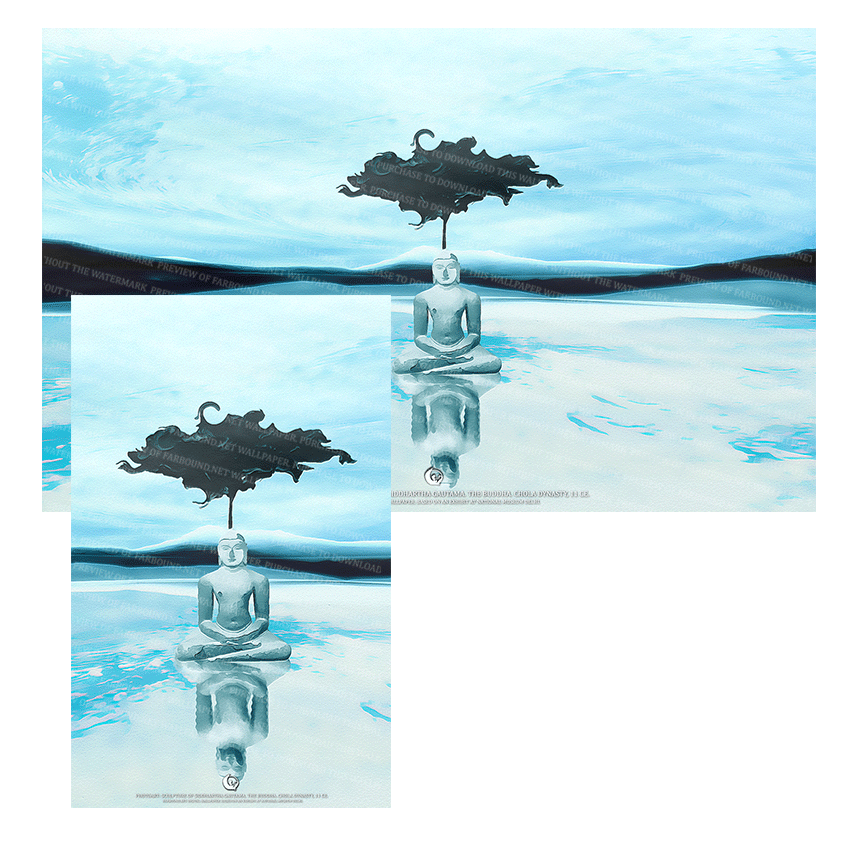
Digital wallpapers for Desktops and Mobile Phones by Farbound.Net ft Buddha.
Actual Dimension: 1200 x 1203 pixels.
However, and even if we do consider that some degree of hostility may have inevitably existed between the competing religions, it is highly doubtful, ‘Vaishnavism’ was a concentrated effort in the initial stages – spearheaded by a committee of Vedic sages in conference and who had jointly produced a plan for its development.
On the contrary, there is good evidence, that ‘Vaishnavism’ had emerged gradually and locally within the Vedic sphere. As the early Vedic populace had begun to sway in their devotion to Vedic rituals, it is possible stray Brahman priests observing trends, had begun to incorporate popular elements into the Vedic belief system and also modify existing and sometimes undesirable aspects of the Vedic religion.
This is indubitable, because by 500 Bce, ‘Vaishnavism’ had not achieved enough importance to be inducted into Vedic literature. ‘Valmiki’s’ original poem, the epic ‘Ramayan’ that was composed in this time frame is free of even the subtlest hint of ‘Vaishnavi’ influence. In 500 Bce ‘Rama’ was still a mortal and not an avatar of ‘Vishnu’ – like he became after 200 Bce.

The implication is also significant for it reveals, ‘Buddhism’ was not yet that big a threat to Vedic religion as it was later between 300 Bce-100 Ce, under the patronage of kings and emperors – and after having been established as a moral and political force by the Mauryan emperor, Asoka.
Patronage of Buddhism and transformation of the early Vedic religion, 300 Bce -100 Ce.
A concentrated effort in preserving the Vedic religion had very likely begun during this period of Buddhist dominance under the patronage of Asoka and his successors. In order to ensure the survival of the religion and its priestly guardians, drastic changes were necessary, and thus the transformation of a part of the Vedic religion into ‘Vaishnavism’ had gained more prominence.
Yet it was only during the reign of the Gupta emperors, sometime between 400-600 Ce and almost 1200-1500 years after its appearance, had ‘Vaishnavism’, become a dominant sect of Hinduism – that too backed by royal patronage.
The ‘Puranas’ with their hyperbolic legends had greatly facilitated its consolidation supported by Vedic literature that had emerged en route.
For example, the expanded edition of the ‘Mahabharata’ that was composed between 400 Bce and 400 Ce, had helped establish the popularity of the non-vedic ‘Krishna’ and his association with ‘Vishnu’ in the Vedic world.
Vedic texts like the ‘Shatapatha Brahmana’ of the ‘Yajurveda’ had provided ‘Vaishnavism’ with the content for its legends. The ‘Chandogya Upanishad’ had shaped its Ahimsamatic and vegetarian aspect, while the ‘Vaishnava Upanishad’ had endowed it with its philosophical and theological framework.
Additionally, Yaksha’s ‘Nirutkata’ had defined for it in clear terms the all pervading nature of ‘Vishnu’s’ name. Contributions had also flowed in from the ‘Taittiriya Samhita’ of the ‘Yajurveda’,‘the Taittriya Aranyaka’, and the ‘Taittriya Brahmana’.
Thus, ‘Vaishnavism’ is generally believed to have emerged as a response to ‘Jainism’ and ‘Buddhism’ – although, and if we go back to its obscure origins, it is possible it was simply a theological and cultural evolution shaped by changing times, and that had simply accelerated down the road.
During a long and complex development, many Vaishnava groups emerged with differing beliefs and aims. Some of the major Vaishnava groups include the Shrivaishnavas and Madhvas of South India; the followers of the teachings of Vallabha in western India; and several Vaishnava groups in Bengal in eastern India, who follow teachings derived from those of the saint Chaitanya. Most Vaishnava believers, however, draw from various traditions and blend worship of Vishnu with local practices.
Dr. Uday Dokras, historian, scholar, author and researcher.
Growth of Vaishnavism from Vasudeva to Purusa Narayana.
According to the Indologist Ramchandra Narayan Dandekar, ‘Vaishnavism’ did not originate from traditional Vedic beliefs but was a merger of non-Vedic traditions, and had emerged shortly before Vedic society had fully transitioned from tribal Janapadas (Vedic chiefdoms) into Mahajanapadas (Vedic kingdoms) during what was the second phase of Vedic urbanization in 600 Bce.
Dandekar explains, that in the initial stage ‘Vaishnavism’ was known as ‘Vasudevism’ and had revolved around the worship of ‘Vasudeva’, a cult figure of the ‘Vrishni’ tribe which had originally dwelled in the ancient region of Surasena (present day Mathura) but had later migrated to the region of Kushasthali /Dwaravati (Dwarka) in the Anarta kingdom. In the expanded ‘Mahabharata’ the tribe is described as the foe of the Magadhan king, Jarasandha.
Dandekar posits, this ‘Vasudeva’ was later merged with ‘Krishna’, a hero of the ‘Yadava’ tribe to become ‘Vasudeva-Krishna’. The amalgamation was possible because the ‘Vrishni’ and ‘Yadava’ were close allies. Farther ahead in time, ‘Vasudeva-Krishna’ was merged with ‘Bala Gopala’, a cult figure of the Abhıras, a tribe of cowherds.
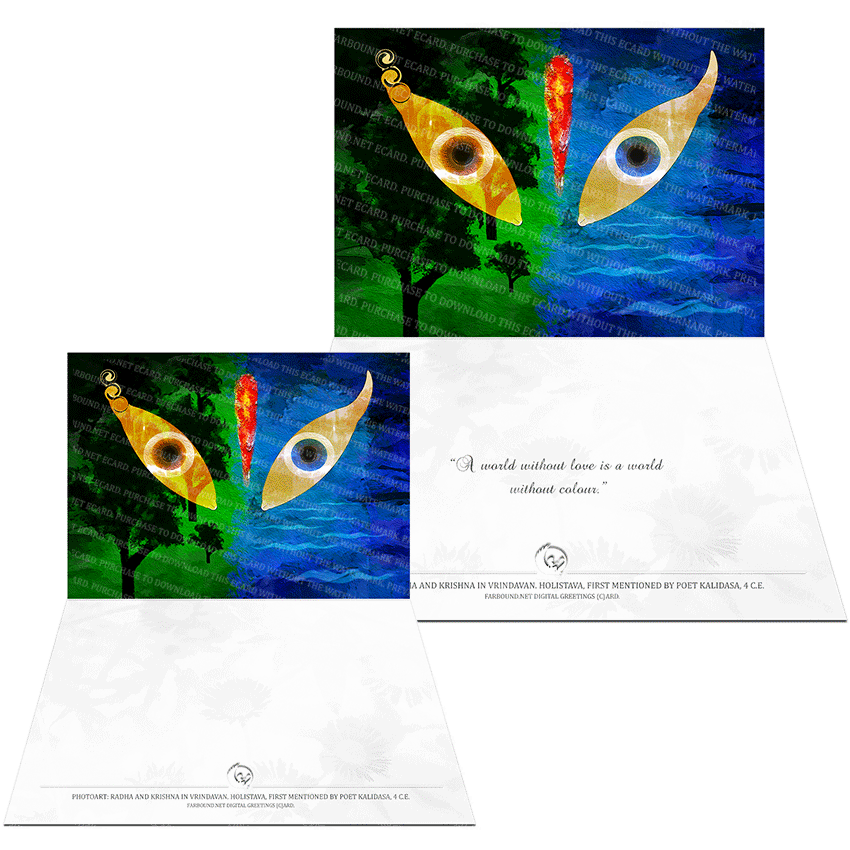
Digital Greetings Cards for Goodwishes by Farbound.Net ft Radha and Krishna.
Actual Dimension: 1200 x 1203 pixels.
These mergers were then absorbed by the Rigvedic ‘Vishnu’, and accordingly the non-Vedic cult of ‘Vasudeva-Krishna-Gopala’ had been drawn into the Vedic fold.
Devaluation and depreciation of the popular tribal figures into parts and subordinates of the great ‘Vishnu’ was necessary since Vedics were uncomfortable with the worship of non-vedic deities and the supremacy of the Vedic religion had to be maintained.
Much, much later, and during the composition of the expanded ‘Mahabharata’, the legends of ‘Nara-Narayana’ was additionally pulled into the evolving concept of ‘Vishnu’. ‘Nara-Narayana’ were a duo of celestial sages, worshiped in Badari on the northern ridge of the Hindu-Kush.
In Sanskrit, ‘Nara’ means man and ‘Narayana’ stands for the divine. In the cult of ‘Nara-Narayana’, the sages represented the link between man and god. The twin sages were inducted into Vedic lore as ‘Purusa Narayana’.
Vaishnavism and the epics.
It is interesting to note that while ‘Vaishnavism’ appeared almost two hundred years before ‘Valmiki’ composed the ‘Ramayana’ in 500 Bce, ‘Valmiki’s Rama’ is not an avatar of a Vedic deity with godly powers but simply a mortal – albeit a cool and composed heroic warrior.
It is only in the later appended ‘Bala Khanda’ and the ‘Uttra Khanda’ composed between 200 Bce and 200 Ce, does one find the influence of ‘Vaishnavism’ in the epic with ‘Rama’ being described as an avatar of ‘Vishnu’.
The Mahabharata is of vital importance for the history of Vaishnaism, for it is the earliest work indicating the rise of devotional cults and giving a sectarian account of the Vaisnavite divinities of Vasudeva-Krsna, Narayana and Vishnu.
Suvira Jaiswal, lecturer of history at Patna University and author of the origin and development of Vaishnaism..
The ‘Mahabharata’, on the other hand, is often considered to the platform that power boosted the concept of ‘Vaishnavism’. Comprising of the foundational ‘Jaya’, the ‘Bharata’ and the expanded ‘Mahabharata’, the epic poem was composed between 400 Bce and 400 Ce – roughly 300 years after the postulated appearance of ‘Vaishnavism’.
In the third installment of this epic poem, the expanded ‘Mahabharata’, is the ‘Bhagavad Gita’, a book of 18 chapters and 700 verses – out of which 575 verses are specifically associated with the personality of ‘Krishna’.
In chapter 10, the ‘Vibhuti Yoga’, verse 21 has ‘Krishna’ introducing himself with the following words: Among the Adityas I am ‘Vishnu’, among lights I am the radiant sun.

Vaishnavism and the Upanishads.
The ‘Upanishads’ are a large collection of verses that appear at the end of all four Vedic canons. Namely, and in chronological order of their composition, the ‘Rigveda’, the ‘Yajurveda’, the ‘Samaveda’ and the ‘Atharvaveda’. In all four canons, they are referred to as the ‘Vedanta’ to signify the ending. In total there are 108 Upanishads.
Among these 108 Upanishads, the ‘Chandogya Upanishad’ and the ‘Vaishnava Upanishad’ is thought to have profoundly influenced the development of ‘Vaishnavism’. The ‘Chandogya Upanishad’ was composed between 800-200 Bce and is the ending portion of the ‘Samaveda’. It has eight chapters and 625 verses – and is the first Vedic text to mention the concept of ‘Ahimsa’.
During the development of ‘Vaishnavism’, the popularity of the ‘Buddhist’ interpretation of non-violence had led to the inclusion of the Vedic concept of Ahimsa in the ‘Vishnu’ faith.
The ‘Vaishnava Upanishad’ is a later ‘Upanishad’ and was composed between 100 Bce and 1500 Ce. It comprises of 14 minor passages that are injected into the framework of existing ‘Upanishads’ to form the ‘Vedanta’ of the ‘Yajurveda’, the ‘Samaveda’ and the ‘Atharvaveda’.
Out of these 14 passages containing theological philosophies and hymns for attaining spiritual freedom, the ‘Krishna Upanishad’, the ‘Gopala Tapani Upanishad’, the ‘Nrisimha Tapani Upanishad’, the ‘Hayagriva Upanishad’, and the ‘Dattatreya Upanishad’ are to be found in the ‘Atharvaveda’.
While the ‘Vasudeva’ and ‘Avyakta ‘Upanishad’ are part of the ‘Samaveda’ and the ‘Narayana’ and ‘Kali Santarana Upanishad’ are attached to ‘Yajurveda’.
Collectively these 14 ‘Vaishnava Upanishads’ lay out the theological and philosophical foundation for the worship of ‘Vishnu’. They elevate him to the status of the Braham, and declare him as the supreme god of the Hindu pantheon.
Furthermore, they also weave in together the locally merged personalities of Vasudeva, Krishna, Gopala, Purusa Narayana as the avatars of Vishnu – in addition to Rama and the Buddha.
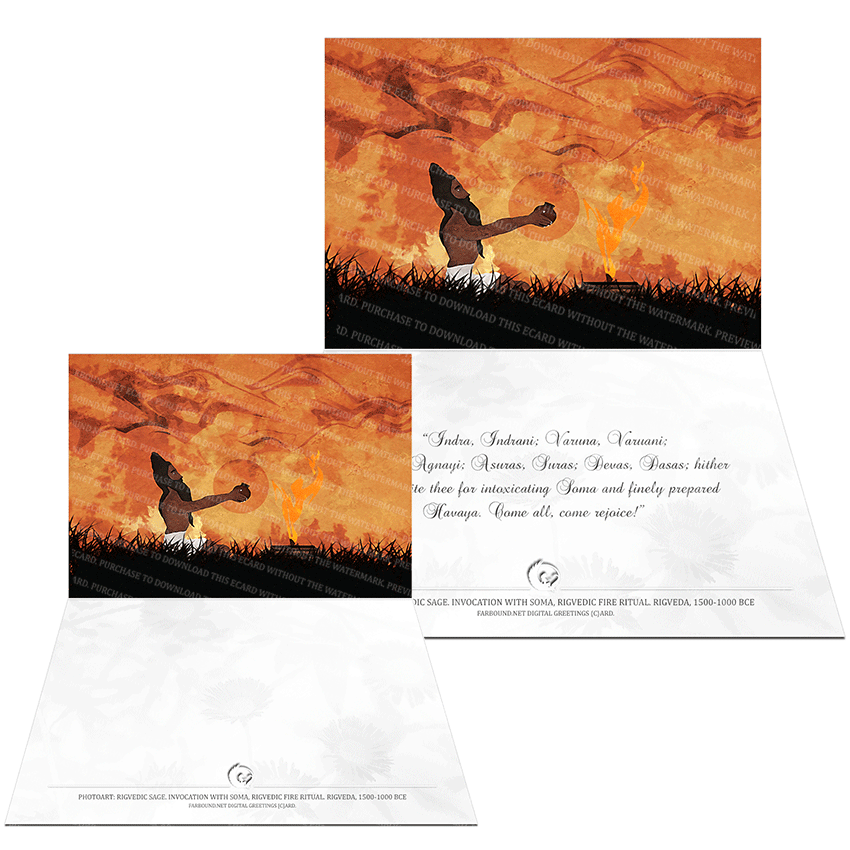
Digital Greetings Cards for Invitations by Farbound.Net ft Rigveda fire ritual.
Actual Dimension: 1200 x 1203 pixels.
Origin of Vishnu.
The earliest mention of ‘Vishnu’ is to be found in the hymns of the ‘Rigveda’, the first of the four grand Vedic canons. Composed between 1500 Bce and 1000 Bce, the ‘Rigveda’ doesn’t just predate the ‘Yajurveda’, the ‘Samaveda’ and the ‘Atharvaveda’ but also the later ‘Brahmanas’, the ‘Aranyakas’ and the ‘Upanishads’.
Moreover, the ‘Rigveda’ also predates, and by a wide margin of centuries, the ‘Ramayana’, the ‘Mahabharata’ and the ‘Puranas’ that came into existence between the 300-1000 Ce.
In this ancient Vedic corpus, ‘Vishnu’ is described as a celestial deity concerned with the wellness of all living beings. Besides this intrinsic character trait, he is also widely exalted and venerated for his three celestial steps known as the ‘Trivikrama’ – and which is mentioned several times in the Vedic canon.
In hymn Rv 1:22, ‘Vishnu’ is further described as a guardian who cannot be deceived, and a close ally of ‘Indra’. This hymn additionally acquaints us with ‘Vishnu’s’ abode, which is the most sublime and laid out like an eye in the heavens – read the complete hymn at the: Internet Sacred Text Archive
Indrani, Varuani, and Agnayi hither I invite, for weal, to drink the Soma juice. May Heaven and Earth, the mighty pair, bedew for us our sacrifice, and feed us full with nourishments. Their water rich with fatness, there in the Gandharva’s steadfast place, the singers taste through sacred songs. Thornless be thou, O Earth, spread wide before us for a dwelling-place – vouchsafe us shelter broad and sure. The Gods be gracious unto us even from the place whence Visnu strode through the seven regions of the earth. Through all this world strode Visnu; thrice his foot he planted, and the whole was gathered in his footstep’s dust. Visnu, the Guardian, he whom none deceiveth, made three steps; thenceforth establishing his high decrees. Look ye on Visnu’s works, whereby the Friend of Indra, close-allied, hath let his holy ways be seen. The princes evermore behold that loftiest place where Visnu is, laid as it were an eye in heaven. This, Visnu’s abode most sublime, the singers, ever vigilant,
Rigveda, Book 1, Hymn Rv 1:22
lovers of holy song, light up.
Overall, ‘Vishnu’ is mentioned close to 93 times in the ‘Rigveda’ and is venerated with five hymns. Four out of which are dedicated solely to ‘Vishnu’ while the fifth is dedicated to ‘Vishnu’ and ‘Indra’.
His description in the ‘Rigveda’ has prompted several scholars to identify him as an early solar deity and his three celestial steps as the rising, culmination and setting of the sun – and in regard to which it must be pointed out that in medieval times, ‘Vishnu’ was worshiped as ‘Surya-Narayana’ and still is in parts of modern India.
Many scholars also posit that ‘Vishnu’ was a minor deity during the period of the Rigveda. Among them are the Indologists Arthur Anthony Macdonell and A.B Keith, who on the basis of the insignificant number of ‘Rigvedic’ hymns associated with ‘Vishnu’ and his description as ‘Upendra’ (younger/junior) suggest he was a deity of lesser importance and was subordinate to Indra, the leading deity of the Vedic pantheon at the time.
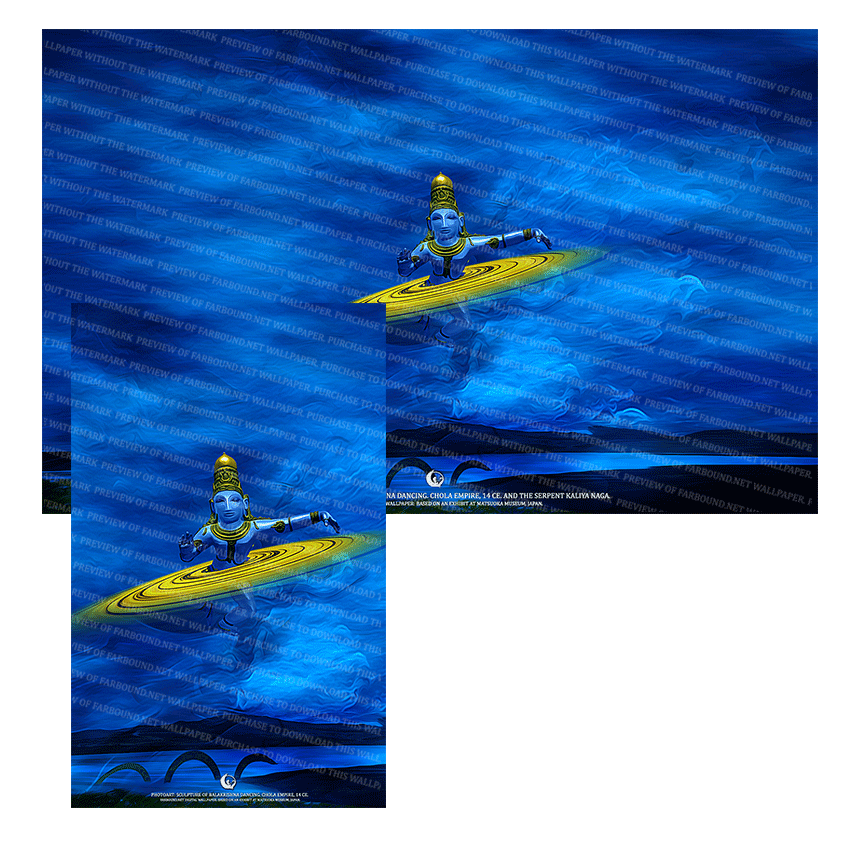
Digital Wallpapers for Desktops and Mobile Phones ft Bala Gopala and Kaliya Naga.
Actual Dimension: 1200 x 1203 pixels.
These scholars hold the opinion that it was only with the passage of time and the appearance of ‘Vaishnavism’ had ‘Vishnu’ grown in importance and finally transitioned into a major Hindu deity.
To elucidate, out of a total of 1,028 hymns in the ‘Rigveda’, ‘Indra’ has approximately 250 dedicated hymns. ‘Agni’, close 218 dedicated hymns and ‘Varuna’, 46 dedicated hymns. ‘Vishnu’ has only five.

Additionally, and if are to abide by the canon’s description of deities, ‘Vishnu’ is most certainly not as popular as ‘Indra’, ‘Varuna’ or ‘Agni’. Nor is he as exalted as the riverine Saraswati, the beloved deity of the Rigveda Aryans – see the Farbound.Net story: The indomitable Saraswati: From a river to a strong willed independent woman, the evolution of a Rigveda deity.
The hypothesis of ‘Vishnu’ being a minor deity during the ‘Rigveda’ period, however, is not collectively agreed upon. The Indologist Jan Gonda, for instance, refuted the hypothesis in 1954 with the publication of his seminal book ‘Aspects of early Visnuism’.
In the book Gonda had challenged the notion by stating ‘Vishnu’s’ infrequent mentions masked his real popularity and that he was already a prominent deity among both the Indo-Aryan and non-Aryan people in the early Vedic times.
In 1989, the German scholar of Hinduism, Klaus Klostermaier, had further reinforced Gonda’s view with his work ‘A survey of Hinduism’ – and in which he noted that the ‘Rigveda’ does not represent, the entirety of early Vedic religious life.
Vishnu in Vedic texts produced after the Rigveda.
How ‘Vishnu’ managed to leapfrog over the likes of ‘Indra’, ‘Agni’ and ‘Varuna’ is hard to understand unless one considers Gonda’s assumption that ‘Vishnu’ was more popular than his mentions and description in the ‘Rigveda’.
Furthermore, parallel to Rajesh Kocchar’s cogent explanation regarding the transfer of ‘Saraswati’s’ epithets to the ‘Ganga’ later in the Vedic timeline, Gonda’s conjecture also suggests that with the passage of time ‘Vishnu’ too had acquired the traits of ‘Indra’, ‘Mitra’, ‘Varuna’ and ‘Savitr’.
According to Gonda, Vedic deities were not rigidly defined individuals, but endowed with fluid roles that overlapped and had transferable virtues.
Thus, in the Brahmanas, that appeared between 900-700 Bce as explanations of the Veda Samihitas, one finds ‘Vishnu’ elevated to the highest rank that could be bestowed to a celestial. In this period, he was no more the subordinate of ‘Indra’ and a peripheral sun deity but the guardian of Vedic sacrifices and sacrifice itself – often referred to as ‘Yajno Vishnuh.’ The Brahmanas had emerged some 100 years after the ‘Rigveda’ period, and close to the time frame that witnessed the appearance of ‘Vaishnavism’.
Among the 19 surviving Brahmana texts, the ‘Shatapatha Brahmana’ of the ‘Yajurveda’ is widely considered to have influenced the growth of ‘Vaishnavism’ and the later ‘Puranas’. Composed between 800 and 300 Bce, ‘Shatapatha Brahmana’ comprises of instructions, philosophies, older tales and legends of deities. This book contains the evolutionary roots of characters that were borrowed, transformed and developed in the later ‘Puranas’.
In the ‘Nirukata’ that was composed by the sage Yaskacharya between 700 and 500 Bce, one finds the word ‘Vishnu’ defined as the ‘all pervading one’. The ‘Nirutkata’ is essentially a running commentary on the ‘Nighantu’ – an older book of Vedic glossary that predates it. Its content is dedicated to the etymological, philological and correct interpretation of Vedic words. The composition of the ‘Nirukata’ shares the time frame as ‘Vaishnavism’ but is likely to have been composed after its appearance.

Digital Greetings Cards with words of wisdom by Farbound.Net ft Valmiki’s Rama.
Actual Dimension: 1200 x 1203 pixels.
However, though ‘Vishnu’ does appear in several Vedic texts after the end of the Rigveda period, the major works that solidified ‘Vaishnavism’ and his status as a super god beyond reproach was the ‘Upanishads’ and the ‘Puranas’.
While the ‘Upanishads’ had laid out the foundational theological philosophies between 800 Bce and 1500 Ce, the ‘Puranas’ had fleshed out and transformed these foundational elements into interesting tales and legends, between 300-1500 Ce.
Among the major 18 Puranas, the ‘Vishnu Purana’ composed between 300-750 Ce, was one of the earliest to be produced and was instrumental in establishing ‘Vishnu’ and ‘Vaishnavism’ as a prominent stream of Vedic religion. The ‘Vishnu Purana’ contains approximately 7,000 verses and is divided into six parts. Its primary focus is on elucidating the concept of ‘Vishnu’ as the supreme god and establishing his ten avatars.
Namely, Matsya, the fish; Kurma, the tortoise; Varaha, the boar; Narashima, the halfman-half lion hybrid; Parusharama, the Brahman sage; Rama, the hero of the Ramayana; Krishna, of the Yadavas; Buddha, the founder of Buddhism; and Kalki.
The ten avatars of Vishnu.
1. In the Puranas, the first avatar of ‘Vishnu’ is the Matsya (fish in Sanskrit): While in early human belief system aquatic life was often though to be the first form of life on earth, in Vedic texts it additionally represented preservation and rebirth. This mythical fish had made its first appearance in the ‘Shatapatha Brahmana’ with the legend of ‘Manu’ and the ‘Deluge’.
Mention of the ‘Deluge’ appears in several cultures around the world. It is to be found in the bible as the ‘Flood of Noah’ and in Sumerian mythology as the ‘Flood of Ziusudra’. The Sumerian account is the earliest known account of the ‘Deluge’ and predates the ‘Shatapatha Brahmana’, the ‘Puranas’ and the ‘Bible’. The ‘Deluge’ also appears in Greek, Chinese and Mayan mythology. It is, however, absent from the Rigveda.
In the ‘Vishnu Purana’, the existing legend of ‘Manu’ and the ‘Deluge’ is slightly altered to present the mythical fish as an avatar of ‘Vishnu’. In earlier versions of the same legend, the fish is a symbol of the creator ‘Prajapati’.
2. The second avatar of Vishnu is the Kurma (tortoise in Sanskrit): In early Vedic religion, the tortoise was a progenitor and the symbol of creation and cosmic stability. It was also symbolically viewed as the solid platform atop which had taken place the Vedic fire rituals. Furthermore, it was additionally regarded as the symbol of the creator ‘Prajapati’ and the cosmic spirit of sacrifice, the Yajna-Purusha.
Prior to its association with ‘Vishnu’, the tortoise had first made its appearance in the ‘Shatapatha Brahmana’ of the ‘Yajurveda’ as the creator ‘Prajapati’. It was equated with the legend of the ‘Saptarishi Kashyapa’, who with his thirteen wives had populated the earth. This cosmic tortoise also featured in the legend of the ‘Samudra Manthan’ or the churning of the cosmic ocean, that was first mentioned in the expanded ‘Mahabharata’.
During the development of the ‘Puranas’ that focused on establishing ‘Vishnu’ and ‘Vaishnavism’, it was incorporated as the avatar of ‘Vishnu.
3. The third avatar of ‘Vishnu’ is the ‘Varaha’ (tusked boar in Sanskrit): The word ‘Varaha’ is to be found in the Rigveda. It is believed to come from the proto Indo-Iranian word ‘Warajha’. The Indo-Iranians were the ancestors of the Iranians and the Indo-Aryans, descendants who later developed the languages of ‘Avestan’ and ‘Sanskrit’.
According to Arthur Anthony Macdonell, an Indologist and Sanskrit scholar, ‘Vishnu’s’ association with the ‘Varaha’ can be traced right back to the ‘Rigveda’, especially to the verses 1.61.7 and 8.66.10. These verses describe ‘Vishnu’ helping ‘Indra’ in stealing a herd of buffaloes from the demon of drought ‘Vritra’ – but who is identified by later scholars as the ‘Asura’ Emusha.
The verses additionally describe ‘Indra’ slaying the ‘Varaha’. Later references in the Rigveda also point to ‘Vishnu’ hunting ‘Varahas’ with dogs. Furthermore, in the Rigveda, Rudra (later Shiva) is referred to as the great ‘Varaha’ of the sky.
In the ‘Taittiriya Samhita’ of the ‘Yajurveda’ the ‘Varaha’ is described as a beast of the ‘Asuras’, a plunder of wealth and guardian of ‘Asura’ riches. It is also a sacrificial animal. The ‘Taittiriya Samhita’ tells us that ‘Vishnu’ is both the bringer of sacrifice (the hunted Varaha) and sacrifice itself, and thus the medium through which the gods acquire the riches of the ‘Asuras’.
Professor J. L. Brockington, an Indologist, reader and head of the department of Sanskrit at Edinburgh university, believes there are not one but two legends associated with the Vedic ‘Varaha’. The first one identifies the boar with the ‘Asura’ Emusha, and the other with the creator Prajapati and later Brahma.
Before becoming an avatar of ‘Vishnu’, the legend of ‘Varaha’ lifting the Earth on its tusks from the bottom of the ocean finds mention in the ‘Shatapatha Brahmana’ of the ‘Yajurveda’, the ‘Taittriya Aranyaka’, the ‘Taittriya Brahmana’ and also the in the later texts of ‘Taittiriya Samhita’ of the ‘Yajurveda’. In the ‘Ramayana’ and the expanded ‘Mahabharta’, the Varaha is associated with Brahma.
However, it is to be noted that despite its varied descriptions, the ‘Varaha’ featured explicitly in Vedic literature. It is possible that during the development of ‘Vaishnavism’, an Ahimsamatic stream of Vedic religion that forbade the slaughter and eating of animals, ‘Vishnu’s’ earlier role of the bringer of the sacrificial ‘Varaha’ was altered to becoming the ‘Varaha’ itself, so as to seamlessly fit into the emerging religion- besides also replacing Parajapati and Brahma as the sole creator of the universe.
5. The fifth avatar of ‘Vishnu’ is the ‘Vamana’ avatar (dwarf in Sanskrit): The legend of the ‘Vamana’ avatar of ‘Vishnu’ draws heavily from the Rigvedic description of ‘Vishnu’ and his three celestial steps.
The dwarf, however, does not appear in the Rigveda, at least as a human. Its first mention is to be found in the ‘Shatapatha Brahmana’ of the ‘Yajurveda. Scholars are of the opinion, this later presentation of a human dwarf, is derived from Vishnu’s association with dwarf animals, particularly the bull – and may have originally meant a ‘dwarfish bull’.
The other names and epithets of ‘Vamana’ are Balibandhana (slayer of the demon Bali), Dadhi-Vamana (the giver and bestower), Trivikrama (one with the three steps), Urukrama (one with the far reaching stride), Upendra (younger to Indra) and Vamanadeva (dwarf god).
In the ‘Puranas’, the ‘Vamana’ legend of ‘Vishnu’ is the only to directly incorporate the ‘Rigvedic’ aspect of ‘Vishnu’s three steps. Although its is also possible the authors of the ‘Puranas’ may have incorporated it from the ready made legend of ‘Vishnu’ in the ‘Shatapatha Brahmana’. The Puranic version differs from the account of the ‘Shatapatha Brahmana’ with its introduction of the demon Bali.
6. Parusharama is the 6th avatar of Vishnu: The Brahman warrior sage was possibly first mentioned in the expanded ‘Mahabharata’, prior to his incorporation in the ‘Puranas’. While this character’s origin is obscure, it may have evolved out of the legend of Nara-Narayana, the two celestial sages who were worshiped in Badari on the northern ridge of the Hindu-Kush.
Nara-Narayan was renamed and introduced in early Vedic literature as ‘Purusha Narayana’, and which may have later evolved into the legend of Parshurama, an avatar of ‘Vishnu’ – there is, however, no concrete evidence of this.
None the less, Parusharama is a unique character and clearly represents the supremacy of Brahmans over the warrior class of the kingly Kshatriyas. His creation and appearance in the Vedic timeline may perhaps have come about during a period of social friction between these two social classes. Throughout Vedic history each had tried to control the other.
His appearance as a ‘Vishnu’ avatar, was perhaps an attempt to suggest Brahmans were the projections of ‘Vishnu’.

Digital Greetings Cards for Goodwishes by Farbound.Net ft Rama as a Vishnu avatar.
Actual Dimension: 1200 x 1203 pixels.
7. The seventh avatar of Vishnu is Rama: The character of ‘Rama’ existed prior to the creation of the ‘Puranas’. The sage ‘Valmiki’ had introduced ‘Rama’ as the main protagonist of his epic poem ‘Ramayana’ in 500 Bce. ‘Valmiki’s’ original ‘Rama’, however, was not a god or an avatar of any god. He was simply a mortal man – albeit a cool and composed heroic warrior.
During the development of ‘Vaishnavism’ and ‘Vishnu’, ‘Rama’ may possibly have been included for his popularity and his kind and benevolent personality. Rama is often portrayed as someone who is always kind towards animals. He is also seen as the ideal king. Legends of ‘Rama’ and ‘Sita’ as the avatars of ‘Vishnu’ and his consort ‘Lakshmi’ respectively, are later additions that emerged during rise of ‘Vaishnavism’.
8. ‘Krishna’, is the eight avatar of ‘Vishnu’: ‘Krishna’ was originally a charismatic figure of the Yadava tribe. During the initial growth of ‘Vaishnavism’ between 700 and 400 Bce, and which was sporadic and a series of local occurrences at best, Krishna was inducted into Vedic lore, possibly to draw in the non-vedic tribe of the Yadavas into the Vedic fold – at a time when the religion was losing worshipers and ground to the new religions of Buddhism and Jainism. He was merged with Vasudeva, a deity or figure of the Vrishni tribe and later with Gopala, a deity of the Abhıras tribe.
Krishna made his presence felt in the expanded version of the ‘Mahabharata’ and was the central character of the ‘Bhagwata Gita’. The expanded ‘Mahabharata’ is widely believed to be the platform that boosted ‘Vaishnavism’, and was developed simultaneously. The Puranic version of ‘Krishna’ as an avatar of ‘Vishnu’ is a more elaborate rendition.

Digital Greetings Cards with Adages from the Pali Dhammapada by Farbound.Net ft Buddha.
Actual Dimension: 1200 x 1203 pixels.
9. Buddha, the ninth avatar of Vishnu: Siddhartha Gautama of the Shakya clan was a religious teacher and the founder of Buddhism, a religion that gained massive popularity among the masses of the early Vedic times for its rejection of rigid ideals. Buddhism was a competing religion, and it is possible the Buddha was inducted into the Vedic system of beliefs to absorb the positive traits of the rival religion and to draw in worshipers who agreed with its philosophies.
The Buddha advocated compassion and kindness to all living beings including animals and representing him as an avatar of ‘Vishnu’ was simply a way for ‘Vaishnavism’ to be seen in the same light.
10. The last avatar of Vishnu: Kalki is the last avatar of ‘Vishnu’ and a prophesied figure. In Hinduism he is predicted to appear at the end of the Kaliyuga, a dark and violent period marked by unrighteousness, chaos, and the decline of moral order. His arrival is said to usher in the end of evil and the beginning of the Satyayuga, the golden age of truth and purity.
Kalki’s earliest mentions appeared in the expanded version of the ‘Mahabharat’ and later in the ‘Puranas’. The ‘Kalki Purana’, composed around 1500-1700 Ce, is dedicated to Vishnu’s Kalki avatar.
It is interesting to note that that appearance of ‘Vishnu’s’ avatars in the ‘Puranas’ corresponds to the scientific evolution of humankind. They begin with the fish/amphibian stage of evolution and gradually proceed on to the human stage – although the ape is left out.
Origin of Narashima.
In ‘Vaishnavism’ ‘Narashima’ is the fourth avatar of ‘Vishnu’ and appears after the ‘Varah’ and before the ‘Vamana’. It is a work of anthropomorphism and presents ‘Vishnu’ as a half-man half lion hybrid.
The name is a combination of the words Nara (man) and Sima (lion). Among all the avatars ‘Narashima’ remains the most enigmatic, in terms of its description and origin. Additionally, its imagery makes it one of most arresting versions of ‘Vishnu.’ How the Vedics arrived at this image of the deity is obscure.
There are, however, streams of thought that attempt to explain the hybrid appearance. These range from non-vedic tribal totems of lions to descriptions in the Vedic texts.
Anncharlott Eschmann, a German Indologist and scholar, believed the image of the hybrid deity had originated from a lion deity or pillar totem worshiped by indigenous tribal groups. In her opinion, these tribes had dwelled in the Deccan and eastern hills.
When it comes to textual residue, it is generally assumed the seeds that led to be creation of the hybrid can be traced to the 154th hymn of the ‘Rigveda’ that describes ‘Vishnu’ as a dreaded wild beast prowling the mountains, there is, however, no specific mention of a lion. Far from it, ‘Vishnu’ is associated with the bull.
I will declare the mighty deeds of Visnu, of him who measured out the earthly regions, who propped the highest place of congregation, thrice setting down his footstep, widely striding. For this his mighty deed is Visnu lauded, like some wild beast, dread, prowling, mountain-roaming; He within whose three wide-extended paces all living creatures have their habitation. Let the hymn lift itself as strength to Visnu, the Bull far-striding, dwelling on the mountains, him who alone with triple step hath measured this common dwelling-place, long, far extended. Him whose three places that are filled with sweetness, imperishable, joy as it may list them, Who verily alone upholds the threefold, the earth, the heaven, and all living creatures. May I attain to that his well-loved mansion where men devoted to the Gods are happy. For there springs, close akin to the wide-strider, the well of meath in Visnu’s highest footstep. Fain would we go unto your dwelling-places where there are many-horned and nimble oxen, for mightily, there, shineth down upon us the widely-striding Bull’s sublimest mansion.
Rigveda Book 1, Hymn 154.
A verse from the ‘Bhagavad Gita’, that constitutes an important part of the expanded ‘Mahabharata’, holds more relevance regarding the hybrid appearance of ‘Narashima’ and its association with ‘Vishnu’.
This verse is the 30th verse to be found in the 10th chapter of the ‘Bhagavad Gita’. In the verse, ‘Krishna’ reveals himself as ‘Prahlada’, ‘Time’, ‘Lion’ and the eagle ‘Garuda’.
It is to be noted, Prahlada, who is a main character of the ‘Narashima’ legend of the ‘Puranas’ is absent in all Vedic texts predating the composition of the ‘Bhagavad Gita. between 500 and 200 Bce, and so is the description of ‘Vishnu’ as a hybrid deity.
In fact, ‘Prahlada’ and the figure of ‘Narashima’ as a half man, half lion hybrid is absent even from the ‘Shatapatha Brahmana’ that predates the ‘Bhagavad Gita’, and from which the later ‘Puranas’ draw much of its content.
Thus, it is possible the mention of ‘Prahlada’ and the ‘lion’ in this verse of ‘Bhagavad Gita’ is what may have led to the creation of the hybrid image of ‘Narashima’ through a process of anthropomorphism – and then inducted in later Vedic texts such as the ‘Nrisimha Tapani Upanishad’ that was composed in 700 Ce and the ‘Puranas’ that were composed roughly between 300-1000 Ce.
While we cannot ruled out that the hybrid image of ‘Narishma’ may indeed have emerged out of tribal totems , there is also clear evidence the Indo-Aryans where very familiar with lions and had revered the big cats for their, power, savagery and strength – especially during the period of the ‘Rigveda’.
This foundational and early Vedic canon abounds with numerous similes of the lion, and that are used to describe deities, prowess and natural events. Like in the case of Rudra (later Shiva), who is described as a dreadful and fierce lion.
Furthermore, during the early period, Asiatic lion were to be found in the regions, forests and mountains of Afghanistan, Pakistan and Northern India, places were the Indo-Aryan Vedics had either resided or migrated through.
The tiger, on the other hand, is absent from the early Vedic texts – and which has led scholars to chart the progress of the Vedic clans who migrated into India from Afghanistan and then with the passage of time expanded across the country.
Absorption of the Namuki legend by Narashima.
‘Narashima’ is mentioned in the foundational ‘Nrisimha Tapani Upanishad’ that outlines the theological and philosophical framework for the existence of the avatar. In this ‘Upanishad’, he is described as the king of hymns capable of destroying fear and granting liberation. He is also described as the mrityu-mrityum, the death of death itself and conqueror of the cycle of rebirth.
The Puranic version of ‘Narashima’ incorporates both the philosophical content of the ‘Nrisimha Tapani Upanishad’ and legend of ‘Indra’ and the ‘Asura’ Namuki from the ‘Shatapatha Brahmana’ – and which in turn draws the legend from the hymns of the Rigveda.
In the Rigveda, the ‘Asura’ ‘Namuki’ is described as a chieftain of a ‘Dasa’ tribe that troubled the ‘Suras’ and ‘Indra’. He is a smart but deceitful and hostile war maker, and the Rigvedic hymns, likewise, describe him as ‘Mayin’ and ‘Makhasyu’, respectively meaning ‘master of trickery’ and ‘war-loving’.
Most hymns dedicated to ‘Namuki’ and ‘Indra’ in the Rigveda reveal them to be adversaries – with ‘Indra’ eventually prevailing by robbing ‘Namuki’ of his magical prowess and later decapitating him with the foam of the sea.
These hymns related to ‘Namuki’ and ‘Indra’ are built upon and elaborated in the ‘Shatapatha Brahmana’ with the introduction of a boon procured by ‘Namuki’ to be immune to Indra’s attacks. The legend in the ‘Shatapatha Brahmana’ describes this boon as being invincible to wet or dry forms of attack, invulnerable during night and day, unbeatable by fists or palm, and unassailable with staff to bow.
‘Indra’, however, is able to negotiate past the stipulated conditions by cornering ‘Namuki’ by the seashore at twilight and beheading him with the foam of the sea.
The origin and meaning of the word ‘Asura’.
It is to be noted here, the word ‘Asura’ is derived from the proto Indo-Iranian word ‘Hasura’ which means ‘Lord’ ‘Master’ or the ‘Powerful one’. The Indo-Iranians were the ancestors of the Iranians and the Indo-Aryans -who were later the Vedics.
While the Iranians had developed the language of ‘Avestan’, the Indo-Aryans had developed ‘Sanskrit’. In the early history of the Indo-Aryans and Iranians, the word ‘Asura’ had carried the same meaning as the word ‘Hasura’ – and in the same light the Vedics had referred to ‘Indra’, ‘Varuna’ and ‘Agni’ as ‘Asuras’.
However, after the Iranian and Indo-Aryans tribes had begun to feud over theological and political issues, the meaning of the word had changed.
While in ‘Avestan’ this word had come to represent ‘Ahura Mazda (supreme creator and god)’, in Sanskrit its interpretation had changed to mean non-luminous and non-believer of Indra, and was used for tribes and people who did not practice Vedic fire rituals. After this change in meaning, the Vedics had begun to use the word ‘Sura’ for their deities and themselves.
According to the Indologist Asok Parpola, the word ‘Dasa’ is an evolution of the word ‘Daha’ – an Iranian tribe that had dwelled in neighborhood of the Indo-Arayns in Afghanistan and had originally meant ‘man’. This word had changed over time to later indicate slave and servant. The Vedics had used this word to refer to themselves as well as for their servants. The Rigvedic hero, Divodasa is a merge of the words ‘Divo’ and ‘Dasa’. He was a chieftain of an Indo-Aryan Vedic tribe.
The Puranic legend of Narashima.
In the Puranic version’, ‘Indra’ is replaced by ‘Vishnu’s Narashima’ avatar and ‘Namuki’ by the demon king ‘Hiranyakashipu’. The boon of invincibility is also expanded.
Unlike ‘Namuki’, ‘Hiranyakashipu’ blessed by ‘Brahma’, cannot be slain during the night or day, inside or outside, on earth or in the air, by man, beast or god, and by human hands or forged weapons.
The Puranic account also borrows the character of ‘Prahlada’ from Verse 30 of the Bhagavad Gita to elucidate ‘Vishnu’s’ ‘Narashima’ avatar as a guardian and protector.
Among the Daityas, I am the great devotee Prahlada and of calculators, I am Time; among quadrupeds, I am the lion; and among birds, I am Garuda.
Bhagavad GIta, Chapter 10, Verse 30.
In the Puranic legend, ‘Prahlada’ was the son of the king ‘Hiranyakashipu’ who abhorred ‘Vishnu’ for having slain his brother ‘Hiranyaksha’ in the form of the Varah or the tusked boar, and thus had forbidden the worship of the god in his kingdom.
But much to his sorrow, his own son ‘Prahlada’ was a staunch devotee of ‘Vishnu’ and inspite his requests, scoldings and warnings had refused to change his ways. ‘Hiranyakashipu’ overcome by his hatred for ‘Vishnu’ had ultimately taken to the path of filicide. His numerous attempts at having his son murdered, however, had failed.
‘Prahlada’ had emerged unscathed from being immersed in boiling oil and having been thrown off a cliff to being locked in a room filled with poisonous snakes, trampled by elephants and even after being made to sit on a bonfire. He had survived by praying to ‘Vishnu’ during all his ordeals.
Eventually, a day had come when ‘Hiranyakashipu’ and questioned the omnipresence of ‘Vishnu’ and in rage struck down a stone pillar. As the pillar had shattered, ‘Narishima’ had emerged from within, grabbed the king, and forcing him down atop his squatting thighs had disembowel him with the claws of a lion at the threshold of the courtyard during the twilight hour.
Thus, rendering ineffective the boon that protected the demon king from being killed indoors or outdoors; during the day or the night; on the ground or in the sky; by any animate or inanimate weapon; and by man, animal or God.
Hindus, over the centuries, have drawn numerous conclusions from the story of this hybrid avatar ranging from god resides in all objects, fathers do not necessarily influence their children, and the universal, god protects his devotees – although what is less talked about and overseen is that ‘Vishnu’ is not really an Ahimsamatic deity of the supposed Ahimsamatic religion of ‘Vaishnaism’.
Like Jehovah of the Bible, his concern and protection extends only to his devotees and to those who believe in him. In contrast, he is fiercely ruthless and unforgiving to those who oppose him or his devotees. ‘Hiranyakashipu’, after all had opposed ‘Vishnu’s’ worship and his devotee ‘Prahlada’.
Sculptures of Narashima.
The earliest sculptures of ‘Narashima’ can be traced back to 200 Ce. Archeological excavations in Kaushambi (now a region in Uttar Pradesh) have unearthed terracotta figurines of the hybrid deity.
Kaushambi was a settlement of the ancient Kuru tribe but by 200 Ce had transformed into a large urban center. It was a stronghold of the Mitra dynasty of kings and the Kushans.
The terracotta figurine excavated here, is a simple sculpture but imbibed with the zoomorphic features of the hybrid deity. Made out of fire clay it features a stylized lion’s head with mane and a human body but lacks multiple arms. One noted feature of all early sculptures of ‘Narashima’ to come from Kaushambi and Mathura, are their portrayal of the deity with two arms.
The first multi armed sculptures of ‘Narashima’ emerged during the Gupta period. In the confines of the Udayagiri Caves in Madhya Pradesh, a rock cut relief, dating back to the reign of Chandragupta II (380-415 Ce), depicts the deity with four arms. Another excavated at Eran, shows signs of having four arms.
On the other hand, multi-armed sculptures of ‘Narashima’ ripping out ‘Hiranyakashipu’ entrails may have possibly first appeared in 578 Ce. This sculpture is to be found inside Cave 3 of the Badami cave temples in Karnataka. The rock sculpture is part of an intricate panel, and was commissioned by the Chalukya King Mangalesha. The four-armed ‘Narashima’ here, can be seen disemboweling ‘Hiranyakashipu’ with two of his hands. In the stone work, ‘Hiranyakashipu’ is laid across ‘Narashima’ thighs.
Sculptures depicting ‘Narashima’ in a tranquil state is believed to have begun during the period of the Kadamba dynasty in Karnataka, 345-450 Ce. In places likes Kubuturu (Kubatur), Halasi, Bidaroor (Bidarur) and Kuppagadde, excavations have unearthed several non-combative sculptures of ‘Narashima’. These sculptures are two-armed version of the deity and most often show him seated. The Kadamba dynasty is credited for popularizing and crystallizing the worship of ‘Narashima’ in peninsular India.
Another significant work of ancient art featuring ‘Narashima’ is the Kondamotu Vrishni Heroes Relief from Guntur, produced during the reign of the Ikshvaku dynasty, 300-400 Ce.
In addition to these pioneering works, countless more were produced in antiquity by different regional empires and kingdoms. Prominent among which were the Gupta dynasty, the Vakataka dynasty, the Kadamba dynasty, the Badami dynasty, the Pallava dynasty, the Hoysala rulers and Vijayanagara.
Narashima sculptures were also produced by the Kushanas – with most created by artists of the the Mathura School of Art. Furthermore, both the Kushan and the Gupta emperors had also minted coins featuring the iconography of ‘Narashima’.
The Yog Narashima.
‘Yog Narashima’ sculptures are believed to have originated broadly between 400-500 Ce. These sculptures are in contrast to the ‘Ugra’ sculptures of ‘Narashima’ that depict him ripping apart ‘Hiranyakashipu’ in violent rage. Traditionally, the ‘Yog Narasimha’ sculptures have depicted the hybrid avatar in a calm and meditative pose.
Legends of ‘Yog Narashima’ are to be found in the Brahmanda Purana (400-600 Ce), Narshima Purana (500 Ce) and the Bhagavata Purana (800-1000 Ce). The legends describe ‘Narshima’ acquiring the meditative pose to subdue his rage, that even after having slain ‘Hiranyakashipu’ and drinking his blood had refused to subside.
In associated Vedic lore, it was also in this calm and tranquil pose that ‘Narashima’ had taught the principles of yoga to ‘Prahlada’. Vaishnavies, consider this to be origin of yoga. In iconography and art, this version of the ‘Yog Narashima’ is depicted with the hybrid deity sitting in the ‘Utkutika Asana’ pose (cross legged) with a yoga strap tied around his knees and back.
I F I This is an independent story highlighting the origin of Narashima and is an attempt at tracing the rise of Vishnu and Vaishnavism. It been created from facts curated from literary sources and historical documents. The sculpture of Narashima is on display at the National Museum in Delhi I