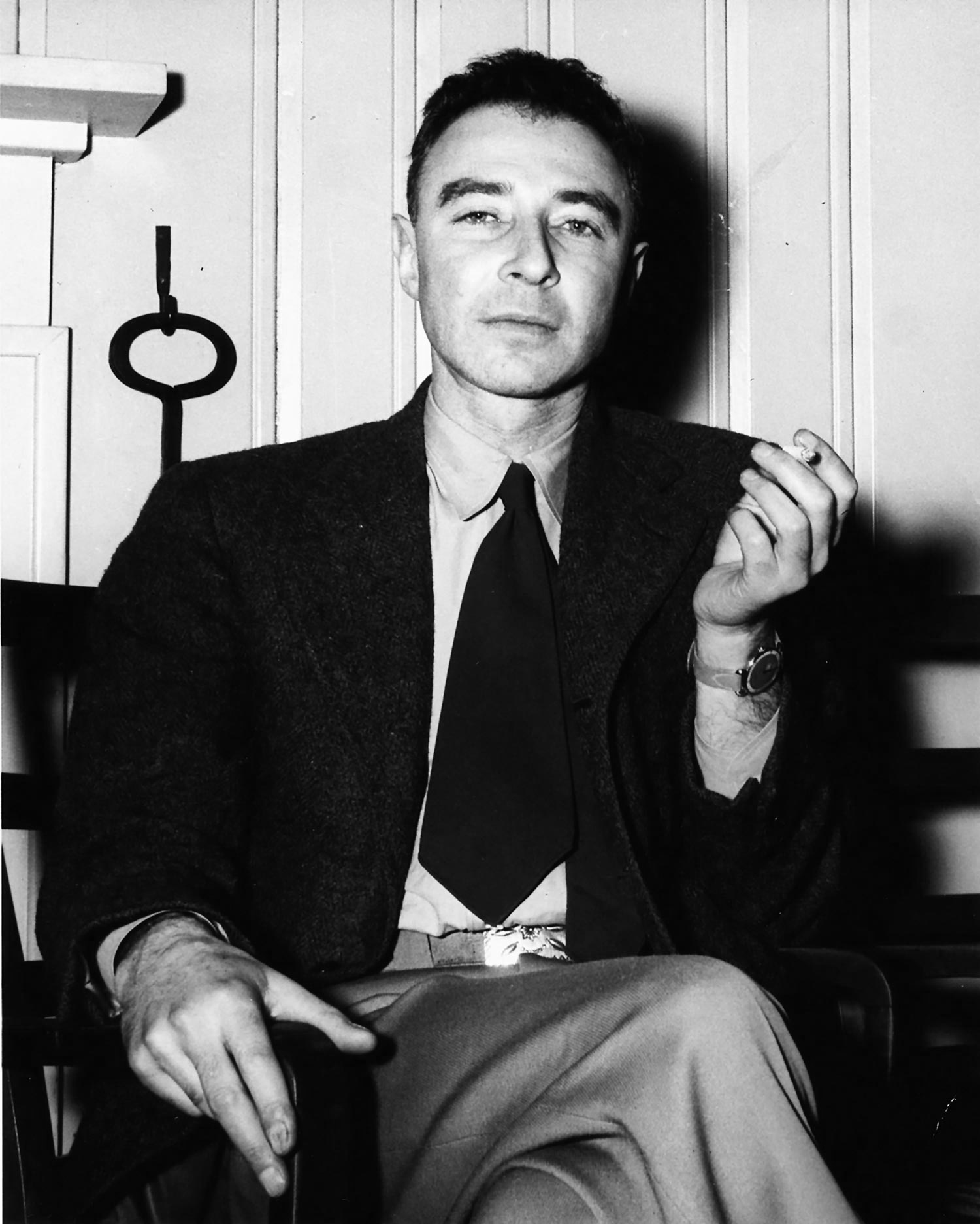

An outstanding theoretical physicist and a man of contradicting tastes, Robert J. Oppenheimer strikes a cool and composed pose with a Chesterfield cigarette wedged between his fingers in this photo produced by Ed Westcott on the 14th of February in 1946.
Oppenheimer, at the time was at the Oak Ridge guest house in Tennessee, attending a conference chaired by David Lilienthal. The purpose of this conference was to determine a policy for the recently discovered nuclear energy and its intended use – and which up to this point in time was exclusively in the hands of the U.S.
The Acheson-Lilienthal report.
A month later from this meeting of eminent industry professionals, government officials, scientists, a public administrator and a military commander had emerged a document that was formally known as the Report on the International Control of Atomic Energy, but more popularly as the Acheson-Lilienthal report – after U.S. Under Secretary of State Dean Acheson and U.S Public Administrator, David Lilienthal.
This document at its core had proposed for the appointment of a Scientific International Community and to entrust it with the authority to control nuclear technology. It had recommended that the United Nations be allowed to monitor and manage all nuclear material and production to prevent an arms race between nations. Furthermore, to allow research only for peaceful purposes.
Although with the submission and approval of this report, the U.S. had relinquished its monopoly on nuclear technology, the proposal, however, had failed to prevent an arms race between nations, especially the Americans and the Soviets.
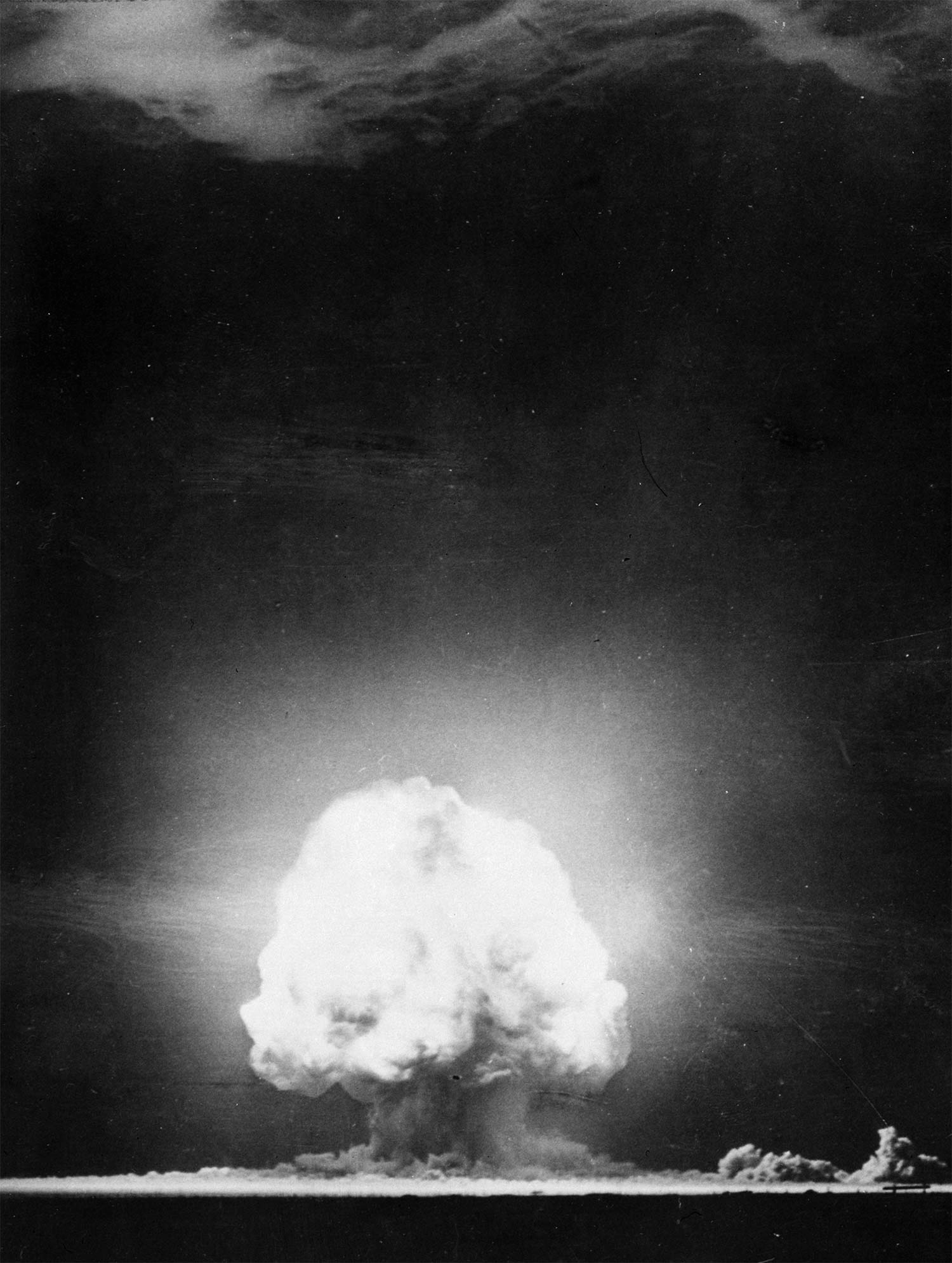
Robert Oppenheimer, father of the Atomic Age.
Honoured as the father of the atomic age for the instrumental part he played in producing the world’s first nuclear bomb, Oppenheimer’s role in the Manhattan Project was both phenomenal and tragic.
A naturalised American citizen of German Jewish parentage with a doctorate in theoretical physics from the University of Gottingen in Germany, although he was handpicked to steer the Los Alamos Scientific Community as its scientific director in 1942.
He was later accused of being a Soviet sympathizer in lieu of his communist views by Lewis Strauss and FBI Director J. Edgar Hoover, publicly humiliated and detached from the nuclear program he was instrumental in developing.
Attacks on him had intensified, after he had objected to the creation of the Hydrogen Bomb in 1950, during what was the beginning of the arms race between the U.S. and the Soviet Union – after the latter had successful invented its own atomic weapon in 1947.
Declared as a security risk during a hearing organized by the Atomic Energy Commission Personnel Security Board, his security clearance was revoked in 1954 and he was effectively exiled from the nuclear project. Right up till in his death at the age of 62, he was never again allowed to be part of a high level Government project.
Among his detractors on that day was his former colleague, Edward Teller. A Hungarian-American theoretical physicist and chemical engineer, Teller later produced the Hydrogen Bomb. Teller is known to have opposed Oppenheimer even during the Manhattan project.
Oppenheimer had objected to the creation of the Hydrogen Bomb on ethical and technical grounds. He considered the Hydrogen Bomb to a weapon of mass genocide, thousand times more powerful than the Atom Bomb, and technically not feasible to create at the time.
It was only in December 2022, fifty-five years after the death of Oppenheimer, had the U.S. Department of Energy rescinded its 1954 decision and referring to the hearing as unfair, reinstated his clearance.
Smoking habits of Robert Oppenheimer.
Oppenheimer was selected by Major General Leslie Groves from among a throng of highly capable men, and despite lacking the managerial experience to undertake an enormous project of critical importance, let alone organise resources and lead an eminent panel of Nobel prize-winning scientists.
His strength, however, had lain in his impressive ability to quickly adapt to his environment, grasp details, and execute decisions fast – above all his intense devotion to seeing a project through.
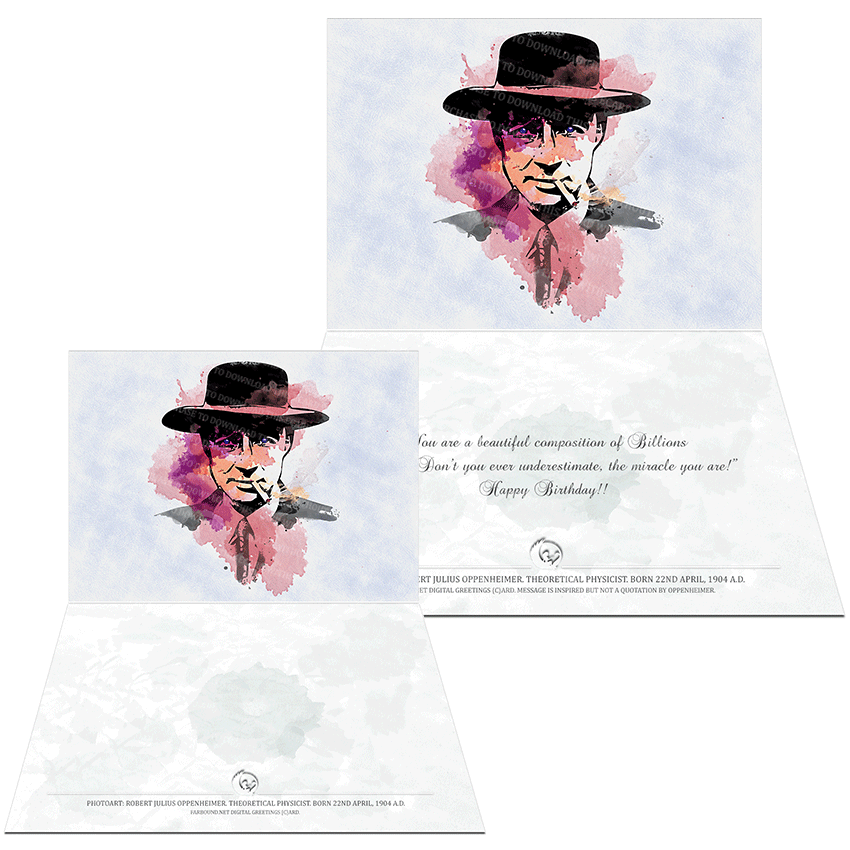
Greetings Cards by Farbound.Net.
Actual Dimensions: 1200 x 1203 pixels
The last of which had come to the fore between 1944-1945, when despite the strain of work affecting his appetite and worsening his health, he had still forged ahead with rotting teeth and an unhealthy body weight of 115 pounds for a six-foot frame – as a result of living on an overdose of Gin, coffee and a hundred cigarettes a day.
The stressful period had eventually turned him into a certified chain smoker for life and afflicted him with long bouts of smoker’s cough. His death in 1967 is attributed to throat cancer. Oppenheimer had the peculiar habit of flicking the ash of a cigarette with his little finger, which almost always remained charred.
Photographer Ed Westcott
James Edward Westcott was a U.S. Government photographer. Born on the 20th of January in 1922, he was only photographer with Government clearance to document scenes and developments at the top secret Oak ridge site and the Manhattan Project.
Prior to joining the Manhattan Project as its 29th employee, Westcott had served as a photographer with the U.S. Army Corps of Engineers. He was transferred to the Oak Ridge facility in December, 1942.
From 1942 to 1966, as the only official photographer of the Manhattan project and the Atomic Energy Commission at Oak Ridge, Westcott produced over 15,000 images (with around 15,250 negatives).
According to Baldwin Lee, a professor of art at the university of Tennessee, Westcott’s photos can be divided into two categories. Photos that document the effort behind the creation and development of the atom bombs and photos that capture the social, domestic and recreational activities of the men and women who populated the top secret sites.
Westcott primarily used a 4×5 Speed Graphic Camera with flash and captured his images in black and white. Due to a shortage of film, he had also, and often, staged photos. His photos were used not just for historical documentation but also for periodicals and in recruitment advertisements for hiring civilian workers.
This photo of Robert J. Oppenheimer by Ed Westcott is now archived with the Department of Energy, U.S.
I F I This is an Independent story highlighting Ed Westcott’s vintage photo of Robert J. Oppenheimer at the Oak Ridge guest house in 1946. The story also sheds light on Robert Oppenheimer’s smoking habits, his role in the creation of the atom bomb and his exile from the nuclear project. Additionally it offers a brief introduction of Ed Westcott as a photographer at Oak Ridge and Manhattan project. It has been created from facts curated out of literary and historical sources. I