
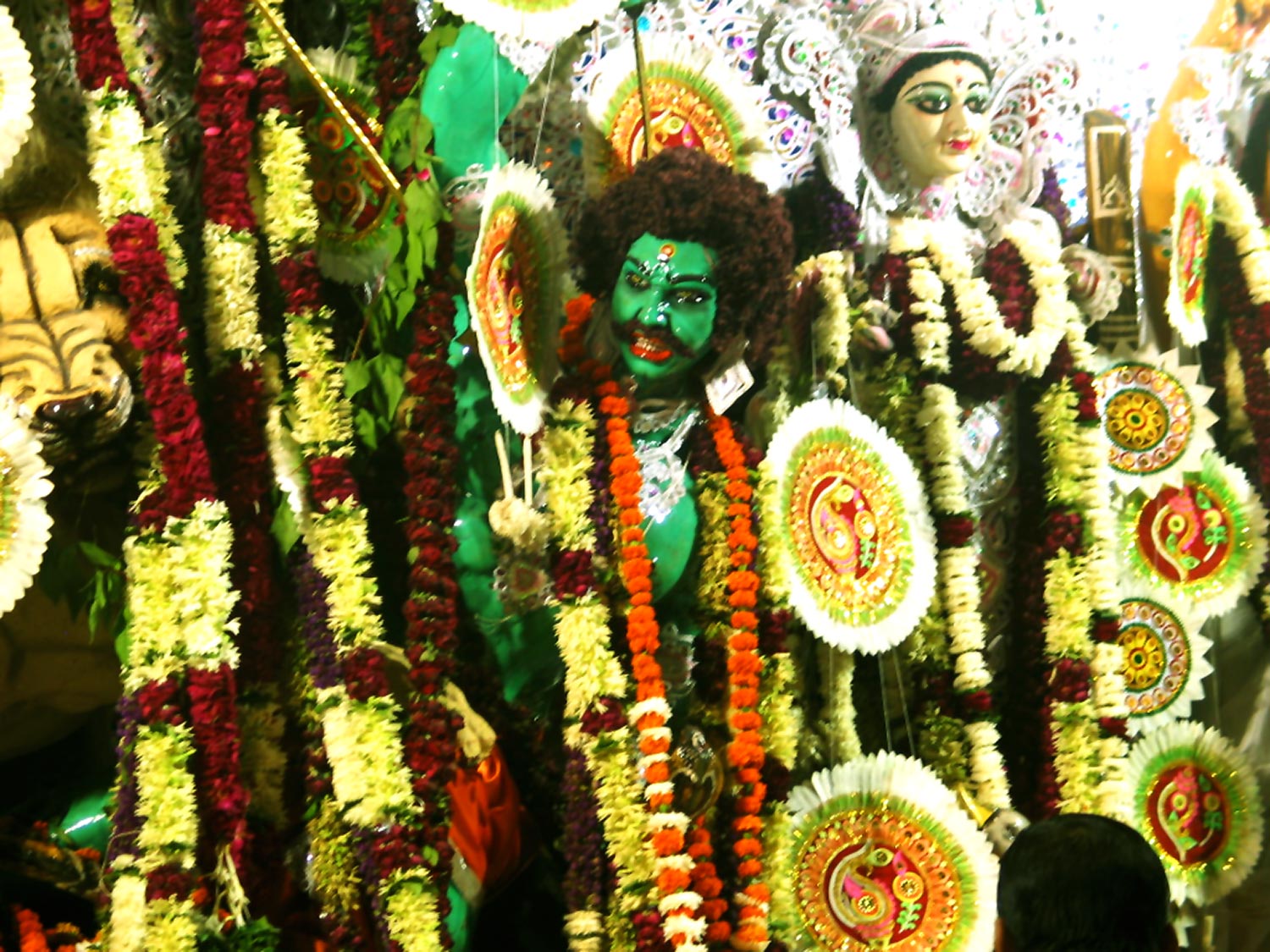
The invincible buffalo demon.

The story of Goddess Durga features a half man half bull demon, similar to the legend of the Minotaur in Crete.

Durgostava, Safdurjung Enclave, new Delhi, India.
Mahishasura and the goddess Durga.

Thousands of miles away from the labyrinth of the Minotaur in Crete, comes another legendary tale of a bull-man creature that in mythological times rose from the underworld to terrorize heaven and earth till finally vanquished by a ten armed goddess sitting astride a lion.

Mahishasura, is a central character in Durgostava and no ordinary demon. A gifted shape shifter he could transform at will into a raging buffalo to unleash carnage among his enemies. Plus protected by a boon from Bhrama, the creator of the universe, he was virtually invincible. No male deity, demon or mortal could slay him with bare hands or weapons. His shield of invincibility, however, did have one fatal flaw. It left him vulnerable to the fury of a woman.

Celebrate by the Bengali community across the world every Autumn, the Indian festival of Durgostava venerates the mythical battle in hymns sung by priests in Sanskrit and in imagery depicting the goddess thrusting her spear into the chest of the demon. His last wish was to be worshiped alongside her, and pleased by his request, the goddess granted it.
Popular in Culture

Wars of Humayun.

A list of battles of the second Gurkani emperor Humayun.

What's new

Indulge

Browse and Buy

More Stories

Albert Ekka: For comrade and country.

Awarded India's highest wartime award, Albert Ekka was a soldier of uncommon valour.

How the Apple came to Himachal.

Himachal was not always the land of apples as it is today. In fact the land had no apple trees.

The poor king’s tomb: The octagonal mausoleum of Muhammad Shah Sayid.

A fine example of Indo-Islamic architecture that found roots during the reign of the Delhi Sultanate.

British allies, sketched and coloured for 40 guineas. By war artist Crimean Simpson.

A colored lithograph depicts troops of native allies of the British, 1800s.

Political Animals.

Tenniel's political cartoon inspired by the massacre of Europeans in 1857
Siddhartha Mukherjee
Siddhartha Mukherjeehttps://farbound.net
I believe in the wisdom of self-reliance, the moral philosophy of liberalism, and in individualism. When not researching and writing editorial content or creating digital products, I spend my time with my dogs and live a life of solitude.

LEAVE A REPLY

Please enter your comment!
Please enter your name here

Featured Stories

How the Bengal army came to be an army of robust Sepoys.

Delving into the fascination of populating the Bengal army with impressive Prussian type native Sepoys.