
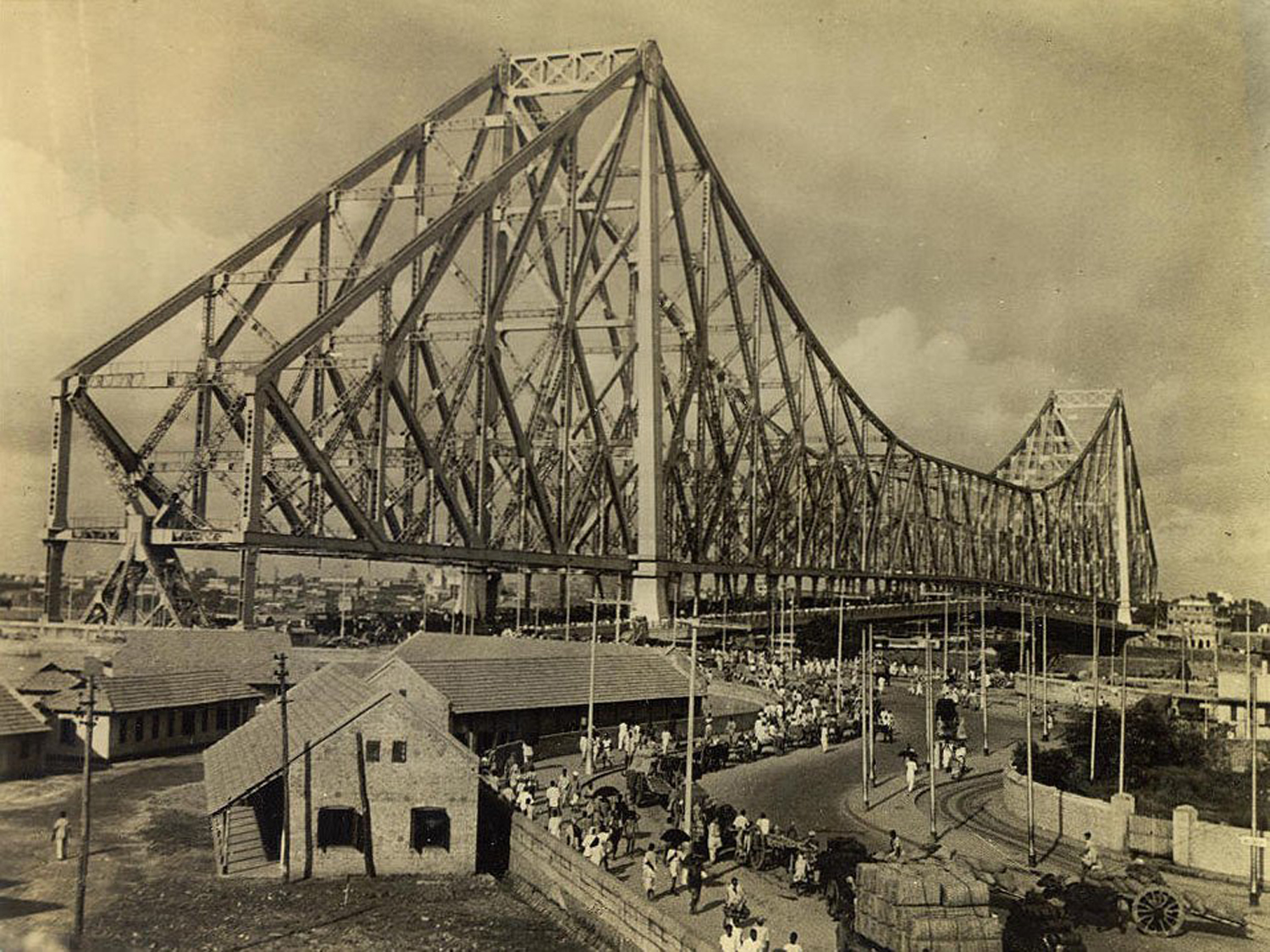

Stretching its massive size over a gently flowing Hooghly, the Howrah Bridge awns to connect the nearby cities of Howrah and Calcutta with its entire length of some 2,150 feet, in this photo produced by Clyde Waddell in 1945.
Constructed at the time by the joint effort of three English civil construction companies namely, the private limited companies of Braithwaite, Burn and Jessop, the massive structure had taken seven years to complete – with the work having begun in 1936 and complete in 1942.
The companies of Braithwaite, Burn and Jessop had merged together as Braithwaite, Burn & Jessop Construction Company Limited on the 26 of January in 1935, with the primary purpose of building the bridge. Later, however, the conglomerate had gone on to construct massive steel bridges for the Indian Railways as well as the second Howrah bridge.
Inauguration of the Howrah Bridge.
Inaugurated on the 3rd of February in 1943, the bridge was constructed with 26,500 tons of riveted steel – with approximately 23,000 tons of the metal procured from the production facility of Tata Steel that was located in the village of Sakchi in Singhbhum – and which is now the city of Jamshedpur.
Tata Steel was founded by Jamsetji Nusserwanji Tata in 1907. During the construction of the Howrah bridge, the responsibility of producing and supplying tons of the high-tensile metal alloy was overseen by then chairman of the company, Sir Nowroji Saklatvala and his successor Jehangir Ratanji Dadabhoy Tata.
Photographer Clyde Waddell.
In 1945, this bridge that is presently considered to be the 6th largest feat of cantilever engineering in the world, was a casual topic of interest for American photographer Clyde Waddell – who was touring British Calcutta to gather a collection for friends curious to know about the city, described at the time as the Jewel of the East.
Waddell was formerly a photographer with the Houston Press located in west Mississippi – a news agency founded on 26th September in 1911 and later acquired by its rival, the Chronicle.
In 1942 he had signed up with the army as a wartime photographer. Prior to visiting Calcutta, he had spend time in Indo-Burma covering the proceedings of World War II in the eastern theater, and in 1943 he had served as the personal photographer of Commander Louis Mountbatten.
Later, he had worked as a news photographer for the Phoenix Magazine based in Calcutta. The Phoenix was a illustrated print tabloid and had described itself as an allied magazine for allied forces in South East Asia Command. It was located at Wellesley House and was particularly active during the last years of the war. The 24 page weekly had kept allied soldiers in the loop with information and propaganda.
The photo of Howrah Bridge.
Waddell had produced this photo after the liberation of Singapore from Japanese hold on the 12th of September in 1945, and while he was on leave. During this time he had toured the old city of Calcutta and visited its crowded and restricted areas. He had photographed the city’s streets, city’s life and opinions of American soldiers then stationed in the city.
His collection of photos was hugely popular in American and British quarters, and to meet a growing demand he had later produced an album of 60 prints titled, A Yank’s Memory of Calcutta, for general circulation among the public.
The original caption attached to the photo reads: Calcutta boasts the third largest cantilever bridge in the world. Its real importance, however, lies in the fact that it serves as Calcutta’s gateway to the wese, being the city’s only bridge spanning the Hooghly. Taking 7 years to build, it cost $10,000,000. It towers 310 feet as the city’s highest structure, is 2,150 feet long with a center span of 1,500 feet. It was completed in 1942, opened in February, 1943.
He passed away at the age of 81 at Houston in Texas, on the 11th of February in 1997. His album of photos are hailed as a rare piece of visual documentary of yesteryear Calcutta.
After the Independence of India in 1947, the conglomerate of Braithwaite, Burn & Jessop Construction Company Limited was acquired by the Government of India. In 2015, it was merged with the Bharat Bhari Udyog Nigam Limited and renamed as Braithwaite Burn and Jessop Construction Company Limited (BBJ Construction Company) – and operates under the aegis of the Ministry of Heavy Industries.
Today the Howrah bridge and the second Howrah bridge (constructed between 1979 -1992) are known as the Rabindra Setu and the Vidyasagar Setu. The second Howrah bridge is a cable stayed bridge.
I F I This is an Independent Story produced to unravel the history behind this featured Vintage Photo of the Howrah Bridge from 1945. The story also sheds a bit of light on the construction of the bridge and photographer Clyde Waddell. It has been created out of facts curated from literary and historical sources. I





Hello,
Good day, hope you’re doing fine!
I am interested to pitch you an article on farbound.net that perfectly fit to your niche and become a guest contributors. In return, I will promote your website link on my Twitter.
Please let me know if you are interested and I will send you the file for your review.
Kind regards
Hello Daisy,
Farbound.Net does have a guest contribution section and you are welcome to contribute there. However, the topics, Farbound.Net would like to concentrate from now on, should be related to either history, culture, environment, architecture or life and times of places and people. Sorry about the delayed reply, your comment somehow landed up in the spam folder, and wasn’t till now that I saw it. Normally genuine comments automatically show up on the site.