
The Rajdhani Passenger Express enjoys an iconic reputation among the trains that transport 25 million passengers each day across the country of India.
In 1969 when the first one, rolled out of the New Delhi railway station and made its historic run for Howrah in West Bengal, a station built by the British and the oldest in the sub-continent, it heralded in a new era of super-fast trains and gained a fan following that till date hasn’t diminished a bit.
Kids who once hopped on board with glee tethered to the arms of anxious parents afraid to lose them in the crowd, many now in their early forties, take their children on long distant journeys without thinking twice about a hike in its fares. While others who have grown up on stories of the express stand wide-eyed on platforms waiting for the trains to roll into the station – and all because of one particular train that proved speedy travel was a possibility on Indian tracks.
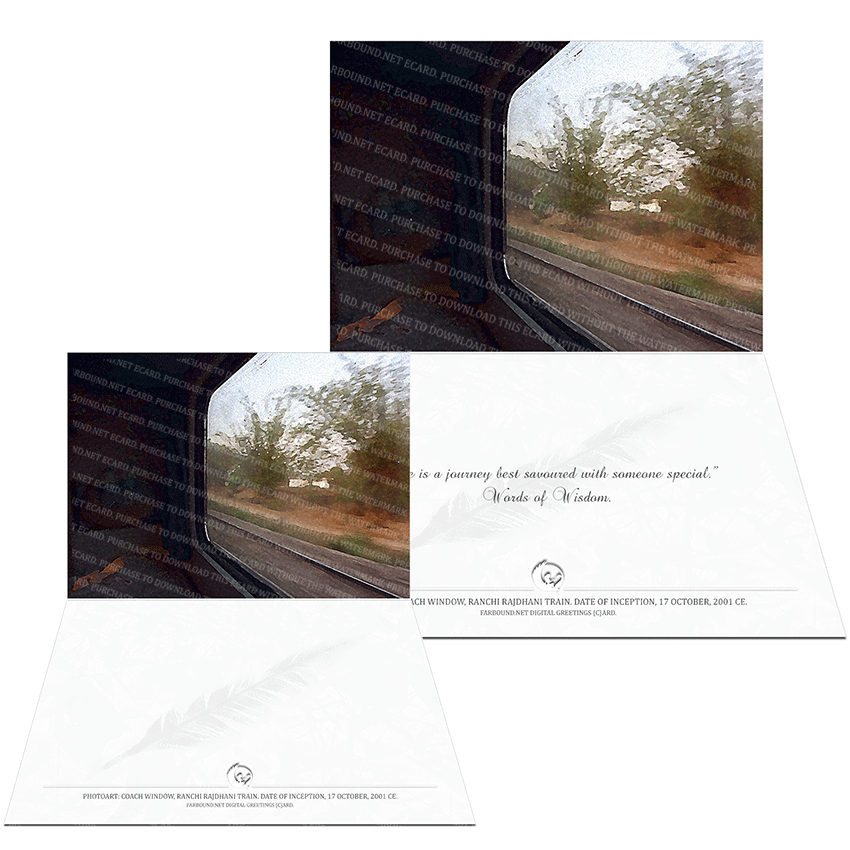
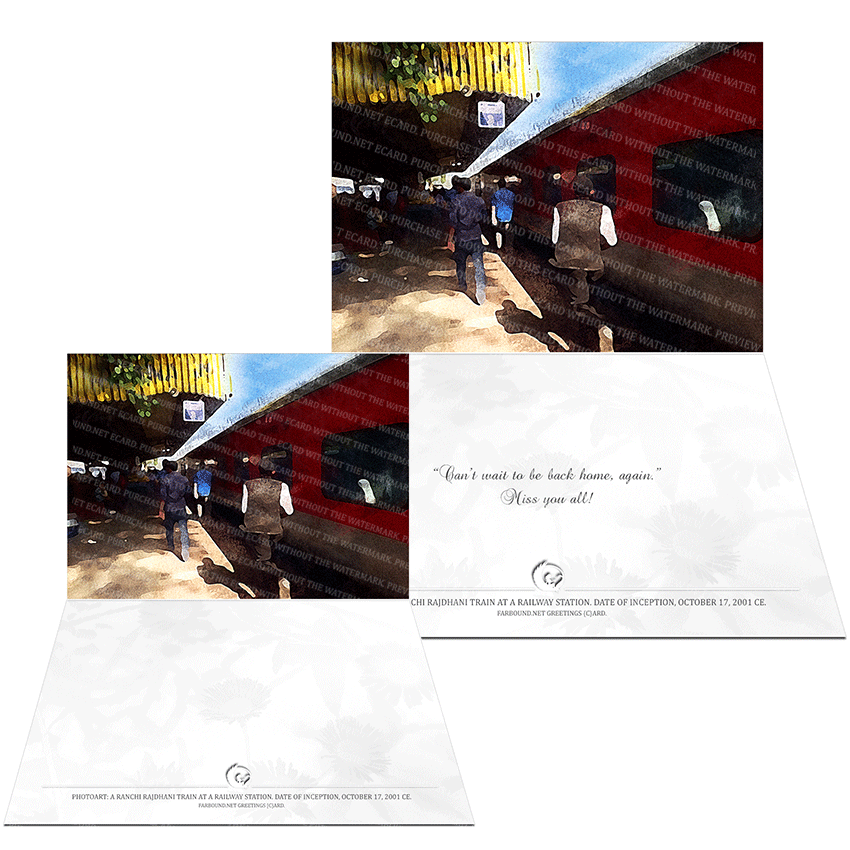
Digital Greetings Card by Farbound.Net, ft trains.
Actual Dimensions: 1200 x 1203 pixels.
The Howrah Rajdhani.
The Howrah Rajdhani, was the first of all the Rajdhani trains to appear on India railway tracks. This train had chugged into service after the Railway Budget of 1969 which had proposed the introduction of a new train service capable of reducing travel time to 18 hours between important destinations – mainly the capital cities of India.
The proposal for the project was put forward by Dr. Ram Subhag Singh, an Indian politician and a member of the Indian Parliament. Subhag Singh had served as Minister for Indian Railways from the 14th of February to the 4th of November, 1969.
He had floated the proposal on the 19th of February in 1969 – and a month later, on the 1st of March, 1969, the Howrah Rajdhani had made its debut as a biweekly train service.
The locomotive of the Howrah Rajdhani in 1969.
Unlike the current trains of the express service, the coaches of the Howrah Rajdhani in 1969 was pulled by a WDM-4 class of locomotive engine produced by the U.S. locomotive manufacturer, Electro-Motive Diesel Corporation – a company that was founded in Cleveland, Ohio in 1922.
The U.S. Company had specifically produced the WDM-4 class of engines in the 1960s to help the Indian Railways replace its aging steam locomotives – after a 224 page report was submitted by the Expert Committee on coal consumption in 1958.
Digital Greetings Card by Farbound.Net, ft trains.
Actual Dimensions: 1200 x 1203 pixels.
The Expert Committee report, 1958.
Headed by Karnail Singh, a member of the Indian Railway’s engineering section, the Expert Committee was formed in 1957 at the request of Indian politician Jagjivan Ram, who had then held the post of the Minister of Railways. Its mission was to ascertain if dependency on high-grade coal was one of the factors responsible for the high maintenance and operational cost indebting the Indian Railways.
According to the report of this committee, trains of the Indian Railways at the time were utilizing a third of the entire coal supply in the country – and which was not only putting an enormous strain on the low availability of high-grade coal but also constituted the single-item factor responsible for the Railway’s exorbitant spending.
Although this committee had initially proposed setting up of washeries for refining an inferior variety of coal for use by the Indian Railways, diesel-powered locomotives had later emerged as a viable option – and thus had come about the WDM-4 type of locomotive engines.

Route of the Howrah Rajdhani.
Inaugurated by Ram Subhag Singh on the 1st of March in 1969, and launched the very same day, the Howrah Rajdhani had made its maiden journey, on the 1,441 km stretch that had connected Delhi to Kolkatta.
Known as the Howrah-Delhi main line, this stretch was originally built by the East Indian Railway Company – a British firm that had worked in collaboration with the East India Company, before the latter’s dissolution in 1858.
The survey was originally carried out in 1846 and development had taken place in stages between 1851 and 1866. The colossal undertaking had seen the laying out of miles of railway tracks, and the construction of wayside stations and bridges over rivers and other large water bodies to connect the two distant cities.
In 1961, the Indian Railways had deliberately opted to test the Howrah Rajdhani on this extensive stretch of laid-out railway lines for the reason that the Howrah-Delhi mainline had boasted of robust and superior infrastructure, that was not to be found elsewhere in India at the time.
Furthermore, between the 1950s and 60s, the railway lines on this route were primarily of the broad gauge type, and in addition to which, several sections were also electrified. This first train of Rajdhani service, however, wasn’t ‘electricity compatible’. Its engine was the WDM-4 class of diesel engines, and it had made use of only the broad gauge tracks.

Time taken by the Howrah Rajdhani to cover the distance.
The Howrah Rajdhani had covered the distance in 17hrs and 20 mins, traveling at a speed of 120 kmph. En route, the train had made technical halts at the stations of Kanpur, Mughalsarai and Gomah. It had left New Delhi at 5:30 pm, on a Saturday and arrived at Kolkatta at precisely 10:50 am, on the following day that was a Sunday.
Upon reaching its destination in the estimated time the train had not only lived up to expectations but also proved that distances could be covered in less time than what other trains of the era were capable of accomplishing in twenty-four hours or more.
On its maiden journey, the train’s WDM-4-powered locomotive engine had pulled nine carriages which had included a dining carriage, five chair carriages, a first-class carriage and two generator cars.
These carriages were specially developed for the Rajdhani by the Integral Coach factory located at Perambur, in Tamil Nadu – and had come with vacuum brakes and an under-slung air-conditioning system.
On the 3rd of March 1969, the train had made its return journey. It had departed Howrah at 5:00 pm on a Monday and arrived at New Delhi at 10:20 am on a Tuesday.
Though there is no way to ascertain who the passengers were during the maiden run, since the list was never published. We know the Rajdhani’s first catering manager and inspector for meals was Ratan Chandra Chandra.
A. Ramji, the divisional operating manager at Allahabad, had monitored the engine crew of two drivers inside the cab of the WDM-4 locomotive. While S. O. Levi, was the guard who flagged off the return journey of the train from Howrah.
In the initial days, the train service was a biweekly service and operated on Mondays and Fridays. It had charged passenger a fare of Rs. 280 for its first-class carriage and Rs. 90 for its chair carriages.

Later trains of the Rajdhani.
Almost three years after the Howrah Rajdhani made its debut, the Indian Railways introduced the New Delhi to Mumbai Central Rajdhani service on the 17th of May in 1972.
This second train of the Rajdhani train service was followed by the ‘August Kranti’ connecting Mumbai Central to Hazrat Nizamuddin in New Delhi, and was inaugurated on the 1st of January in 1992.
The fourth to rollout was the KSR Bengaluru to Hazrat Nizamuddin Rajdhani train, inaugurated on 1st of November in 1992.
A year later, on the 3rd of July in 1993, the Indian railways simultaneously launched on the same day, the Thiruvananthapuram to Hazrat Nizamuddin Rajdhani, the MGR Chennai Central to Hazrat Nizamuddin Rajdhani and a second train of the Howrah to New Delhi Rajdhani to ferry passengers via Patna.
On the 1st of April in 1994, had debuted the Bhubaneswar to New Delhi Rajdhani and a month later was launched the Dibrugarh to New Delhi Rajdhani, on the 6th of July in 1994. Followed by the Jammu Tawi to New Delhi Rajdhani on the 10th of July in 1994.
Two years later, on the 1st of September in 1996 was launched the Rajendra Nagar (Patna) to New Delhi Rajdhani, and on 1st of January in 1998, had debuted the Ahmedabad (Sabarmati) to New Delhi (Swarna Jayanti) Rajdhani.
On the 17th of October in 2001, the Ranchi-Rajdhani train service made its debut, and on the 13th of September in 2005, was introduced the Sairang (Mizoram) to Anand Vihar Terminal (Delhi) Rajdhani.
Presently, the Rajdhani Express train service operates around 52-54 individual trains with 26-27 operational pairs.

Induction of the Wap series of locomotives, 1983.
In 1983, some fourteen years after the U.S. made WDM-4 diesel locomotive had chugged the Delhi-Howrah Rajdhani on its maiden run, it was succeeded by the electric Wap series of locomotives produced by the Chittaranjan Locomotive Works in West Bengal, India. This upgrade was largely made possible by the electrification of railways routes and incorporation of the 25 kV AC system.
Unlike the WDM-4 that runs on diesel, the Wap series is completely powered by electricity. These modern series of locomotives were produced by the state run Chittaranjan Locomotive Works in collaboration with the Indian Railways and via a sharing of technology with ABB – a multinational technology corporation based in Zurich, Switzerland.
Among the series of locomotives produced, the Wap-1 was introduced in 1980 and was India’s first fully indigenous made electric locomotive. This engine was capable of generating up to 3,760 hp. In 1994, it was succeeded by the Wap-4 variant with 5,350 hp capability. Later were introduced the Wap-5 and Wap-7 variants. The abbreviation Wap stands for Wide gauge, Alternating current and Passenger.
The first Rajdhani train to upgrade to the Wap series was none other than the Delhi-Howrah Rajdhani. Presently, the Wap-7 variant is the standard heavy duty engine that powers most long distance Rajdhani trains. While the Wap-5, a high speed electric locomotive, is deployed on important routes.
Induction of the LBH Coaches, 2003
In 2003, the Rajdhani train service had initiated the process of upgrading its aging ICF (Internal Coach factory) rail bogies to the newer and advanced LBH rail coaches.
An abbreviation of Linke Hofmann Busch, these coaches were imported in from Germany in the year 2000 and gradually inducted into service. The LBH coaches were specifically developed for the Indian Railways by the manufacturing company, Linke-Hofmann-Busch, now known as the Alstom Transport Deutschland.
Originally a wheelwright workshop that was established in 1834 by artisan and entrepreneur Gottfried Linke at Wrocław, a city on the banks of the river Oder in southwestern Poland, this small unit by 1839 had expanded into a wagon building company for producing freight cars – and between 1912-28, merged with other potential business to become the Linke-Hofmann-Busch manufacturing company, and an established name in producing modern rail and passenger coaches.
With the onset of World War I, the company had diversified into the aeronautical space to produce airplanes for the Deutschen Luftstreitkrafte. While during World War II, it had engaged in the production of heavy armaments, armoured trains and rocket components.
Later, and having lost its production facilities at Wrocław in the aftermath, it had reestablished its presence at Salzgitter in West Germany. In 1994, it had evolved into Alstom Transport Deutschland to become one of the country’s leading name in rail and locomotive industry with offering ranging from rolling stock manufacturing to digital rail signaling and comprehensive maintenance services.
The induction of the LBH coaches had come about after the Indian Railways had submitted a proposal for replacing its aging ICF coaches with newer variants in 1993-94. In the same year the Railways had initiated a global selection process to choose a locomotive and rail car manufacturer from abroad since at the time Indian manufacturers had lacked the technology and know how.
In 1995, Linke-Hofmann-Busch had won the global contract to manufacture and design the new cars, and between 1995 and 2000, it had provided the Indian Railways with 24 air-conditioned LBH coaches – and which were allotted to the premier New Delhi-Lucknow Shatabdi express in November, 2001.

Later, via a clause in the agreement, Linke-Hofmann-Busch had shared technical knowledge with manufacturing plants in India for the domestic production of the LBH coaches – leading to their production at the Rail Coach factory in Kapurthala in Punjab in 2003, followed by the Integral Coach Factory in Chennai and the Modern Coach Factory in Raebareli.
The Indian railways had opted to replace the older, heavier and corrosion-prone ICF railway cars with LBH variants for the purpose of enhanced safety and speed. The new lightweight stainless steel cars were not only apt for traveling between 160 and 200 Kmphs but were designed with several advanced features – such as their anti-telescopic and anti-mounting built that safeguarded rail cars from crashing or mounting on top others in the event of a collision.
Other features that made up the merit list was the integrated FIAT bogie suspension for smooth travel and disc brakes for better braking.
Moreover, the 77.2 feet long and 10. 6 feet wide LBH coaches at the time were also deemed ideal for accommodating more berths. In comparison to the old ICF rail cars, these coaches were longer by 1.7 to 2 meters. In addition to this, the modular interior of the coaches with sound insulation and better air conditioning had further aided in their selection.
In December, 2003, the Mumbai-Rajdhani became the first train in the Rajdhani family of trains to be equipped with the LBH coaches. Followed by the Bhubaneswar, Trivandrum, Bangalore, and Ahmedabad Rajdhanis, between 2009 and 2012.
The New Delhi–Bilaspur Rajdhani, operating on the 1,502 Kms stretch between Delhi and in Chhattisgarh, was officially the last Rajdhani train to upgrade. The historic ICF rakes was discontinued on the 1st of January in 2021.
Induction of more coaches per Rajdhani train, 1980-1990.
Between 1980 and 1990, the Rajdhani train service had embarked on the process of both streamlining and scaling-up its operations to keep up with its growing popularity. While initially, this train service had operated with the standard configuration of nine rail cars per train, in this decade it had increased its number of coaches and done away with less viable features.
In the October of 1981, the service had expanded the Delhi-Mumbai Rajdhani train with 18 coaches and by the beginning of the 1990s, phased out its ‘Chair Cars’ for the AC coaches. Furthermore, by 2017 it had begun to allocate a uniform number of coaches to all trains.
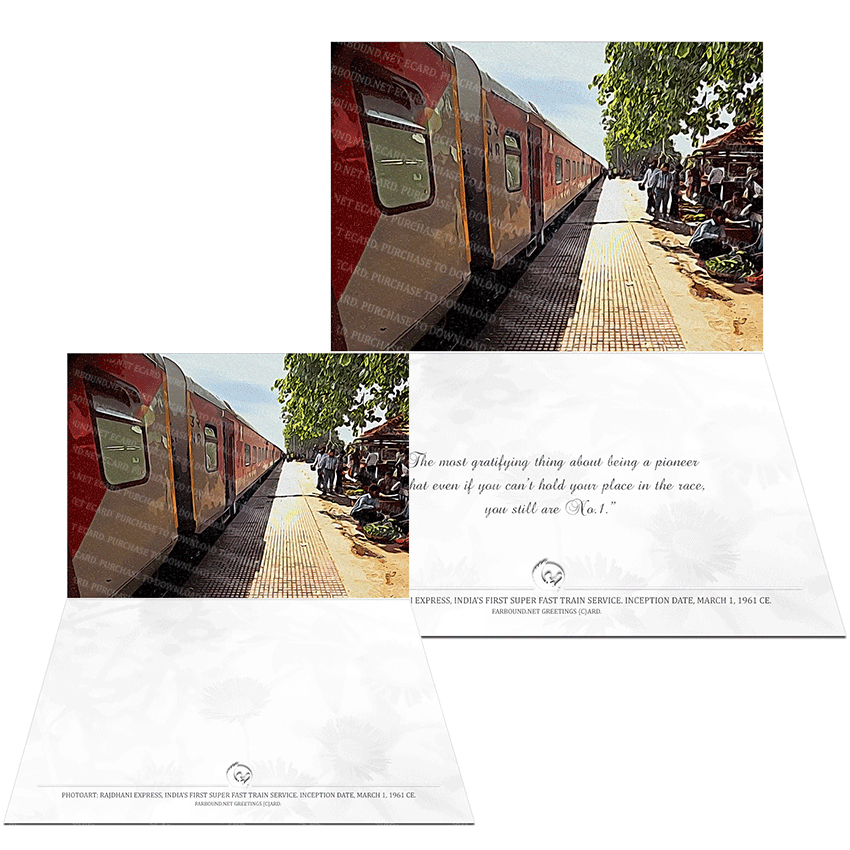
Digital Greetings Card by Farbound.Net, ft trains.
Actual Dimensions: 1200 x 1203 pixels.
Presently, a train of the Rajdhani typically operates with around 20-22 coaches, and sometimes, depending on route, passenger traffic and platform limits, 24 coaches. These coaches usually include 19 passenger cars, one pantry car, and two power cum luggage cars.
The coaches are further segregated into three categories: The AC-1 Tier, the AC-2 Tier and the AC-3 Tier – with the Ac, being an acronym for Air Conditioning.
The AC-1 Tier comes with two passenger cars. The AC-2 Tire with 5 passenger cars, and the Ac-3 Tire, with around 12 passenger cars.
Out of these three classes, the AC-1 tier continues to be the most luxurious. The coaches of the AC-1 Tier comprises of private cabins with four spacious berths – and offers more privacy and personal space. The AC-2 Tier coaches are equipped with a four berth open compartment on one side of the aisle and dual berths on the other.
The interior of the AC-3 Tier coaches is similar to the AC-2 Tier, except the coaches here provide wayfarers with a six berth open compartment on one side of the aisle and double berths on the other. Every berth is provided with a clean bed sheet, a single blanket and a pillow.
Overall, the AC-1 Tier contains 24 berths per coach. The AC-2 Tire, 52 berths per coach. While the AC-3 Tier has approximately 72 berths per coach.

Debut of the Ranchi-Rajdhani.
The Ranchi Rajdhani, a part of the Rajdhani Express Service, was initiated on the 17th of October in 2001- some ten months after the formation of the state of Jharkhand with Ranchi as its capital city – and which officially took place on the 15th of November in 2000.
The train service was inducted to connect Delhi to the newly designated state capital of Ranchi- and was inaugurated by Indian politician Nitish Kumar, a former minister of Indian Railways.
On its inception, it had operated on a weekly basis – and connected Delhi to Ranchi via the stations of Bokaro and Hatia.
In 2004, it had begun to operate on a bi-weekly basis and from 2006 onwards, it had extended its reach to cover the destinations of Prayagraj, Mughalsarai, Daltongang, Barkakana and Muri.
In 2016, the train service had further extended its range to include the stations of Lohardaga and Tori – and which was made possible by the construction of the Ranchi-Lohardaga and the Lohardaga-Tori broad gauge railway lines.
Ranchi-Rajdhani: Trains of the Northern Railways.
Currently, the Ranchi-Rajdhani train service operates six trains, on the line connecting the capital cities of Delhi and Ranchi with several other stations that fall en route. These trains are managed by the Northern Railways, a division of the Indian Railways.
Among them, the Ndls Rnc Raj Exp (Train No. 20840) operates on a biweekly basis and ferries over a thousand passengers to their destination in an eighteen-hour journey – barring aside unforeseen technical snags, traffic and low visibility in winter months.
The other five trains of the Ranchi Rajdhani, the Rnc Ndls Raj Exp (Train No. 20407), the Rnc Ndls Raj Exp (Train No. 12453), the Rnc Rajdhani (Train No. 20408), the Rnc Ndls Raj Exp (Train No: 20839), and the Rnc Rajdhani (Train No. 12454), operate on a weekly basis.

Meals on board Rajdhani trains.
Meals provided on Rajdhani trains are not prepared by the Indian Railways but provided for by private caterers hired for the job on a contract basis. A pamphlet served alongside the meals comes with the name of the caterer. Trains operating on different regional routes offer a slightly different menu while first class passengers are served a wider choice of dishes.
Meals served in all trains of the Rajdhani, however, are included in the price of the ticket and offer a choice between vegetarian and non-vegetarian dishes. Sometimes, the menu also includes a special dish, which is charged separately and served between the appetizer and dinner.
The meals onboard are usually served an hour after departure. On the Ranchi-Rajdhani that departs in the evening, the first item to be served is tea and light snacks. Followed shortly afterwards, by soup, bread sticks and butter. Then dinner and finally desserts. Tea with biscuits is served quite early in the morning, followed by breakfast.
Rajdhani Personnel.
The staff onboard the Rajdhani trains can usually be identified by their black and white attires, and maroon shirts and striped sleeveless jackets. The attendants on board serve meals as per the prescribed timetable and generally care for the passengers. Besides the attendants, the train service also has a housekeeping staff and a security crew comprising of railway police members. The staff who work these trains are on most occasions, friendly and extremely helpful.
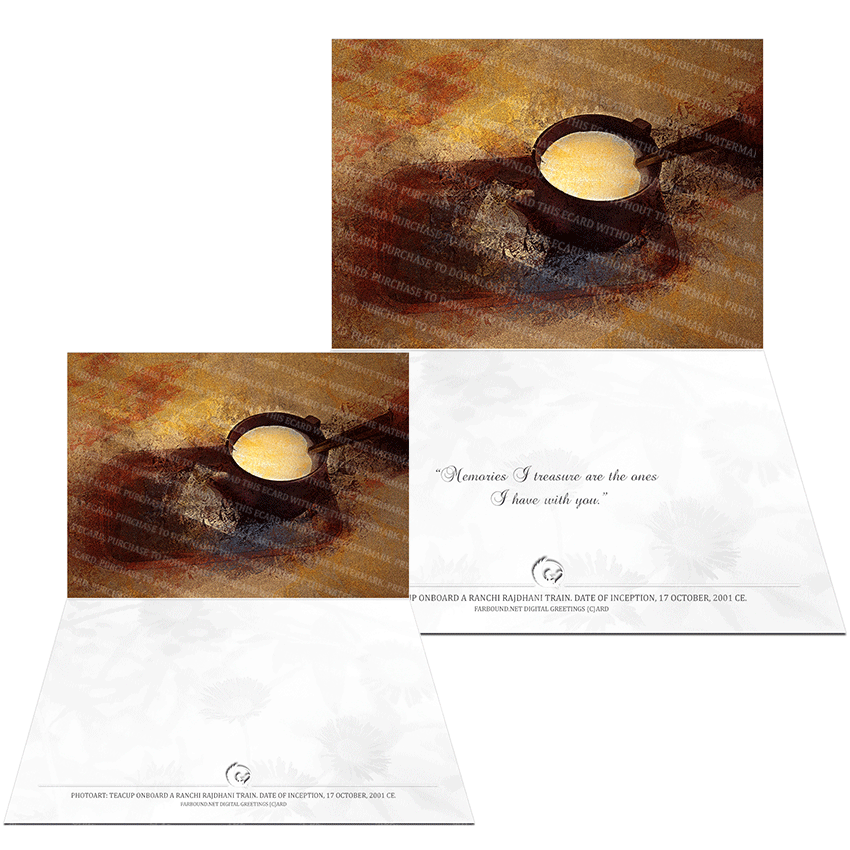
Digital Greetings Card by Farbound.Net, ft trains.
Actual Dimensions: 1200 x 1203 pixels.
The Rajdhani Express: A forerunner of change.
Among Indian train services, the Rajdhani has always been at the forefront of change since it first introduced the concept of super fast travel in 1969. In addition to initiating the age of speed travel, it was also the first to provide passengers with Wi-Fi connectivity and the first to make use of the domestically built variants of the German LBH type coach – fitted with advanced safety features and an early fire warning system.
Furthermore, it was the third train service in India to provide air conditioned cabins. In this department, this train service was preceded by the ‘Frontier Mail’ in 1934. Followed by the ‘Deluxe Train service’ that operated on the Howrah to Delhi and the Mumbai to Delhi track, in 1956.
The ‘Frontier Mail’, a British Indian train service, had used ice blocks and battery powered air blowers to circulate cool air – with the ice blocks were stored in compartments underneath the floor of the coaches.
Keeping with this tradition, the train service has plans of upgrading all its trains with the home-built Tejas variant of coaches – which upon completion will effectively transform it into the Tejas Rajdhani Passenger Express. These new coaches are stated to be equipped with automatic doors, dedicated reading lights, bio-toilets, a passenger information system and CCTvs, besides an improved interior and exterior design.
Presently, 7 pairs of Rajdhani trains operate with the Tejas coaches.

Popularity of the Rajdhani trains.
In the 21st century, all three tiers of Ranchi Rajdhani continue to be the preferred choice of India’s large population of middle and lower-middle income earners. Onboard one mostly finds men and women, families and businessmen, corporate and government employees, students and occasional wayfarers from very humble and ordinary backgrounds.
People for whom an eighteen-hour long journey inside an air-conditioned cabin with meals being served on schedule far outweighs the discomfort of traveling in a local train. Especially for what the train service offers, in terms of services, hospitality, and safety in comparison. Or for that matter travel ling in a luxurious environment at higher prices.
Despite occasional hikes in fares, most still find the tickets to be economical when compared to flights, or other modes of road transport that can be uncomfortable and more time-consuming.
The principal factor, however, that prompts wayfarers, hailing from this bracket of Indian society, is the train service’s record of getting people to their destinations in the shortest possible time, on Indian railway tracks.

Speed of the Rajdhani trains, today.
Though the current trains of the Howrah Rajdhani are far superior to the one that ushered in the era of super fast trains in India, in terms of speed, structural integrity and amenities. None ever accelerates to their maximum speed of 140 kmph for safety reasons.
Furthermore, this express service that celebrates its birthday on the 1st of March each year and has been operational for over half a century, also does not qualify in the category of the ‘fastest in the world’.
Yet its reputation for punctuality and service, remains unmarred and unbeaten by any, except perhaps the later Shatabdi and the Duronto train service that matches it in both areas with some even superseding it.
Late, the trains can still get, over technical delays – and especially during winter months with dense fog hampering visibility.
I F I This is an independent story highlighting the history of the Rajdhani express including the Ranchi-Rajdhani. It has been curated from historical documents and literary sources, and includes my personal experience of having traveled onboard the Ranchi-Rajdhani in an Ac 3 tier coach. The photographs are of the interior of Ranchi-Rajdhani. They were produced during my journey in 2014. For more information on Indian Railways, visit the Indian railways website: Government of India. Ministry of Railways I