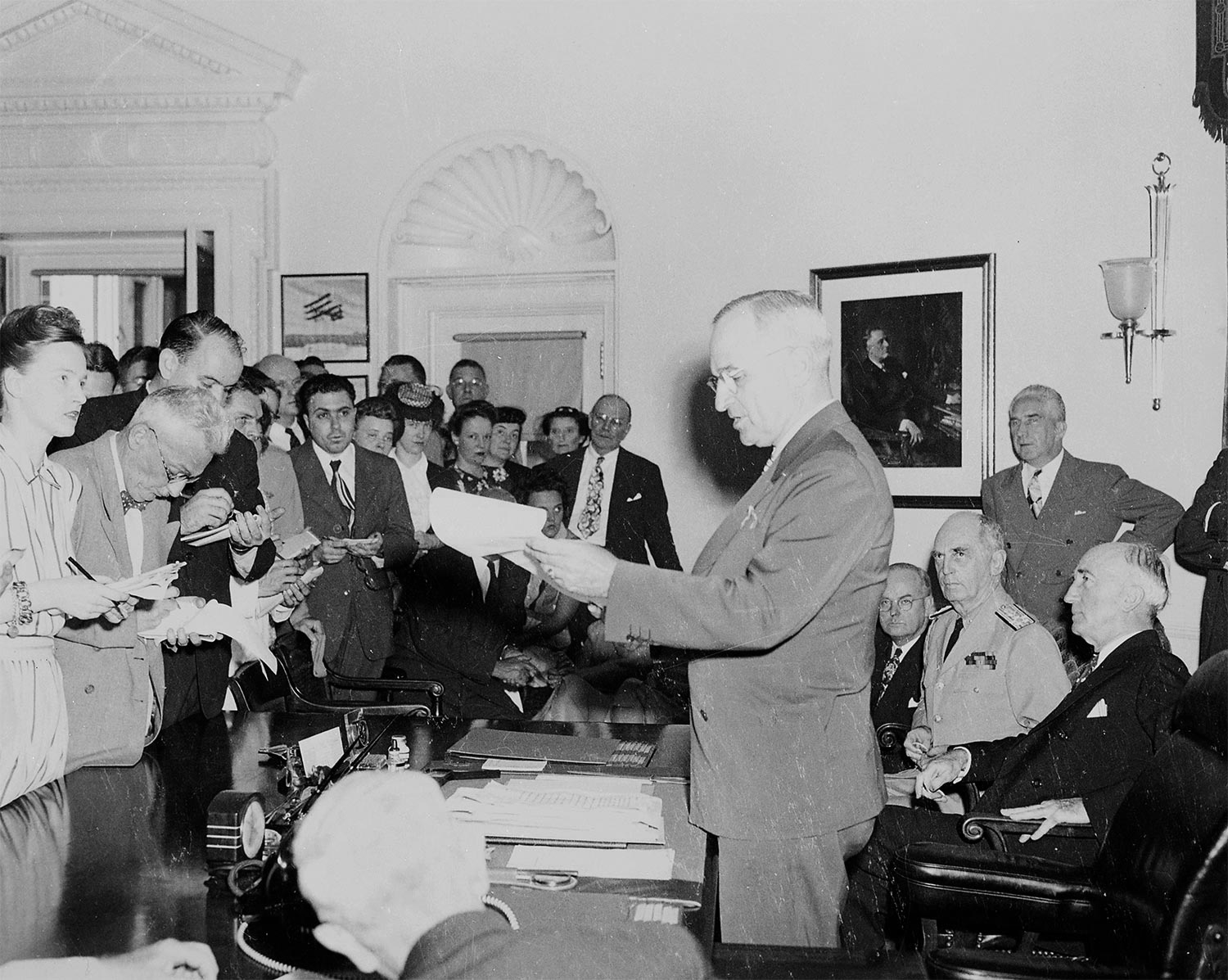

U.S. President Harry S. Truman announces the surrender of Japan to a jostling crowd of press reporters, in this photo produced by Abbie Rowe on the 14th of August in 1945.
The monumental moment had marked the end of World War II – that since the Japanese attack on Pearl Harbour in 1941 had claimed 4,07,316 American lives, out of 60 million casualties worldwide.
Harry S.Truman.
Born on the 8th of May in 1884, Harry S. Truman was the 33rd U.S. President. He was the son of a farmer from Lamar in Missouri and was, by all definitions, an ordinary man with an ordinary level of education and talents.
He was as Robert Nixon, a White Correspondent, described him, a man who had been picked at random off the street with absolutely no usable background and usable information.
Hailing from an impoverished background, he had little money to attend college and in his youth worked on the railroads and as a clerk. Later he had cheated his way into the army by memorizing an eye chart. But in the army he had distinguished himself as an officer and later as the captain of an artillery unit sent to serve in France, during World War I.
Truman had embarked on his political career in 1922. He was elected Senator in 1934 and Vice President in 1944. Then in the following year, as author A.J Baime puts it, ascended to the most powerful office in existence as a result of a confluence of bizarre events.
Asked to succeed his much loved and respected predecessor, Truman inspite of not possessing the same political eloquence and experience had not shied away but stepped up to the occasion, and on the 12th of April in 1945, he was sworn in as the President of the United States – after the sudden death of Franklin D. Roosevelt.
In 1948 he was chosen President again, this time having won the Presidential Elections by 2,135,361 votes.
Although Truman was the President who guided the U.S. out of World World II, he is remembered less for his constructive work and more as the only American President to have authorized the use of the atom bombs.
Truman and the Manhattan project.
Truman’s first brush with the top secret nuclear program had come about unintentionally in 1943 when as a senator he had initiated an investigation into the National Defense Program only to be stopped in his tracks by U.S. Secretary of War, Henry Stimson. Even as Vice President he had remained oblivious to the existence of the secret project.
It was only after he was sworn in as President, was he made aware of the Manhattan Project. He was briefly informed about it on the night of his oath, and fully debriefed thirteen days later on the 25th of April in 1945 – by Henry Stimson and Major General Leslie Groves, a high ranking military officer responsible for spearheading and keeping the nuclear project a secret.
In stark contrast, Stalin had known of the secret project long before Truman. Primarily through his spy network and informants like Klaus Fuchs – a scientist associated with the Manhattan project and a communist who considered the ideologies of the Soviet Union to be far superior to that of the U.S.
Trueman sanctions the use of the atom bombs.
Though Truman is known for authorizing the use of the atom bombs on Hiroshima and Nagasaki. A decisive call be had reserved solely for himself and taken after a lengthy discourse with his advisory committee and the U.S. Joint Chief of Staff.
The use of the atom bombs was in reality an allied agreement, particularly a British-American joint agreement. Winston Churchill was full aware of the clandestine operation and kept updated with developments.
Furthermore, the decision of deploying the atom bombs was setup for him by his predecessor, Franklin Roosevelt. In 1939 Roosevelt had sanctioned funds for the project and in collaboration with Churchill paved the path for their use. It was he who had proposed for the atom bombs to be used on Nazi Germany and Imperial Japan, if the need had arised.
Both Germany and Japan at the time were also experimenting with developing their own atomic weapons but had failed to achieve any results.
When Truman had decided to sanction the use of atom bombs.
The decisive call to use the atom bombs had come about after the close of the Potsdam Conference held between the 17th of July and 2nd of August in 1945.
In this conference that was held at Potsdam in Germany, Truman, Churchill, Stalin and other allied leaders had met to address issues related to the recently concluded war in Europe. From this conference also had emerged the Potsdam Declaration and which was essentially an ultimatum issued to Japan for unconditional surrender.
This declaration was issued on the 26th of July in 1945, two months after the unconditional surrender of Germany on the 8th of May in 1945. It was issued by Truman, Churchill and the Chinese premier, Chiang Kai-Shek.
Japan had rejected the ultimatum, since it had not mentioned the fate of the Japanese emperor, Michinomiya Hirohito.
Criticism of Truman’s Decision.
Though Truman at the time had clearly stated, the aim was not the destruction of the Japanese culture or the imprisonment of the people but only to stem Japan’s military aggression, in modern times questions have been raised over his historic decision.
According to a section of modern day historians, Japan at this stage of the war had reached the brink of collapse both economically and militarily. Naval blockades had starved her of resources. Defeat and near annihilation of her forces had left her depleted in manpower. Regular bombardments had razed her cities and disrupted her infrastructure.
These historians believe Japan would have inevitably surrendered by the 1st of November in 1945 even without having to launch an invasion let alone deploy the atom bombs – with Soviet Russia having declared war on her and U.S. forces closing in from the Pacific.
The widely accepted view.
The more widely accepted view, however, remains that the use of the atom bombs was primarily to bring World War II to an effective and quick end – without having to sacrifice a million more human lives, both allied and Japanese.
A key factor that is said to have influenced Truman’s decision towards this end was public pressure. By this stage of the war, the American people had grown weary of the conflict and begun to display signs of anxious concern. This sentiment is reflected in the words of U.S commanding officer George Marshal and U.S. Chief of Naval Operations, Ernest King.
While Marshall had famously stated, that a democracy cannot fight a seven years war. King had responded, that pressure at home would force a negotiated peace before Japan was defeated.
Thus, when Japan had initially refused to surrender and a full fledged invasion of her homeland had become a necessity, the deployment of the atom bombs had taken priority – especially in view of the fact that Japan at this time was waging a fanatical war, and an invasion would have inevitably resulted in higher than acceptable casualties.
Among the scholars and historians who support and argue in favour of this stream of thought are military historian Paul D. Walker, author Denis Wainstock and historian Robert P. Newman.
While with curated information procured from archives, Walker informs that U.S. war planners at the time had anticipated the invasion to have cost between 8,00,000 and 1,000,000 casualties – since at this time Japan was waging a fanatical war with suicide attacks having become its main offensive, in line with her continuing agenda to groom its entire male population with the ancient Bushido code of honor.
Author Denis Wainstock, strengthens the argument by quoting the words of Japanese Admiral Tomioka. Who after realizing a Japanese victory was impossible to achieve, is recorded to have said that the only alternative left was to discourage an invasion by inflicting heavy losses.
Historian Robert P. Newman, further adds that besides the war planner’s concern over the high causality rate, morale was also a crucial factor.
After the victory over Germany, U.S. troops had looked forward to returning home under the assumption the terrible war was over. But when told that they had to still fight Japan in the Pacific, many had taken to openly complain and refused to continue.
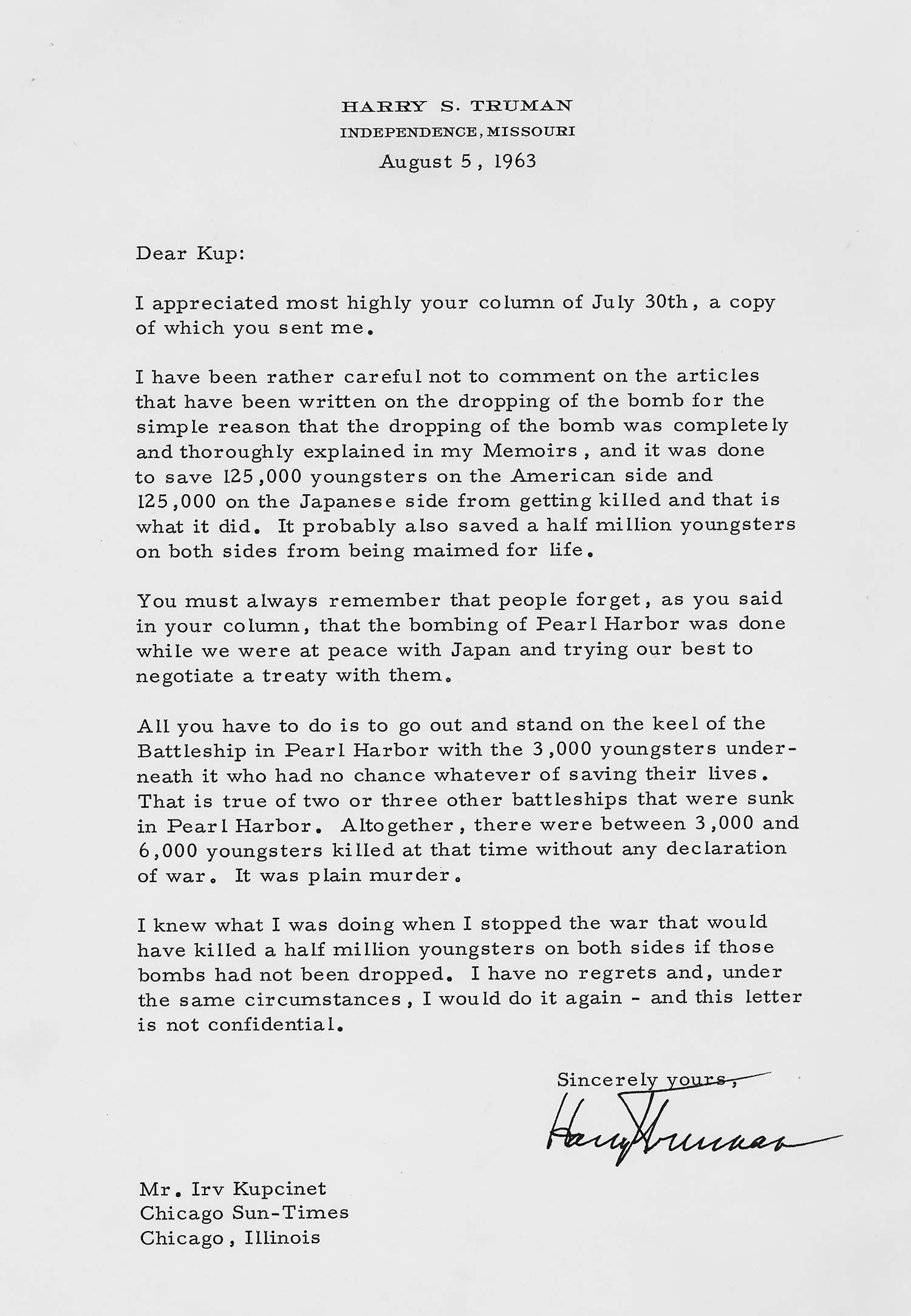
Truman had not only accepted the full responsibility for deploying the atom bombs but had also stood fast by his decision till his death on the 26th of December in 1972. He had defended his decision in his memoirs as well as to the public and press.
Photographer, Abbie Rowe.
Abbie Rowe was a former public works and distinguished National Park Service photographer. In 1941 he was assigned to Roosevelt and went on to document the tenures and presidential activities of four more U.S. Presidents, till replaced by John F. Kennedy in 1961.
Rowe was assigned to the White House when there were no dedicated photographer for the job. Between 1941 and 1961, he produced an exhaustive collection of photos featuring presidents, events, ceremonies and presidential activities.
Prior to his death in 1967, he was honoured with the distinguished Service Award from the Department of Interior.
The photo Rowe produced on this day, was not just of a U.S. President making an announcement inside the Oval Office, but a milestone in history, and an announcement that would leave an entire nation jubilant.
It is now archived with the U.S National Archives Catalog as a part of its photographic series related to the administration, family and personal life of Harry S. Truman, 1957-2004.
I F I This is an Independent Story produced to unravel the history behind this featured Vintage Photo from 1945. The story also sheds a bit of light on Harry S. Truman and what spurred his decision to deploy the atom bombs. It has been created out of facts curated from literary and historical sources. I