
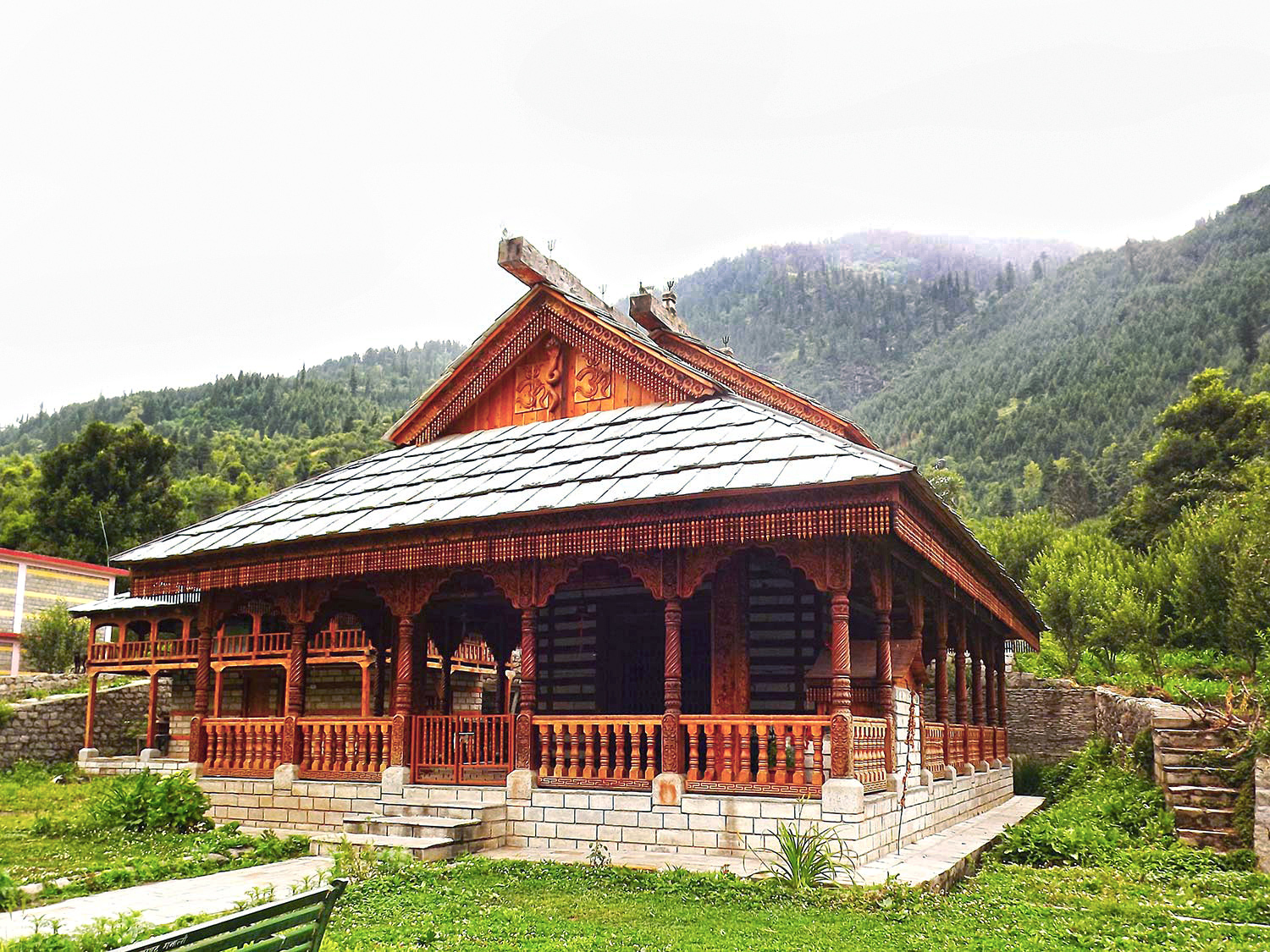

On an elevated stretch of pious ground in the village of Goshal, a collage of wood, stone and slate mesh together to present the edifice of Kana ‘Naga’, locally known as the Goshali ‘Naga’.
The temple, built as per the doctrines of the Kath Kuni style of architecture is a single storied structure with a slanting roof and a veranda that warps around the sanctorum. The entire structure sits inside a fenced but modestly spacious enclosure.
Kath Kuni is a very common building style in these parts of the Himalayas. It is to be found in the blueprint of houses, civic structures and religious building, in almost every village dotting the scenic hills. The word ‘Kath’ means wood and ‘Kuni (a corruption of the word, Kona)’ stands for a corner. Kath Kuni is basically a style of ‘wooden architecture’.
Traditionally, this style of architecture made use of natural construction materials such as timber and stones, but of late, slates have also found their place in the design.
The local populace, considers the Kath Kuni to be a highly efficient building style, and using it create their buildings to be seismic resistant structures and fitting examples of modern-day sustainability – with the natural thermal interiors also serving as storage space.
The origin of this particular style of architecture remains unexplored, but the style very likely sprouted in a geographical region where resources were scarce, other than the availability of wood, and inhabitants endured harsh, cold weather.
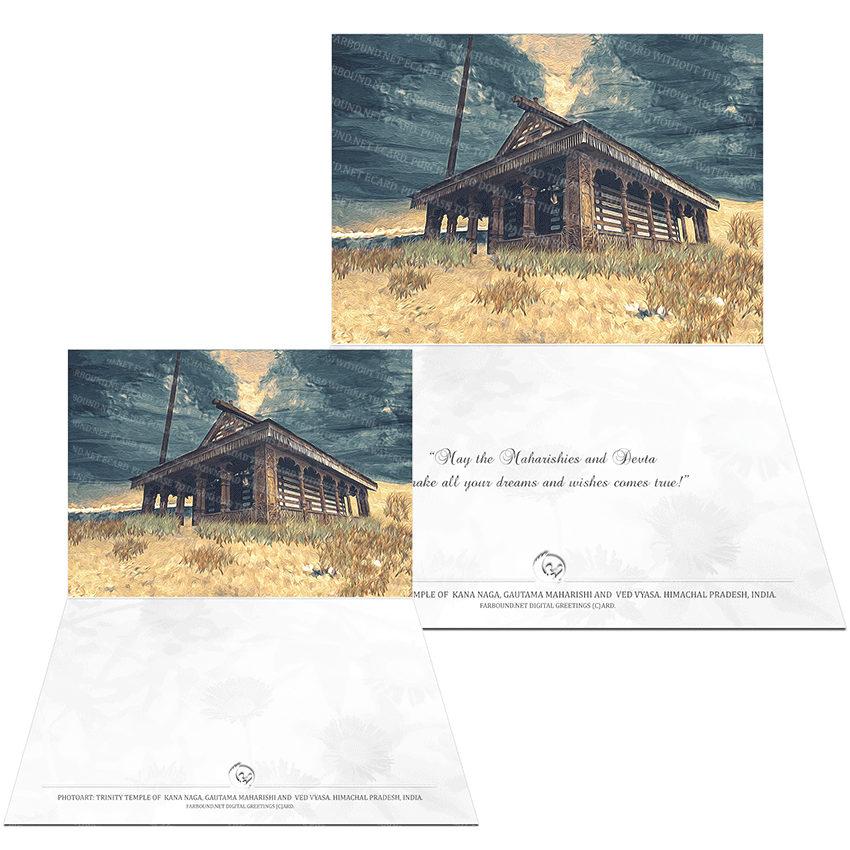
Greetings Cards by Farbound.Net for Goodwishes.
Actual Dimension: 1200 x 1203 pixels.
Origin of the trinity temple at Goshal.
Like the architecture, the origin of the temple, too, remains obscure. What is presently known, however, is that this temple, for some time now, has been dedicated to two venerable sages from Vedic mythology and a serpent deity.
Namely, Gautam Maharishi, a learned sage, who turned his wife into stone after her supposedly adulterous affair with the king of the Devtas, Indra. Veda Vyasa, one of the authors of the epic Mahabharata, and Kana ‘Naga’ – a serpent deity.
According to a western Himalayan legend, Kana ‘Naga’ is one of the eighteen children of Basuki – the mythical lord of snakes that stays coiled around the neck of Shiva like a sacred Brahmanical thread.
In the village of Goshal, and in chronological order, he is the oldest of all three divinities, and if we are to abide by what the legend tells us, he is also the patron deity of the village and the principal owner of the temple.
The legend of the Atthara Kardu.
The Atthara Kardu is a legend to be found in the pages of the western Himalayan folklores. The name comes from one of the several dialects spoken in the state of Himachal Pradesh – and is thought by scholars to have originated from Kadru of the Kashyapa-Kadru legend of Vedic mythology, in which Kadru is portrayed as the mother of all snakes.
In essence, the Atthara Kardu (in English, 18 serpents), is a mythical account of how serpent worship came to grow roots in hills of Himachal and describes the coming of 18 ‘Naga’ deities.
Historically, this legend is a composite snap shot of the presence of the historical ‘Naga’ tribes in the mountainous region. Supported by information provided in Vedic texts, such as the Mahabharata.
Mention of Kana Naga in the legend of Atthara Kardu.
According to the legend, once long ago Basuki, disguised as a handsome young man, had wooed and bedded a beautiful girl from the village of Goshal – with the union producing eighteen serpents.
Basuki, however, had no desire to reside at Goshal for long and one day had departed to travel far away lands. But before leaving he had instructed his wife to keep his children inside a bamboo basket and feed them with a bowl of milk each day, with a lit incense placed nearby.
His wife had dutifully obeyed his instructions till one fateful day, forced to leave on an errand she had tasked her sister (sometimes said to be her mother) with the responsibility of placing the offerings.
This other woman, hitherto oblivious, to what was inside the basket had let her curiosity get the better of her, and had unfastened the lid to have a glimpse. Upon espying the nest of serpents, however, she was so terrified that she had accidentally dropped the lit incense into the basket and, thus, started a fire.
Scorched by the smouldering embers, suffocated by the smoke and the heat, the panicked serpents had escaped by breaking out of the basket. They had scattered in different directions and made their way to different parts of the Himalayas, to be later discovered by the local populace and edified as deities – with each named after their individual ordeal.
Out of these eighteen serpents, Kana ‘Naga’, had remained behind at Goshal. The name ‘Kana’ literally means ‘one eye blind’, and is an allusion to the fire accident that left him impaired in one eye. Kana ‘Naga’ was later rescued and edified as the patron deity of Goshal.
His temple at Goshal lies close to the temple of his brother Shirgan ‘Naga’ at Bhanara – see the Farbound.Net story: The Himalayan temple of Shirgan Naga at Bhanara.
Alternate Legends related to the coming of the Nagas.
Although this legend of Basuki consorting with a beautiful girl from the village of Goshal is quite popular, it isn’t the only one in existence. Another version, and one that may have appeared at an earlier date, mentions only seven children born to Bauski and his wife.
In this particular legend, the mother is not a girl from the village of Goshal but a ‘Naga’ woman who, having taken shelter inside a potter’s shop, had given birth to the seven serpents in an unbaked earthen pot. Which, when put in the fire the next morning, had forced the reptiles to make their escape in a similar fashion.
Furthermore, there is also the legend that has the Vedic sage Jamdagani bringing home the eighteen ‘Naga’ deities in a bamboo basket after visiting Mount Kailasha – see the Farbound.Net story: Behind the myth of the serpent people.
Local Legend describing the construction of the temple.
Other than these legends, there is also a local legend, and which specifically describes the construction of the temple at a later date.
This legend that appears to have cropped up locally, in the Kullu-Manali belt, in more recent times, narrates the temple was built after a man tilling his farm had stumbled upon a holy relic and a heavenly voice had revealed the identity of the object as the embodiment of the Trinity.
Born dumb, this encounter had blessed him with the power of speech.
Nagas, a historical tribe.
Historically, the ‘Nagas’ are stated to a tribe of Tibeto-Burmese speakers who had migrated into India from the North East, sometime in 4000 Bce. The historian A.K Mazaumdar, thought, they were physically similar to east Asians in features and had boasted of high cheekbones, muscular frames and very little facial hair.
Scholars like Mudaliyar C. Rasanayagam, on the other hand, was convinced that during their stay in India, the ‘Nagas’ had become a more mixed-race through intermarriages with other local tribes, including both the Harappans and the Indo-Aryan Vedics.
Their later presentation in Vedic texts as half-human, half serpent beings, is believed to have sprung from their association with the serpent (the hooded Cobra) that generations of Vedic writers had merged with mythology and the supernatural to present them as mythical beings, divinities and evil spirits.
This act of zoomorphism, a prehistoric human tendency of infusing animal traits to humans is remarked upon by British-era historian James Talboys Wheeler when speaking about the ‘Nagas’.
In the process of time these Nagas became identified with serpents, and the result has been a strange confusion between serpents and human beings
James Talboys Wheeler – A History of India.
Furthermore, Vedic texts, especially the epic ‘Mahabharat’, a poem originally composed to immortalize the Kuru race, also contains enough reliable information for historians and scholars to say with certainty, the ‘Nagas’ were a people of flesh and blood.
The epic provides a list of several non-vedic tribes that existed in the hills of Himachal in antiquity, such as the Daradas, Kiratas, Khasas, Tanganas and the Parvatas (unidentified clans).
Out of which the ‘Nagas’, Kasmiras and Pishachas are described to have dwelled in the vicinity of the present day region of Kashmir, bordering the present day state of Himachal in India.
These serpent deities, may originally have been ‘Naga’ deities or chieftains. While the mention of ‘snakes in a basket’ in the legends, perhaps an allusion, to their practice of actually keeping serpents in earthen pots and bamboo baskets.
Integration of Vedic sages with Kana Naga.
The integration of the Vedic sages, Gautam Maharishi and Veda Vyasa, with the legend of Kana ‘Naga’ was the outcome of Vedic assimilation – a process that begun in antiquity and witnessed the absorption of non-vedic deities into the Vedic sphere of belief, either as representations of Vedic sages or deities, or as associates – as is the case of the Trinity temple of Goshal.
Thus, while Kana ‘Naga’ with his own unique legend, may possibly have been the sole and original deity of Goshal, in present times he shares his temple with the Vedic sages.
It is possible, like Bhanara in antiquity, the village of Goshal also may once have been a ‘Naga’ settlement or a village where the ‘Nagas’ had merged with the local populace through wedlocks and alliances. Like Bhanara, however, there now hardly exists any residue of a historical past, other than legends and the temple of Kana Naga.
What the name of the village means.
The name Goshal comes from the Sanskrit word ‘Goshala’ – which in English translates into a cow shelter. The dwellers of the village believe, that it was here, among their ancestors, the Vedic sages Gautam Maharishi and Veda Vyasa had once lived in their ashrams.
Kana ‘Naga’ is highly revered by the Goshali villagers and, much like his brother Shirgan ‘Naga’, interacts with them through his intermediator, the temple’s Gur (shaman/priest).
The original temple was probably a mound of stones. Moreover, the origins of Himachal’s non-vedic deities differ significantly from the Rigveda deities of the Indo-Aryans – see the Farbound.Net story: The indomitable Saraswati. From a river to a strong willed independent woman, the evolution of a Rigveda deity.
When I last visited the temple in 2016, it was during the evening hours and the sleepy little village was abuzz with activity. A newspaper article I later discovered online, mentioned the village of Goshal maintains silence for a month out of respect for the serpent deity – August was perhaps not that month.
I F I This is an independent story exploring the temple of Kana Naga in relation to his legends in Western Himalayan Folklore. The story is primarily built out of facts curated from literary sources, but also takes into account local folklore and information available in local publications. I