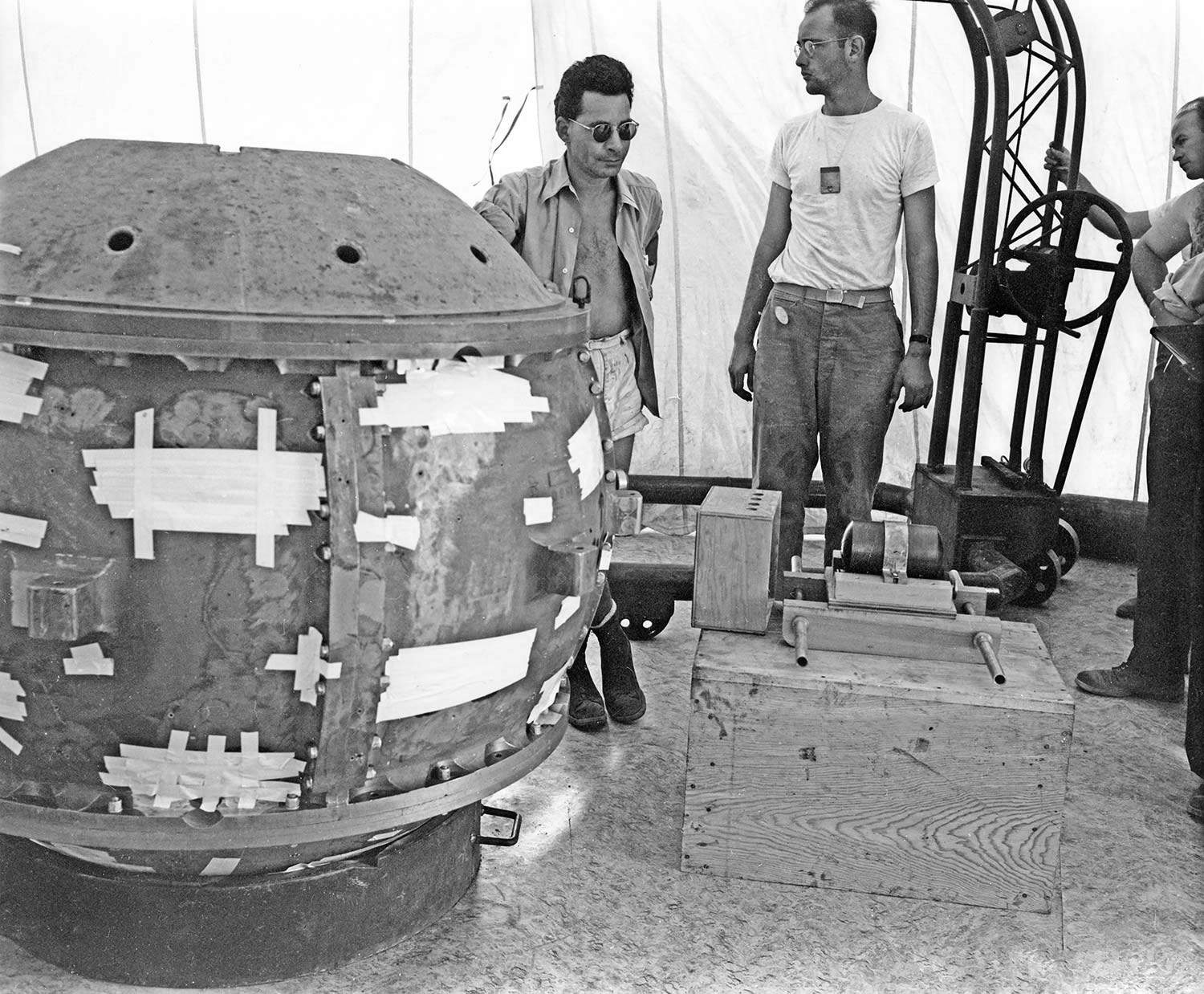

Clad in a pair of old army boots, short pants and sunglasses, and with his shirt unbuttoned for better ventilation against the intense desert heat, Canadian physicist Dr. Louis Slotin leans against a partially assembled Trinity Gadget in this photo produced on the 13th of July in 1945.
The Gadget was scheduled for detonation two days later and would usher in the world’s first atomic explosion, at 5:29 a.m.
A scrawny 34-year-old assistant researcher with a PhD in Physical Chemistry, Slotin was an indispensable member of the Manhattan Project’s Critical Assembly Group, tasked with the assembly of the most dangerous components of an atom bomb – and which on this day he performed with drilled precision.
He had first kept a watchful eye for radiation spikes as a crew had taken to assemble the Gadget inside a generator lit ranch house with tapered walls and aluminum painted roof, and later he had personally placed the core component inside the Gadget.
Louis Slotin, the chief armorer at Los Alamos.
Though Slotin played an important and constructive role in the development of the atomic project and was nicknamed the chief armorer for his expertise in handling volatile materials with ease. His methods, nonetheless, are considered by many in retrospect to be somewhat reckless – with even Fermi, having cautioned him once.
Slotin at the time of his mishap was experimenting with the same 6.2 kilograms of nickel-plated plutonium orb that a year prior had resulted in the death of his friend and assistant Harry K. Daghlian on the 15th September in 1945(see Farbound.Net snippet: The lethal after-effects of radiation poisoning).
It is universally agreed upon that his mishap was solely due to the reckless techniques he employed, and which had emerged from over confidence and haste. Prior to the mishap Slotin had skillfully carried out the same procedure countless times. But on that day, however, he was in hurry to get through the procedure.
How Slotin’s mishap occurred .
Slotin’s mishap occurred on the 21st of May in 1946, during an unscheduled experiment he organized to familiarize his successor, Allen Cushman Graves, with the process of monitoring neutron emission with a critical assembly unit. Six other scientists were also there with him on that day.
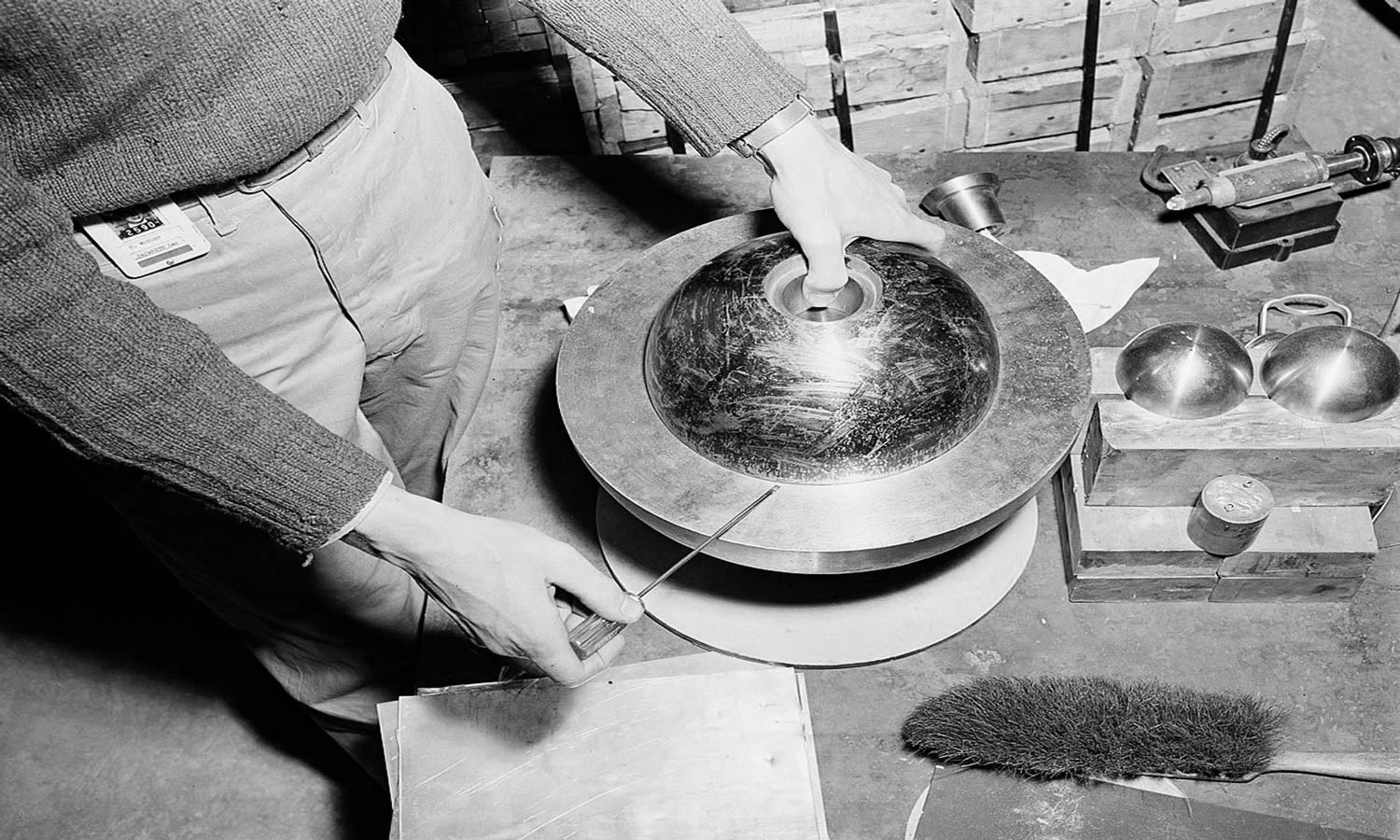
Abandoning the safety protocol of using wooden blocks to keep separate a Beryllium shell from a Plutonium core, he had instead relied on the thin blade of a screwdriver.
The Beryllium shell, which he had held with his left thumb and fingers had slipped and landed on the core with the blade of the screwdriver unable to keep the two separated. This had created a super-critical mass, and which in turn had produced a sudden burst of neutrons, gamma rays, soft x-rays and electrons.
As Slotin was standing very close to the assembly, he was instantly exposed to a dangerous 2100 rem of radiation, and which had further increased when to prevent an explosion he had dismantled the assembly by hand.
Slotin’s symptoms of radiation exposure.
The burst of radiation had left him nauseated and weak within moments. Though he was quickly admitted to the Los Alamos hospital, he passed away on the 30th of May in 1946, barely nine days after the incident. His exposure of 2100 rem was far above the 510 rem Daghlian was exposed to in 1945.
Slotin’s skin had turned blue then red. His white blood cells were completely obliterated, and his end had come about in a coma – with his parents by his bedside.
Out of the seven other scientists who were present with Slotin on the day of the mishap, the radiation burst was responsible for minor and serious ailments.
Allen Graves, later a divisional head at Los Almos, developed cataracts. Four out of the other six scientists present were afflicted with either acute myelogenous leukemia, refractory anaemia or myocardial infarction, and which led to their deaths at a later date.
How Slotin’s death effected Los Alamos.
The second death to occur at Los Alamos, Slotin’s death had a chastising effect on the scientific community there. Following his mishap, all experiments at the nuclear site was brought to a temporary halt in 1946.
Existing laboratories were reinforced with radiation shielding and human operators were substituted with robotic arms – eventually, a new laboratory was built at the Pajarito Canyon. Inside this new laboratory, human operators performed risky experiments with remote control devices, from within a safe and secure control room a quarter of a mile away.
Known to his colleagues at Los Alamos as a quiet and friendly person and someone easy to get along with, Slotin at the time of his mishap was on the verge of leaving Los Alamos.
Having spent more than a year with the Manhattan Project, he was eager to return to the University of Chicago. More importantly, and before rejoining, proceed with a new assignment.
This new assignment he was entrusted with was to monitor the detonation of an assembly unit at Bikini coral atoll in the Pacific. In 1945, Slotin had put in a request to witness the assembly of the atom bombs on the island of Tinian in the Pacific. His request was denied. Thus, the assignment at the coral atoll was an opportunity he looked forward to.
His travel permit was approved and he was impatient to be on his way. The assembly unit that was to be detonated at the coral atoll was put together by him and Daghlian.
The photograph.
While most of Daghlian and Slotin’s photos during their hospitalization at the Los Alamos hospital was produced by army photographer Jon Michnovicz – who was assigned to document activities at the atomic city between 1944 and 1947. The photo on top does not bear a photographer’s name in the credits.
The photo, however, is archived at Los Alamos National Laboratory, the rightful legatee of the former Manhattan Project.
Prior to arriving at Los Alamos, Slotin had built the world’s first Cyclotron – during his five-year tenure at the University of Chicago. The critical parts he assembled on the 21st of May in 1945, was the same one marked for detonation at the Bikini coral atoll. The code name of the project was Operation Crossroad.
The 6.2 kg Plutonium sphere responsible for the deaths of Slotin and Harry Daghlian was nicknamed the Demon Core.
I F I This is an Independent Story highlighting this Vintage Photo of Louis Slotin from 1945. The story also sheds light on the mishap that befell Slotin during a demonstration and led to his death due to radiation. Slotin was the second American casualty to succumb to the after effects of radiation exposure. It has been created from facts curated from literary and historical sources. I