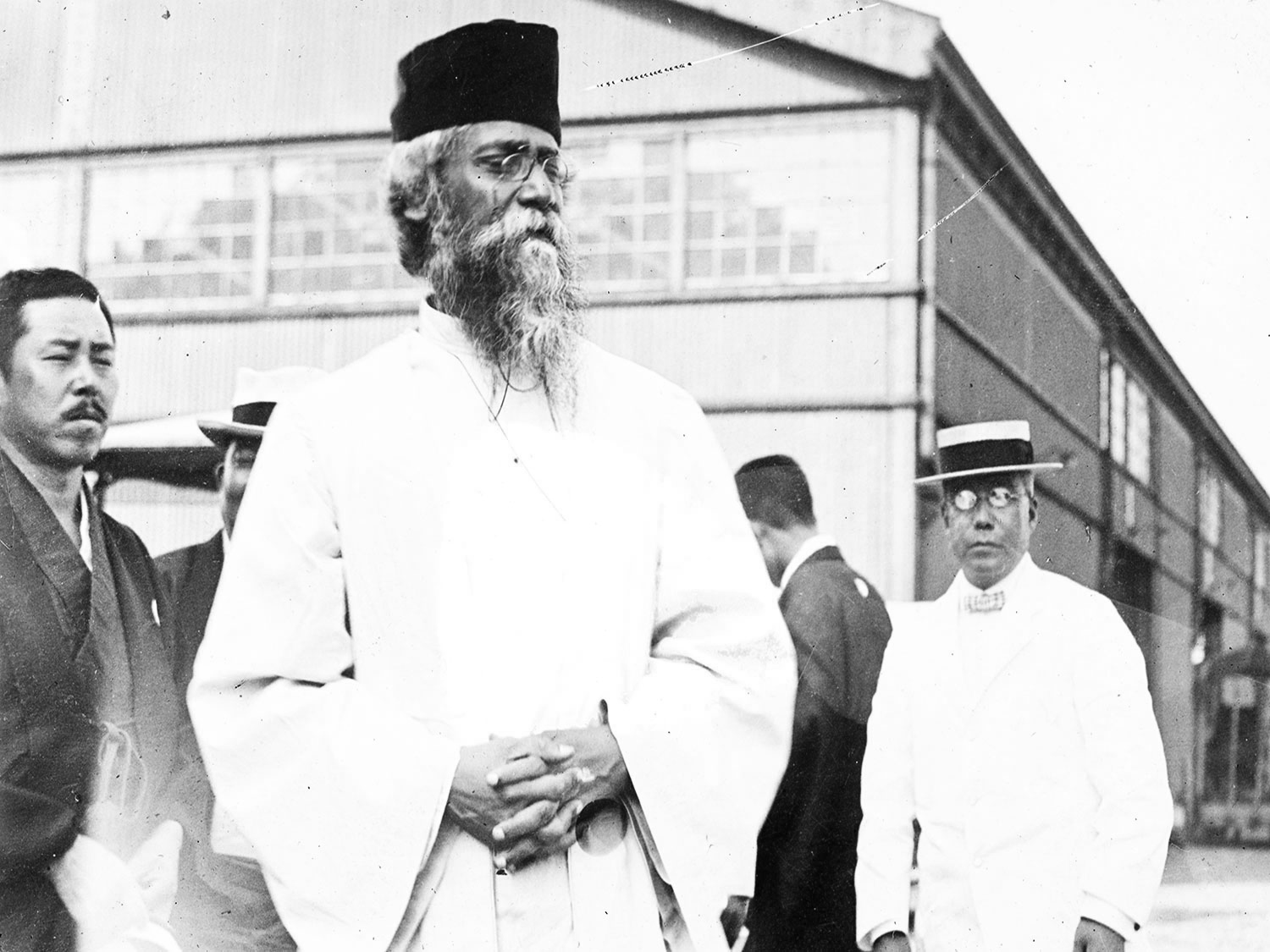

Bengali polymath and Asia’s first Nobel Laureate, Rabindranath Tagore, passes a contemplative glance in this photo produced by legendary photographer George Grantham Bain, in May 1916.
Tagore at the time was in Tokyo to foster cultural ties between India and Japan. He was hosted and welcomed by the Nihongo Newspaper, Asahi Shimbun (in English, the Morning Sun). While Bain was there to cover the poet laureate’s visit for the Bain News Service – a photojournalism agency he had founded in 1898.
Rabindranath Tagore.
Born on the 7th of May in 1861, Rabindranath Tagore (in Bengali Rabindranath Thakur) was a versatile creative genius. In his lifetime he was a poet, playwright, storyteller, lyricist and artist. His contribution of poems, songs and stories not only embellished Bengal’s literary landscape with wit and depth but continues to inspire generations of creative talents from authors to filmmakers.
Hailing from a wealthy and affluent land-owning aristocratic family of Brahmanical roots he was sent to England to be educated in jurisprudence, at the age of seventeen. Yet, had abandoned his study of law at the University of London for language and literature, and upon his return in 1880, dedicated himself to writing poems, stories and composing music.
Though his father had wanted to see him as a barrister, Tagore, nonetheless, had persisted in the pursuit of creativity, and in the following years, established his reputation as one of India’s finest literary personality.
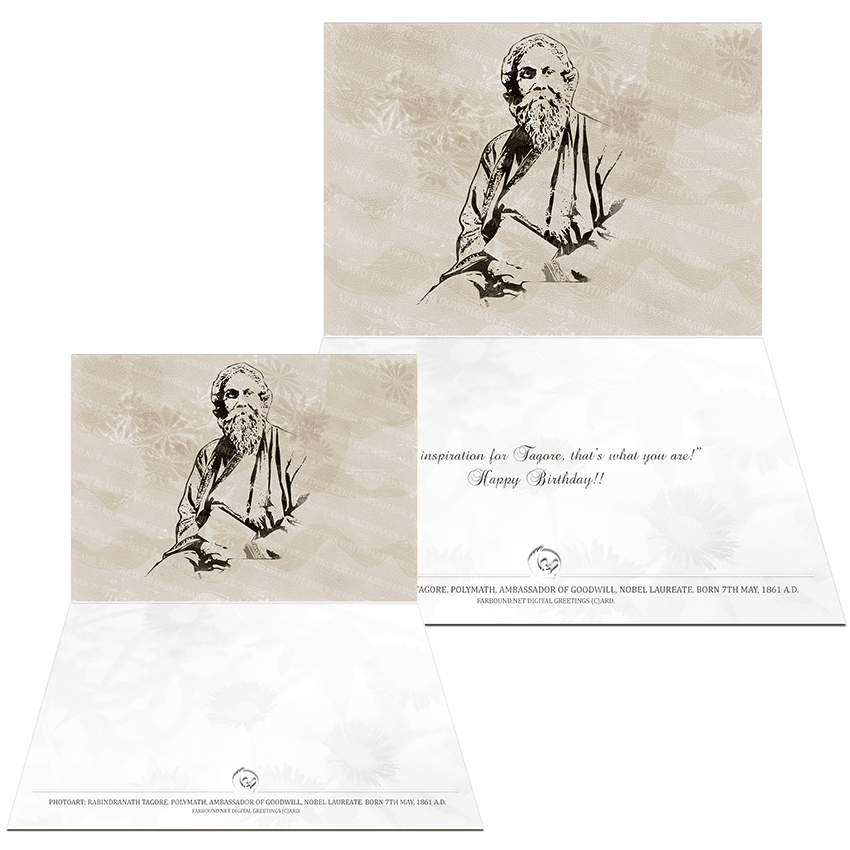
Greetings Cards for Birthdays, featuring Rabindranath Tagore
Actual Dimension: 1200 x 1203 pixels
Tagore, however, was more than just a poet of his day. He was an open-minded scholar critical of his own follies and a revolutionary thinker who sought to blend together the best of European and Indian values.
He was also a social reformer who worked tirelessly for the welfare of the neglected classes, buried under India’s caste hierarchy and the taboo of untouchability.
In 1921 he founded the Visva Bharati at Santiniketan as a center of culture and learning to connect India to the world. In 1922 he founded Sriniketan, an institute for Rural Reconstruction. This later venture he established with British agricultural economist, Leonard Knight Elmhirst – his secretary and friend, and who later toured with him for a great many years.
Rabindranath Tagore, the Nobel Laureate.
What catapulted Tagore into the limelight was his experimental translation of the Geetanjali in 1912. The Geetanjali was a collection of poems he had composed after the death of his wife and children in 1905 and was originally written in his native language of Bengali. Upon its translation into English, however, the collection had turned into an international sensation – after it was discovered by his friend, the author and painter, William Rothenstein and Irish poet W.B Yeats.
Furthermore in 1913, this collection of poems had gained him a Nobel Prize for Literature – and made him the first literary person from India to tour and promote intercultural harmony via lectures and speeches.
Rabindranath Tagore’s grand vision of intercultural harmony.
Though Tagore was a close acquaintance of Nehru, Gandhi and other politicians of the All India National Congress Party, he was, nonetheless, an anti-nationalist at heart. He was critical of Gandhi’s ideologies and condoned Gandhi’s notion of Swaraj as narrow and chauvinistic.
He was more in favour of championing humanity, justice, and equality for all, and was an outspoken advocate who stood rigidly by his own ideals. Tagore also considered patriotism and nationalism to be limited in scope, political, restricted to boundaries and inferior to the grander idea of intercultural harmony, what was right and what projected the greater good of humanity.
On being criticized for his stance by Abala Bose, wife of Bengali botanist Jagdish Chandra Bose, he had explained his stance on patriotism in a letter with the following words.
Patriotism cannot be our final spiritual shelter; my refuge is humanity. I will not buy glass for the price of diamonds, and I will never allow patriotism to triumph over humanity, as long as I live
Rabindranath Tagore , Selected Letters.
A sentiment which he again expressed, this time on blind nationalism, through the protagonist of his popular novel, Ghari Barai (Home and the World).
I am willing to serve my country; but for my worship I reserve ‘RIGHT’. Which is far greater than my country. To worship my country as a God is to bring a curse upon it
Rabindranath Tagore -Selected Letters (Ghari Bari).
Rabindranath Tagore’s belief in Independence.
Despite the fact that Tagore was not an enthusiastic fan of Gandhi, he, nonetheless, firmly believed in independence. He was proud of his cultural roots and was sensitive to the suffering of his countrymen. He never once failed to openly criticize the vices of British colonial rule or express his indignation with letters and in prose – despite the deep respect he had for the British people and their system, and which he never hesitated to reveal with heartfelt praise.
In protest of the Jallianwala Bagh massacre that occurred on the 13th April in 1919, he returned the Knighthood, which was bestowed upon him by the King of England George V, on the 3rd of June in 1915. Prior to the renouncement of this honour, he had also strongly protested against the partition of Bengal in 1905.
His song, Amar Shonar Bangla (My Golden Bengal) that was originally composed to protest against the partition of Bengal is now the national anthem of the country of Bangladesh. While the opening stanza of his song, the Bharoto Bhagyo Bidhata, is the national anthem of India. It was first sung in Calcutta during an All India National Congress party meet in 1911.
George Grantham Bain.
Born on 7th of January in 1865 in Chicago (Illinois), George Grantham Bain was a globe trotting photojournalist. He had begun his career in journalism as a reporter with the St. Louis Globe Democrat and later worked as a correspondent. In 1898, after a stint with the United Press, he founded the Bain News Service – a photojournalism agency.
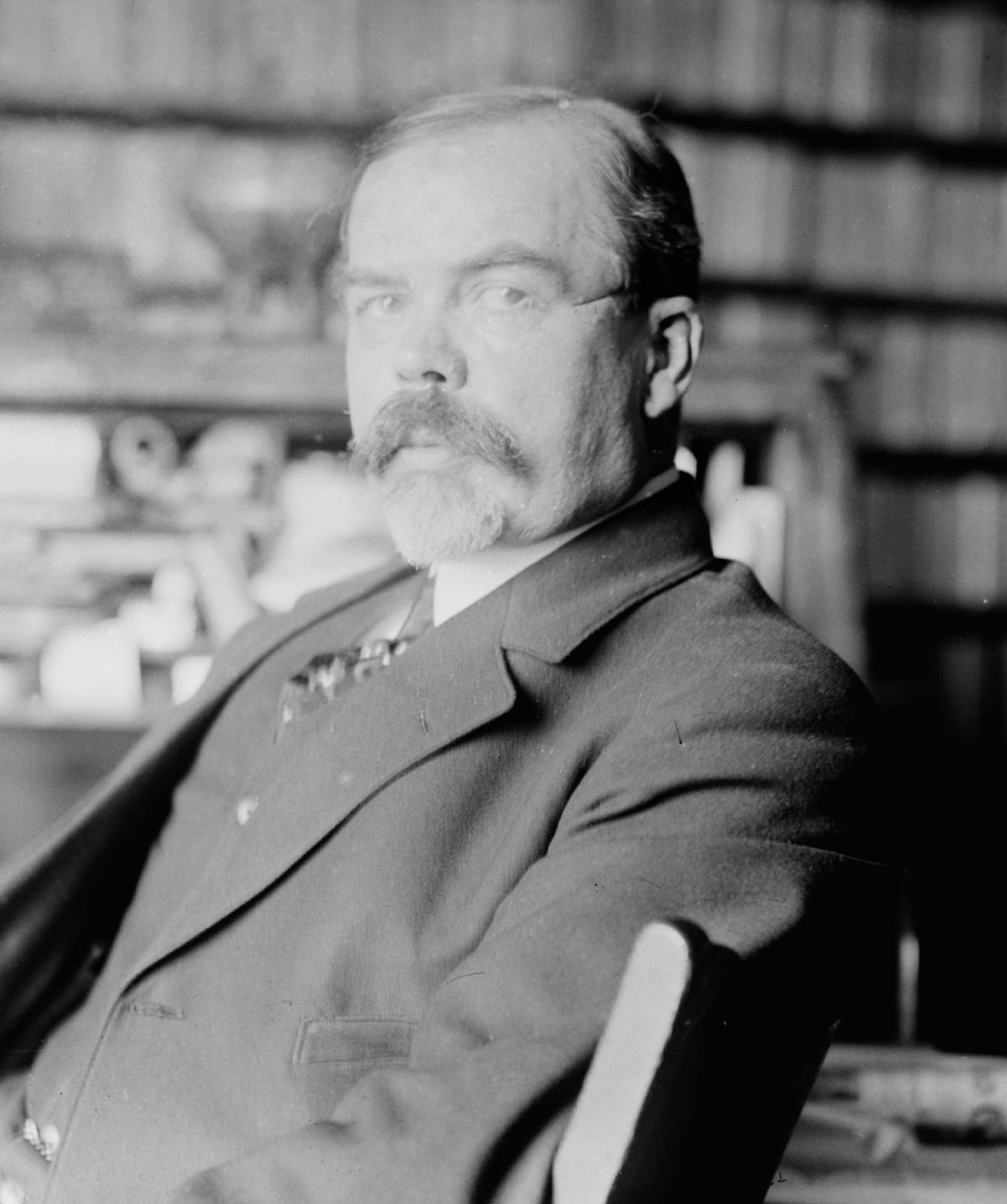
Bain was a pioneer in photo journalism and was later honoured as father of foreign press photographic news.
In his lifetime he amassed a massive collection of 50,000 photographic prints highlighting a wide variety of topics, that he captured in different parts of the world.
He passed away at the age of 79, on the 20th of April in 1944.
The photo.
In this photo that Bain produced in the May of 1916, Tagore can be seen walking in an undisclosed location in Tokyo, perhaps en route to deliver his lecture at either the Tokyo or the Keio university – as an ambassador of intercultural harmony.
The lecture, is now widely known as the Spirit of Japan and alternatively as India’s Message to Japan.
In this lecture Tagore had boldly criticized Japan’s rising nationalist spirit and imperialist tendency as well as praised her spirit of development. His words at the time had not thrilled the Japanese audience, and his reception had turned from a warm welcome to a cold acknowledgement.
Rabindrnath Tagore’s residence in Japan.
Tagore had landed at the port city of Kobe in May 29 and made his way to Tokyo. While in Japan he had resided with Tomitaro Hara, who was a wealthy merchant and a patron of the arts. Tomitaro Hara’s residence was in the Sankeien Garden in Yokohama and he had offered it to the poet laureate at the request of artist Yokoyama Taikan. Tagore had resided there with artist Mukul Dey and Charles Freer Andrews, a priest, educator and social reformer.
In 1937, Tagore was again invited to Japan, this time by Bengali revolutionary and extremist, Rash Behari Bose. He was invited to lend his support for a nationalist movement being planned in alliance with the imperial eastern power.
On this occasion, too, he had stood firmly by his former convictions and turned down his fellow countryman. His letter to Rash Behari Bose reflects both the hopes he once had for Japan and his disappointment in her actions during World War II.
I know in making this appeal, you counted on my great regard for the Japanese. For I like the rest of Asia, did once admire and look up to Japan, and did once fondly hope that in Japan, Asia had at last discovered its challenge to the West. That Japan’s new strength would be consecrated in safeguarding the culture of the East. But Japan has not taken long to betray that rising hope and repudiate all that seemed significant in her wonderful, and to us, a symbolic awakening. And has now become itself a worse menace to the defenseless people of the East
Rabindranath Tagore, Selected Letters.
I F I This is an Independent Story produced to unravel the story behind this Vintage Photo of Rabindranath Tagore in Tokyo. The story also sheds light on the photographer George Grantham Bain who took this photo in May 1916. It has been created from facts curated from literary and historical sources. I