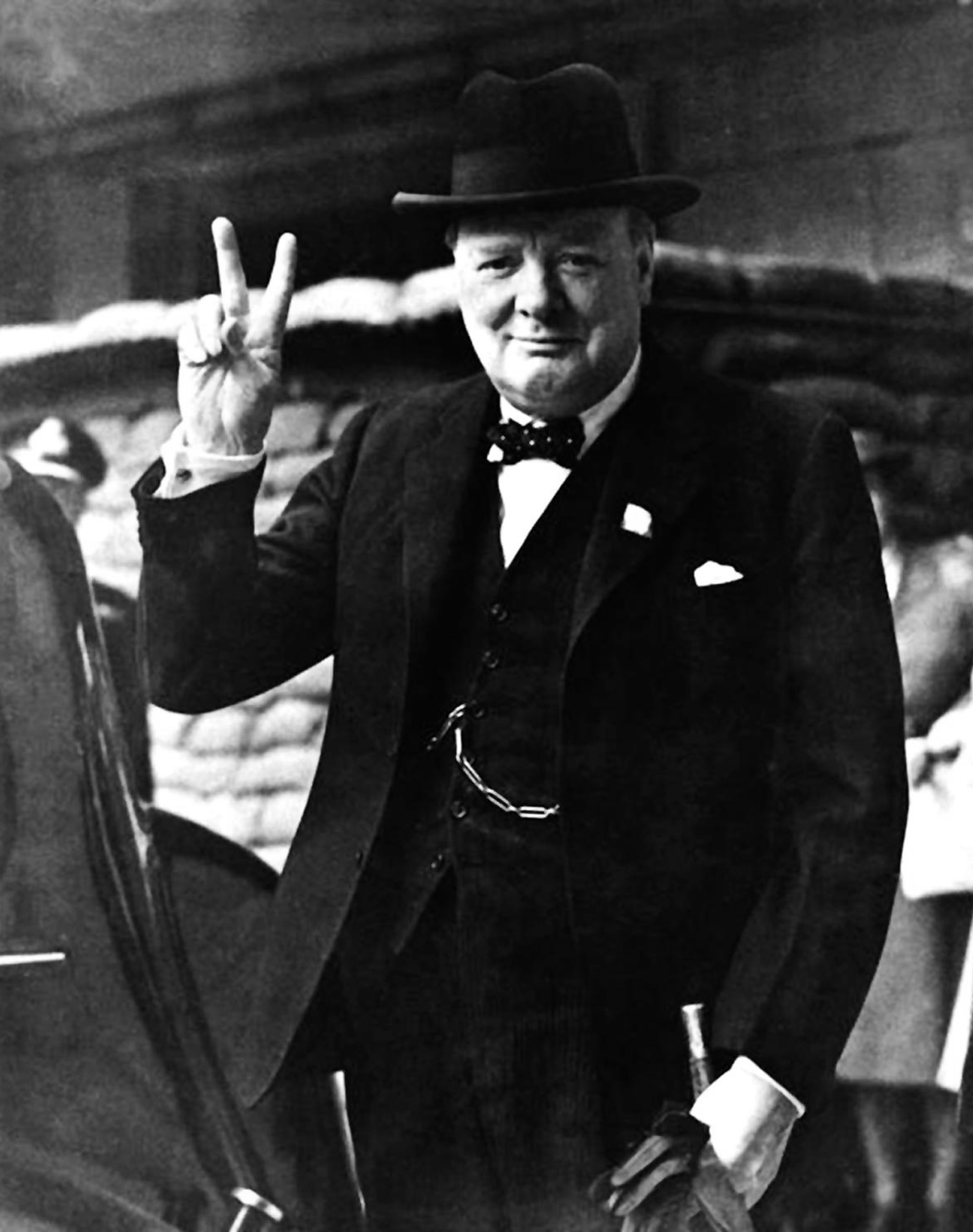

With palm facing the viewer, British Prime Minister Winston Churchill makes the proper Victory sign in this photo produced on an undisclosed date and in an undisclosed location.
Though now synonymous with Churchill, the V sign wasn’t invented by him but adopted from a rallying call made by Victor de Laveleye on the 14th of January in 1941.
Victor de Laveleye was a Belgian minister in exile and during a BBC radio broadcast he had called upon his countrymen to rally around the alphabet V, in their fight against Nazi Germany. Laveleye had chosen this alphabet since it was the first letter in “Victoire” (word for victory in French) and “Vrijheid” (word for Freedom in Dutch).
Churchill had subsequently incorporated it into his own speeches, and first mentioned it during a broadcast on the 18th of July in 1941.
Churchill makes the V sign in the U.S.
Churchill, however, had made the V sign famous in the U.S. during his historic visit on the 26th of December in 1941 – the day he had become the first British Prime Minister to address a U.S joint congress at Capitol Hill in Washington D.C.
Three months prior to this historic meet, U.S. President Franklin Roosevelt and Churchill had drafted the Atlantic Charter on the deck of the HMS Prince of Wales on the 14th of August in 1941.
This declaration had contained a set of clear objectives for the allied nations to respect during their war against the Axis powers and which had included the liberation of occupied territories, restoration of self-governments and lifting of trade embargo.
Also see photo of Churchill and Roosevelt: Farbound.Net story,Churchill weds Roosevelt: Atlantic Superpower Summit and the creation of the Atlantic Charter, 1941.
Furthermore, Churchill had also publicly announced the making of the charter in the English Parliament on the 24th of August in 1941, even though at the time the United States had yet to commit its military resources in World War II.
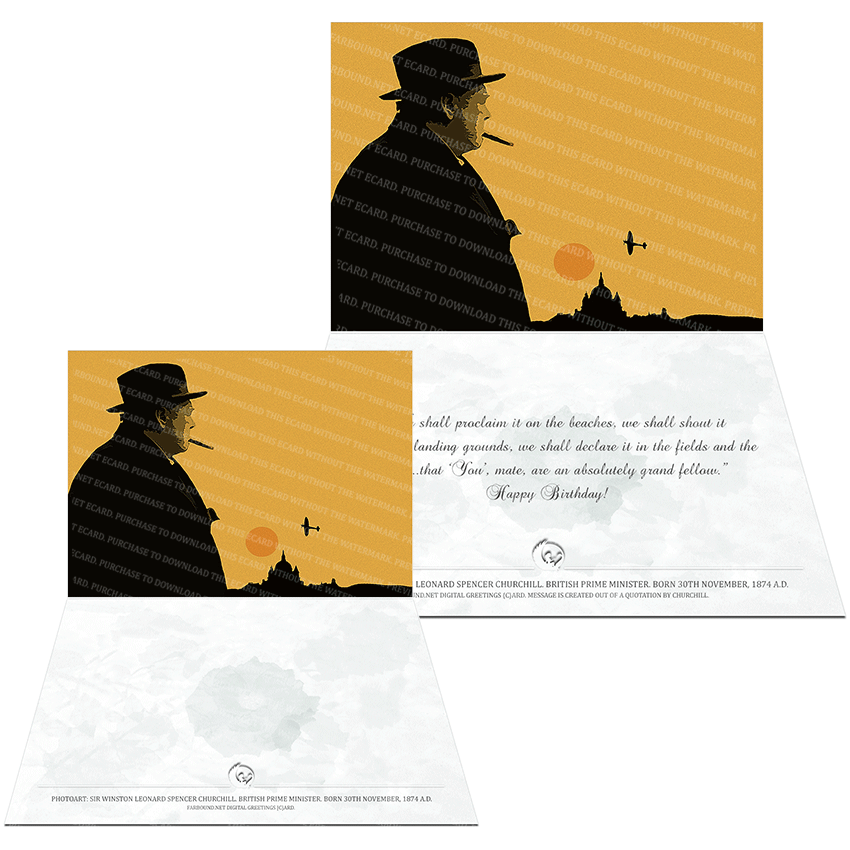
Greetings Cards by Farbound.Net featuring Winston Churchill.
Actual Dimension: 1200 x 1203.
His speech on Capitol Hill in December had taken place three weeks after the Japanese attack on Pearl Harbour on the 7th of December in 1941, and which had brought about the official commitment of the United States in World War II.
Churchill had embarked on the official visit to basically express solidarity and urge the United States to jointly combat the Axis powers with Great Britain.
At the end of this 30 minutes speech that was broadcast live across the U.S., he had famously flashed the V sign and received a standing ovation from those present.
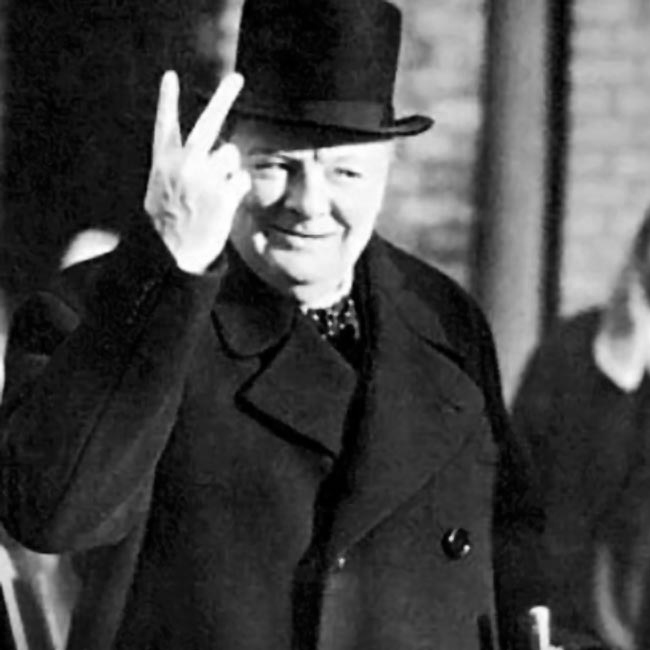
When Churchill had arrived in Washington in 1941.
Churchill had arrived in Washington on the 22nd of December in 1941 and prior to the convention, he had celebrated Christmas with the Roosevelts on the eve of the 25th. He had delivered Christmas greetings to a crowd of 15,000 people and later spend his hours preparing for the meeting the next day.
Churchill’s entourage on this occasion had included Lord Halifax, Lord Beaverbrook, his personal physician Charles Wilson and his youngest daughter, Mary Soames.
In the evening of the 26th of December, he had suffered from a mild heart attack but had later traveled by train to Ottawa to address the Canadian parliament on the 30th of December in 1941.
On the day of his speech he was 67 years old and had sailed for the U.S., across the Atlantic ocean, on the HMS Duke of York. During the ten day voyage, the ship had maintained complete radio silence to avoid German submarines.
Churchill’s V Sign in Reverse.
The reverse V sign made with the palm facing inwards is regarded as an insult in Great Britain, Ireland, Australia, New Zealand and South Africa. According to some sources, the sign is believed to have appeared in the 1780s as an offensive gesture – with parents encouraging children to make the sign towards Joseph Priestley, an English chemist and philosopher.
While the British Prime Minister was informed and educated on how to properly make the sign and its different connotations. He is known to have still gone ahead and flash the sign with his palm facing inwards.
Churchill, nonetheless, was instrumental in making the V sign famous throughout the British empire and its armed forces.
The Atlantic charter that Churchill and Roosevelt drafted in 1941, was titled the ‘Declaration of the United Nations’. It later led to the creation of the present-day United Nations. The V sign made with the palm facing inwards is the same as raising the middle finger.
I F I This is an Independent Story produced to highlight this vintage photo of Winston Churchill flashing the famous V sign. The story also sheds light on the origin of the V sign and the connotation of presenting the sign in reverse. It has been created from facts curated from literary and historical sources. I