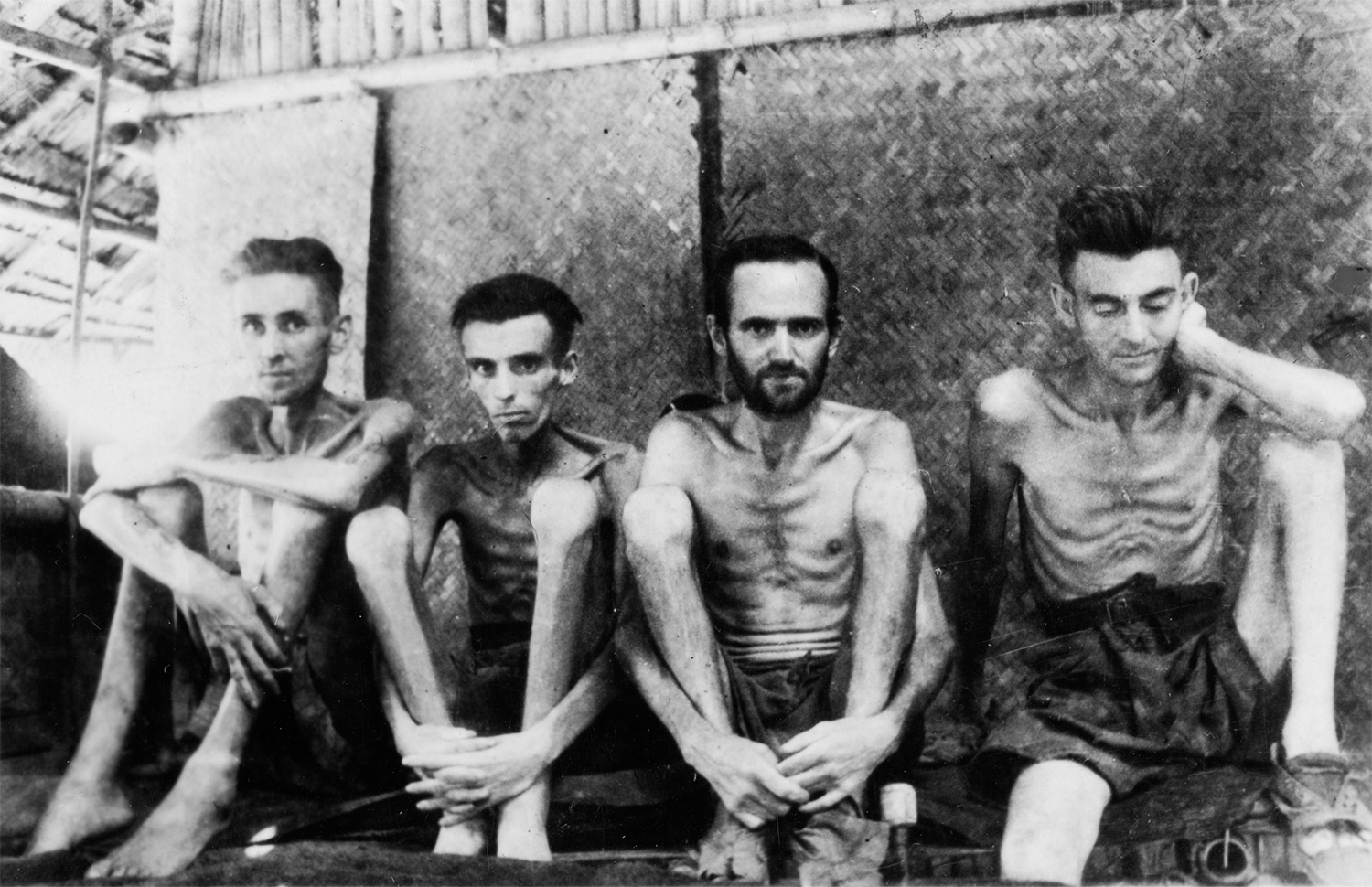

Four emaciated soldiers of Australian and Dutch origin present a grim picture of severe malnutrition and abuse, in this photo produced in 1943.
Liberated from a Japanese Prisoners of War camp at Tarsau in Thailand, the men were suffering from Beriberi – a deficiency of Vitamin B, and which left untreated causes loss of muscle strength and paralysis.
Burma-Thailand Railway Line, 1942-43.
They were but a small portion of the 61,000 soldiers who were captured after the fall of Singapore in 1942, and sent to work on the Thailand Burma Link Railway – constructed to transport troops and equipment across a 415 kilometer stretch, between present day Ban pong in Thailand and the city of Yangon in Burma.
Recalled by survivors to be a hell hole of horror, at the war camp in Tarsau, British, Australian, Dutch and other allied prisoners of war were starved, punished and forced to work in the most deplorable and inhuman conditions.
Prisoners of War.
Out of the 61,000 enlisted men assigned to the project, 19,000 died from starvation, cholera, beatings or torture. Out of the 250,000 Burmese and Malayan workers, who worked alongside as forced labour, 90,000 perished.
The mistreatment of workers during the construction of the railroad is considered as one of the many war crimes committed by Japan during World War II. After the nation’s surrender on the 15th of September in 1945, 32 Japanese military personnel responsible for the atrocities were court-martialed and sentenced to death.
This brutal episode of the war later inspired the semi-historical movie, Bridge on the river Kwai released in 1957, and in more recent time, The Railway Man, released in 2013.
An estimated 330,000 men are believed to have worked on the construction of the railroad. To the men forced to work on the project, it was known as the Death Railway.
The Photo.
This photo was produced by an uncredited photographer, possibly a wartime army photographer. Among the four soldiers, two are identified. On the left is Jan Hakkaart, a radio operator from the Dutch Navy who was captured in Java by the Japanese. Sitting next to him is Private Cornelius Valentine Hayward.
The original caption attached to the photo reads: Australian and Dutch prisoners of war at Tarsau in Thailand. The four men are suffering from Beriberi.
The photo is now a part of the Australian War memorial collection.
I F I This is an Independent Story produced to unravel the history behind this featured Vintage Photo from 1943. The story also sheds a bit of light on how prisoners of war were used and maltreated by the imperial Japanese army during the construction of the Burma-Thailand railways. It has been created out of facts curated from literary and historical sources. I