
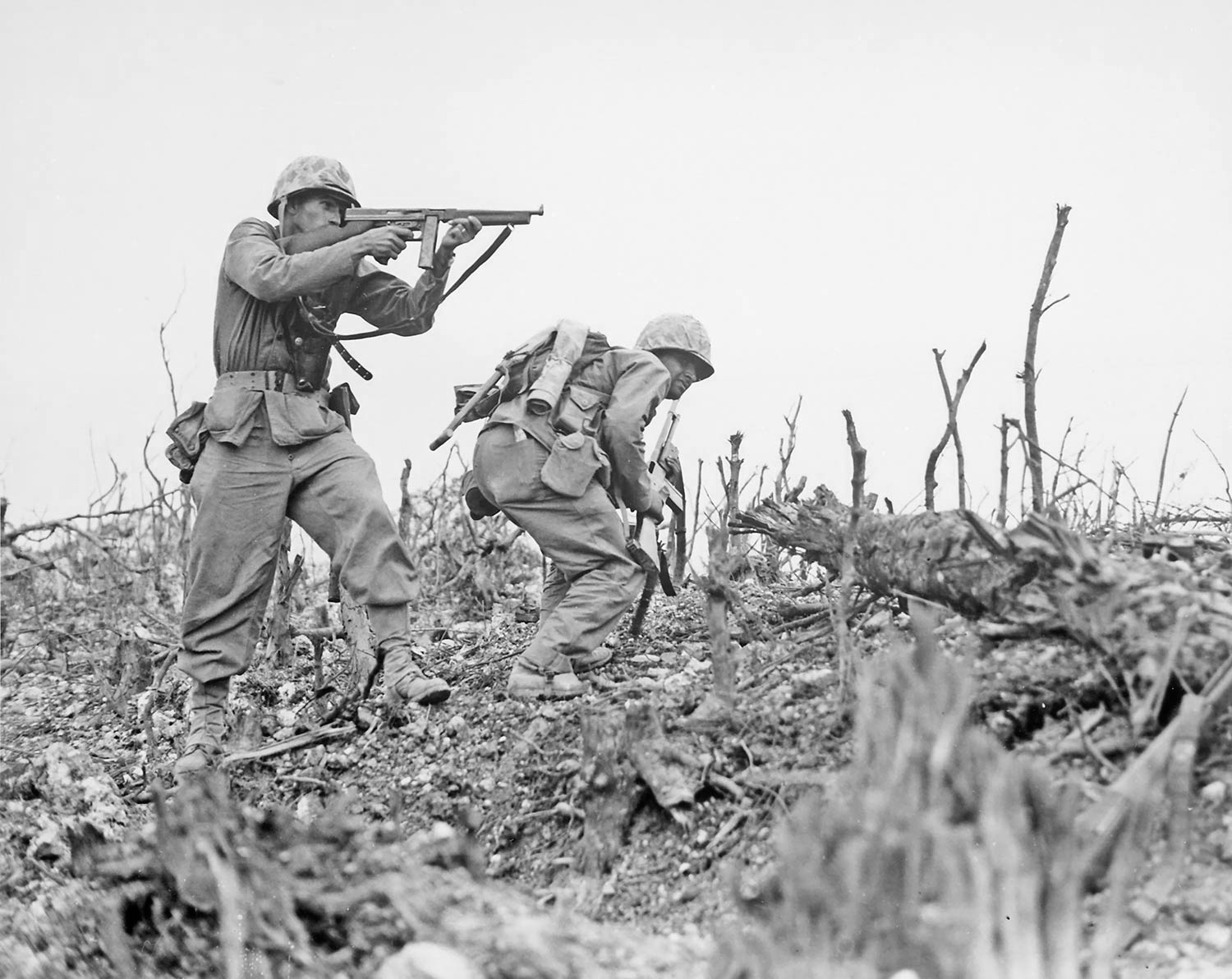

With the butt-stock of his Thompson sub-machine gun firmly braced against his right shoulder, a U.S. marine takes blind aim while his companion crouches to spot a hidden Japanese sniper on Wana Ridge in Okinawa, on the 20th May in 1945.
The largest island in the Ryukyu group of Islands, that arcs from Taiwan to mainland Japan, Okinawa witnessed a major engagement between the U.S. 10th army and the Japanese 32nd army, during what was the remaining days of World War II.
This battle was the last major military engagement of the war, and saw the largest amphibious assault ever attempted. It was also a death struggle between two very resolute sides.
The strategic importance of Okinawa in 1945.
For the allied forces closing in on Japan in a pincer movement, the 60-mile long island with a population numbering slightly less than half a million, was of strategic importance. Its capture had meant naval bases and runways for bombers to easily target the industrial plants of Japan – not to mention a springboard to later invade the mainland.
On the other hand, for 86,000 Japanese soldiers and 24,000 Okinawans, it was the last opportunity to turn the tide of the war by inflicting the maximum possible damage. Both sides were determined to succeed, whatever the cost.
The invasion had begun on the 23rd of March in 1945 with intense aerial and naval bombardment followed by assault on land by U.S ground forces on the 1st of April in 1945. It had ended on the 21st of June in 1945. During the 82 days of conflict, every inch of the ground was bitterly contested and every encounter no matter how small, came to be etched in the memory of those who survived.
High casualties during the invasion of Okinawa.
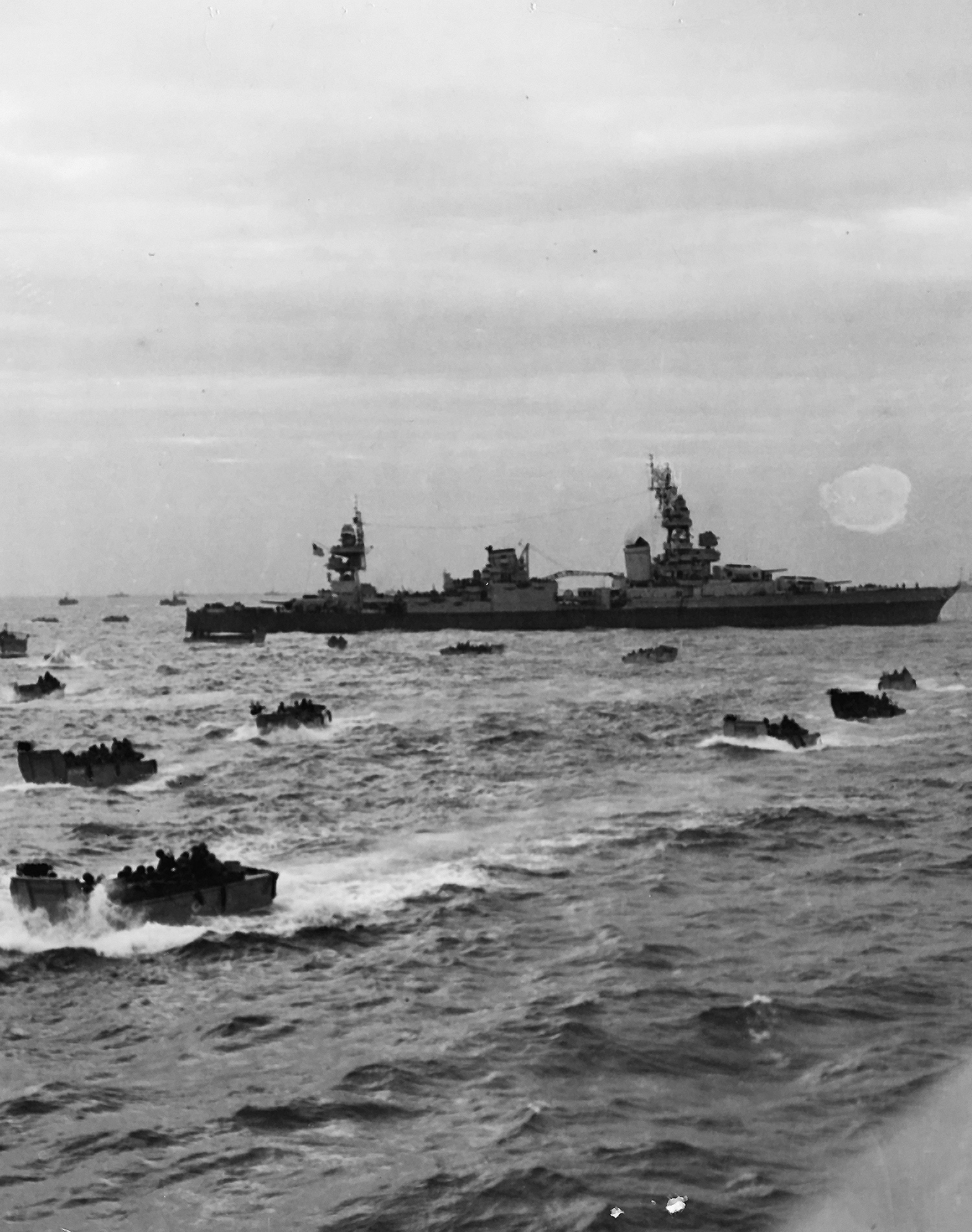
In the invasion, a huge allied force of approximately 600 naval ships, 1,727 aircrafts and 183,000 ground troops participated.
While on sea, 1,500 Japanese Kamakazi Zeros making their suicide dives disabled or destroyed almost half of this naval force.
On land, strongly entrenched Japanese troops familiar with the terrain extracted a heavy toll of casualties leaving some 12,670 dead and over 40,000 wounded.
The outcome for Japan was even more devastating. By the end of the engagement, approximately 110,000, Japanese and Okinawans perished.
Furthermore, here on this island, as U.S. ground troops reported back of Japanese soldiers refusing to surrender for honour’s sake, ordinary citizens being forced to commit suicide with hand grenades, and schoolboys sent out to fight in the front, U.S war planners had begun to search for alternatives over launching more full-scale invasions – convinced future engagements to be equally bloody.
As the brutal conflict had raged on the island, back in Washington the balance had tipped in favour of using the atom bombs.
The two Marines in the photo.
The two marines in the photo are Davis Hargraves and Gabriel Chavarra. These men were soldiers of the 2nd battalion of the 1st marine regiment. Their orders was to secure Wana Ridge located near the town of Shuri, the capital of Okinawa.
On the 19th of May in 1945, the 1st marine regiment had replaced the 7th marines – after the latter had sustained heavy losses in its effort to gain a foothold on Wana Ridge, and bring the allied advance closer to the town of Shuri.
During the invasion, the headquarters of the 32nd Japanese army was located at Shuri, and the ridge had formed a protective perimeter. Devoid of significant vegetation and trees, it was open to assault from three sides and had offered very little cover for men advancing on its surface.
The marines had at first attempted to take the ridge during heavy rains without adequate tank support and were continuously assailed with mortar and gunfire.
Assault on Wana Ridge.
On the 20th of May in 1945, after tanks and artillery had managed to weaken the enemy flank with an intense barrage of shelling, marines of the 2nd and 3rd battalion had assaulted the ridge and quickly progressed to the base of a 100 meter cliff by dusk. During the operation, the hard coral surface of the ridge had left them exposed to Japanese fire, especially from unreachable sections of the cliff.
At the base of the cliff, the marines had been forced to withdraw in the face of concentrated firepower. Then close to midnight on the following day they had found themselves embroiled in repelling a counterattack – launched by a force of two hundred Japanese infantrymen, who had scaled the left side of the ridge to dislodge them.
With the rains getting worse, the 2nd had suspended operations till on the 28th of May in 1945, it had again launched two assaults on the cliff. However, only the battalion’s E-Company had managed to reach the crest. Faced with relentless enemy fire and rising casualties, it later abandoned the hard-gained ground.
The ridge was ultimately captured by the 77th U.S. infantry division on the 31st of May in 1945.
The photo.
This photo was taken by U.S army photographer, staff sergeant Walter F. Kleine. It shows Davis Hargraves aiming blindly into the distance for the crouching Gabriel Chavarra to ascertain the location of a Japanese sniper. Kleine had produced the scene, seconds after a marine was shot dead by the sniper.
In the counteroffensive, the Japanese sniper who was holed up inside a cave was sealed inside by the two men with C-4 charges and hand grenades – since by this time both were out of ammunition.
The original caption attached to the photo reads: A marine of the 1st marine division draws a bead on a Japanese sniper with his Tommy gun as his companion ducks for cover. The division is working to take Wana Ridge, before the town of Shuri, Okinawa, 1945.
Significance of the invasion of Okinawa.
Although, the engagement at Okinawa was the last major engagement of World War II and witnessed the largest amphibious assault ever attempted during the war, its real significance was the sanctioning of the use of the atom bombs.
According to authors and military historians, the fanatical resistance of Japanese soldiers and high casualty sustained by U.S forces, is what had crystallized Harry Truman’s decision to use the bombs – and which were eventually released over Japan some forty five days after the end of the engagement on the 21st of June in 1945.
The Japanese defenders on Okinawa referred to the invasion in Nihongo as Tetsu No Bofu (in English, typhoon of Iron) and Testu No Ami (in English, rain of iron), for the intense and unrelenting bombardment that they were subjected to during the allied assault.
Marines, Davis Hargraves and Gabriel Chavarra, returned home after the war. Kleine’s photo is now archived by the National Archives and Records Administration.
I F I This is an Independent story produced to highlight this featured Vintage Photo of Two Marines trying to ascertain the location of a hidden sniper on Wanna Ridge during the invasion of Okinawa in 1945. The story also sheds light on who these Marines were, the regiment they belonged to and the nature of the conflict at Okinawa. It has been created from facts curated out of literary and historical sources. I