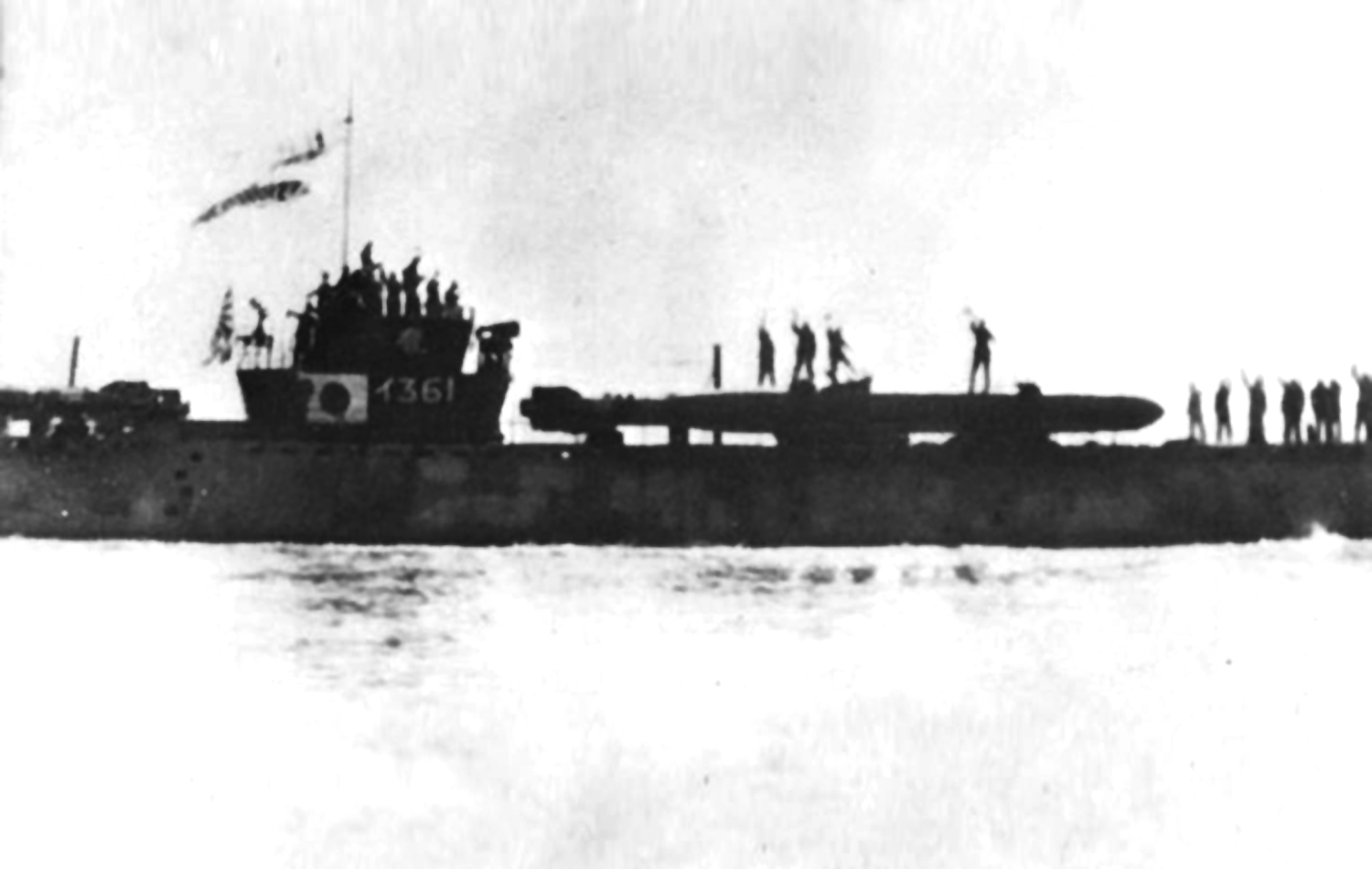

A photo produced by an uncredited photographer of the Japanese imperial navy reveals a group of Japanese sailors waving the Nisshoki from the deck of submarine I-361 as she prepares to skim the open ocean like a leviathan of the deep, close to the Hikari Naval Base on the 23rd of May in 1945.
The photo is murky, the sailors appear as silhouettes and are barely discernible on what appears to be a bright sunny day. Yet the scene is electrifying and energetic. Of passionate young men going into battle confident of victory, ready to serve their country and emperor by performing the ultimate act of bravery.
However, while the young sailors are eager and confident, to their superiors in the Japanese admiralty, the scene is a grim reality of the war. Clearly apparent in the long cigar-shaped Kaiten torpedo that is held fast to the deck of the submarine – a symbol of Japan’s desperation and disciplined fanaticism of a proud martial nation standing on the brink of defeat.
Kaiten Torpedoes.
Kaiten is a Nihongo word that means a Turn for Heaven and in the year 1944 it had represented hope and the promise of a better future for the empire of Japan. Produced prior to the era of guided missiles it was the name of a special submersible Japan had used to at first gain a decisive edge in a losing war and later in an attempt to negotiate a more favourable peace.
It was a modified torpedo that could be manoeuvred by a human pilot to explode ships more predictably than conventional torpedoes and was the naval version of the Kamikaze, with one crucial difference.
Unlike the Kamikaze, once the Kaiten was launched from its mother ship, the fate of the pilot was doomed. If the pilot was not blown out of the water by enemy guns or had exploded on impact with the target, he had faced the grim fate of perishing in the cold sea, as a return was never possible.
Sealed coffins.
Kaitens were initially not deployed by the Japanese Navy as suicide crafts. They had come with ejector buttons. However, the propensity of their operators to willingly embrace death had subsequently resulted in later versions being produced as sealed coffins, without even the option to open the hatch from inside.
The pilots who operated these submersibles were young and bold men groomed in the Japanese Bushido code of honour, stories of Samurai and the 47 Ronin. Proud to serve their country and emperor, they had preferred death over dishonour and courage over disgrace. Unwilling to shame not just themselves, but also their families, regiments and military units.
Inventor of the Kaiten.
The inventor of the Kaiten was Hiroshi Kuroki. A young Lieutenant and submariner with a promising career in the Japanese navy, Hiroshi had conjured up the idea of this submersible after Japan’s crippling defeat at Midway – a battle that was fought between the 4th and 7th of June in 1942.
The near decimation of the Japanese imperial fleet in the North Pacific ocean had convinced Hiroshi that for Japan to win the war, a destructive weapon was required and shortly afterwards, he had conjured up the idea of the Kaiten torpedo.
An extreme idea.
Hiroshi’s innovation, however, was not immediately implemented by the Japanese high command. Despite of having suffered a heavy defeat at Midway, his idea was felt to be ‘too extreme’ even in the martial echelons of Japan’s warrior society. His proposal was at first dismissed with a sympathetic attitude and praise for his devotion to service and country.
Hiroshi nonetheless had persisted and over the course of the next two years continued in his endeavour to have his project sanctioned by his superiors and the war ministry. At one point in time, he had even gone to the extent of penning a letter in his blood for Admiral Yamamoto, the mastermind behind the attack on Pearl Harbour.
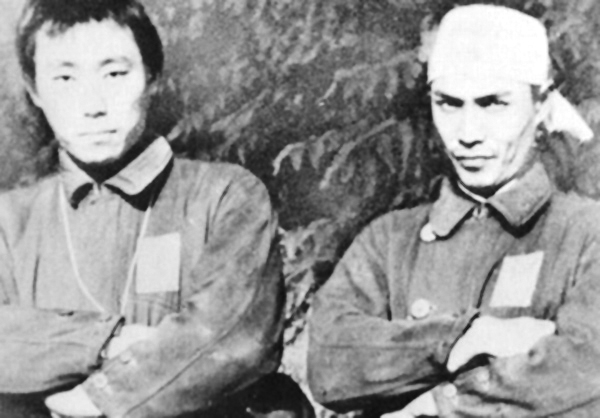
Later, though, as the tide of war had turned against Japan and the future had begun to appear terribly bleak, Hiroshi was eventually granted permission to create a prototype.
Fate of the ten submariners.
However, Hiroshi’s idea of the Kaiten wasn’t approved because Japanese high command had thought it to be an effective weapon.
Why the idea was ultimately given a go ahead was because the concept had reminded them of the fate of ten submariners – who, in their mini-submarines had attacked ships at Pearl Harbour on the 7th of December in 1941.
Nine of these submariners upon death were edified as heroes, while the tenth, upon capture, was decried, shamed and dishonoured by the Japanese public – and which, more than anything else, had revealed the overshadowing popularity the Japanese Navy had enjoyed over the Japanese air force, and more importantly, the powerful sentiment Japan reserved for heroic deaths.
Development of the Kaitens.
The actual development of the Kaiten took place in 1944 at the Kure Naval shipyard, some 20-odd kilometres away from the city of Hiroshima – and by which time, Japan was reeling from multiple defeats on multiple fronts. Her resources, fuel and experienced manpower were sharply diminished and an imminent invasion of her homeland was an undeniable reality.
Though Hiroshi did not live to use his Kaiten in battle, having drowned at the bottom of the Tokuyama Bay during a training session in 1944. Japan had ultimately produced some six variants of the Kaiten, based on different types of torpedoes.
In total, Japan is believed to have manufactured an estimated 410 Kaiten torpedoes for use during World War II. All of these were operated by young men between 17 and 28 years of age and almost all of them had perished at sea with their submersibles blown out of the water before impact.
Japanese submarine I-361.
The Japanese submarine I-361, which can be seen in the photo, was a transport ship tasked with ferrying troops and equipment through hostile territories, especially where enemy air superiority was intense.
Built at the Kure Naval Shipyard near Hiroshima in 1943, the submarine was later used as a mothership for launching Kaitens. On the 30th of May in 1945, the I-361 was destroyed by U.S. warplanes, East of Okinawa (see Farbound.Net story: The storm before the atom bomb).
This photo that was produced by a photographer of the imperial Japanese navy, shows the I-361 departing the Hikari Naval Base in Honshu, en route to participating in the battle of Okinawa, some 8,521 miles away, and where it was eventually destroyed.
I F I This is an Independent story produced to highlight this featured Vintage photo of Japanese submarine I-361 and the Kaiten Torpedo-that was in essence a human guided missile. The story also highlights the inventor of the Kaiten and its development and eventual use. It has been created from facts curated out of literary and historical sources. I